
Close Menu
    Facebook X (Twitter) Instagram
    SciTechDaily
    • Biology
    • Chemistry
    • Earth
    • Health
    • Physics
    • Science
    • Space
    • Technology
    Facebook X (Twitter) Pinterest YouTube RSS
    SciTechDaily
    Home»Space»Magnetic Field of a Spiral Galaxy: Field Lines Extend Far Beyond Galaxy’s Disk
    Space

    Magnetic Field of a Spiral Galaxy: Field Lines Extend Far Beyond Galaxy’s Disk

    By National Radio Astronomy ObservatoryJuly 23, 20201 Comment3 Mins Read
    Facebook Twitter Pinterest Telegram LinkedIn WhatsApp Email Reddit
    Share
    Facebook Twitter LinkedIn Pinterest Telegram Email Reddit
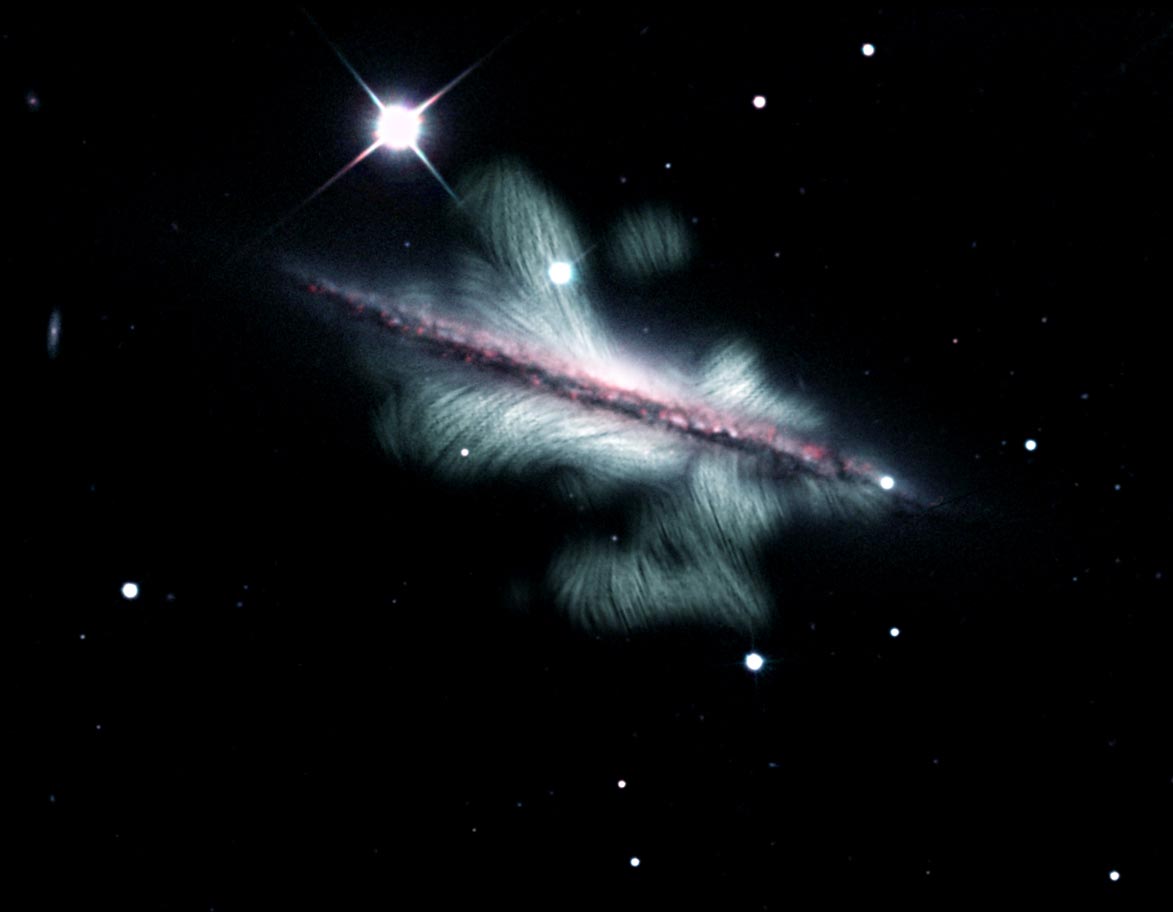
    Galaxy NGC 4217
    Radio/Optical composite image of the edge-on spiral galaxy NGC 4217. Magnetic field lines (green), revealed by the VLA, extend far above and below the plane of the galaxy. Credit: Y. Stein (CDS), NRAO, SDSS, KPNO 0.9m, J. English (U. Manitoba), R.-J. Dettmar and A. Miskolczi (Ruhr U.), R.J. Rand (U.N.M.), and J. Irwin (Queen’s U.).

    This image shows the huge extent of a spiral galaxy’s magnetic field. The galaxy NGC 4217 is a star-forming, spiral galaxy, similar to our own Milky Way, 67 million light-years from Earth in the constellation Ursa Major. The galaxy is seen edge-on in a visible-light image from the Sloan Digital Sky Survey and Kitt Peak National Observatory, and the magnetic field lines, shown as green, are revealed by the National Science Foundation’s Karl G. Jansky Very Large Array (VLA) radio telescope.

    The magnetic field lines extend as much as 22,500 light-years beyond the galaxy’s disk. Scientists know that magnetic fields play an important role in many processes, such as star formation, within galaxies. However, it is not fully understood how such huge magnetic fields are generated and maintained. A leading explanation, called the dynamo theory, suggests that magnetic fields are generated by the motion of plasma within the galaxy’s disk. Ideas about the cause of the kinds of large vertical extensions seen in this image are more speculative, and astronomers hope that further observations and more analysis will answer some of the outstanding questions.

    “This image clearly shows that when we think of galaxies like the Milky Way, we should not forget that they have galaxy-wide magnetic fields,” said Yelena Stein, of the Centre de Données astronomiques de Strasbourg, leader of the study.

    The scientists who produced the image are reporting their results in the journal Astronomy & Astrophysics.

    For more on this research, read New Cosmic Magnetic Field Structures Discovered: Superbubbles, Giant Loops and X-shaped Fields.

    Credit: Composite image by Yelena Stein of the Centre de Données astronomiques de Strasbourg (CDS) with the support of Jayanne English (University of Manitoba). VLA radio data from Yelena Stein and Ralf-Juergen Dettmar (Ruhr University Bochum). The observations are part of the project Continuum HAlos in Nearby Galaxies — an EVLA Survey (CHANG-ES) led by Judith Irwin (Queen’s University, Canada). The optical data are from the Sloan Digital Sky Survey. The ionized hydrogen data (red) are from the 0.9m telescope of the Kitt Peak National Observatory, collected by Richard J. Rand of the University of New Mexico. The software code for tracing the magnetic field lines was adapted by Y. Stein from Linear Integral Convolution code provided by Arpad Miskolczi of Ruhr University Bochum.

    Reference: “CHANG-ES XXI. Transport processes and the X-shaped magnetic field of NGC 4217: off-center superbubble structure” by Y. Stein, R.-J. Dettmar, R. Beck, J. Irwin, T. Wiegert, A. Miskolczi, Q. D. Wang, J. English, R. Henriksen, M. Radica and J.-T. Li, 21 July 2020, Astronomy & Astrophysics.
    DOI: 10.1051/0004-6361/202037675

    The National Radio Astronomy Observatory is a facility of the National Science Foundation, operated under cooperative agreement by Associated Universities, Inc.

    Never miss a breakthrough: Join the SciTechDaily newsletter.
    Follow us on Google and Google News.

    Astronomy Astrophysics National Radio Astronomy Observatory
    Share. Facebook Twitter Pinterest LinkedIn Email Reddit

    Related Articles

    Stellar Collision Triggers Supernova Explosion – “This Is the First Time We’ve Actually Seen Such an Event”

    Gas Re-Accretion Observed in Dying Galaxies for the First Time

    Surprising Insights Into Star Formation From Unprecedented Survey of the “Nurseries” Where Stars Are Born

    Mind the Gap: Direct Link Uncovered Between Protoplanetary Disk Structures and Giant Exoplanets

    Young Chaotic Star System Reveals Secrets of Planet Formation

    Astronomers Discover Jets from Massive Protostars Might be Very Different from Lower-Mass Systems

    Map of the Nearby Universe Created by Cosmic Cartographers Reveals the Diversity of Star-Forming Galaxies

    Cosmic Lens Reveals Faint Radio Galaxy More Than 8 Billion Light-Years From Earth

    New Clues About Early Universe From Black Hole Powered Cosmic Jet 13 Billion Light-Years From Earth

    1 Comment

    1. xABBAAA on July 24, 2020 7:30 am

      the comment on “it is not fully understood how such huge magnetic fields are generated and maintained”
      …
      Well, people usually think that only some types of metal have magnetic properties, but the things are spinning and in very strong magnetic fields some strange stuff is happening.
      And one not needs to say that magnetic force is bit stronger than that gravity one.
      Yes, there is one more interesting thing now. The galaxy doesn’t spin only in 2D, there is a way more complex motion, that can result in some more stuff.

      Reply
    Leave A Reply Cancel Reply

    • Facebook
    • Twitter
    • Pinterest
    • YouTube

    Don't Miss a Discovery

    Subscribe for the Latest in Science & Tech!

    Trending News

    “I Couldn’t Do It Anymore” – Antarctic Guides Quit Their Dream Jobs After Witnessing Tourism’s Damage

    Scientists Say Eating Less Protein May Help You Live Longer

    Scientists Solve a Long-Standing Mystery About Bird and Dinosaur Eggs

    Belly Fat and Low Vitamin D May More Than Double the Risk of Early Death

    Lost in Space: Rare Cosmic Flare Exposes a Wandering Black Hole Far From Its Galaxy’s Center

    Dark Matter May Be Leaving a Signal in Earth’s Atmosphere

    Scientists Discover a 300-Million-Year-Old Geological Time Capsule Inside Fossilized Wood

    Oral Weight Loss Pill Helps Patients Lose up to 12% of Body Weight

    Follow SciTechDaily
    • Facebook
    • Twitter
    • YouTube
    • Pinterest
    • Newsletter
    • RSS
    SciTech News
    • Biology News
    • Chemistry News
    • Earth News
    • Health News
    • Physics News
    • Science News
    • Space News
    • Technology News
    Recent Posts
    • 85% of Atypical Alzheimer’s Patients May Not Qualify for Treatment
    • Sitting Up Straight Could Actually Help You Make Better Decisions
    • A Cannabis-Based Drug Dramatically Reduced PTSD Nightmares
    • Never-Before-Seen Vortices Are Swirling Across the Sun
    • Something May Be Flowing Beneath Pluto’s Giant Heart-Shaped Glacier
    Copyright © 1998 - 2026 SciTechDaily. All Rights Reserved.
    • Science News
    • About
    • Contact
    • Editorial Board
    • Privacy Policy
    • Terms of Use

    Type above and press Enter to search. Press Esc to cancel.