
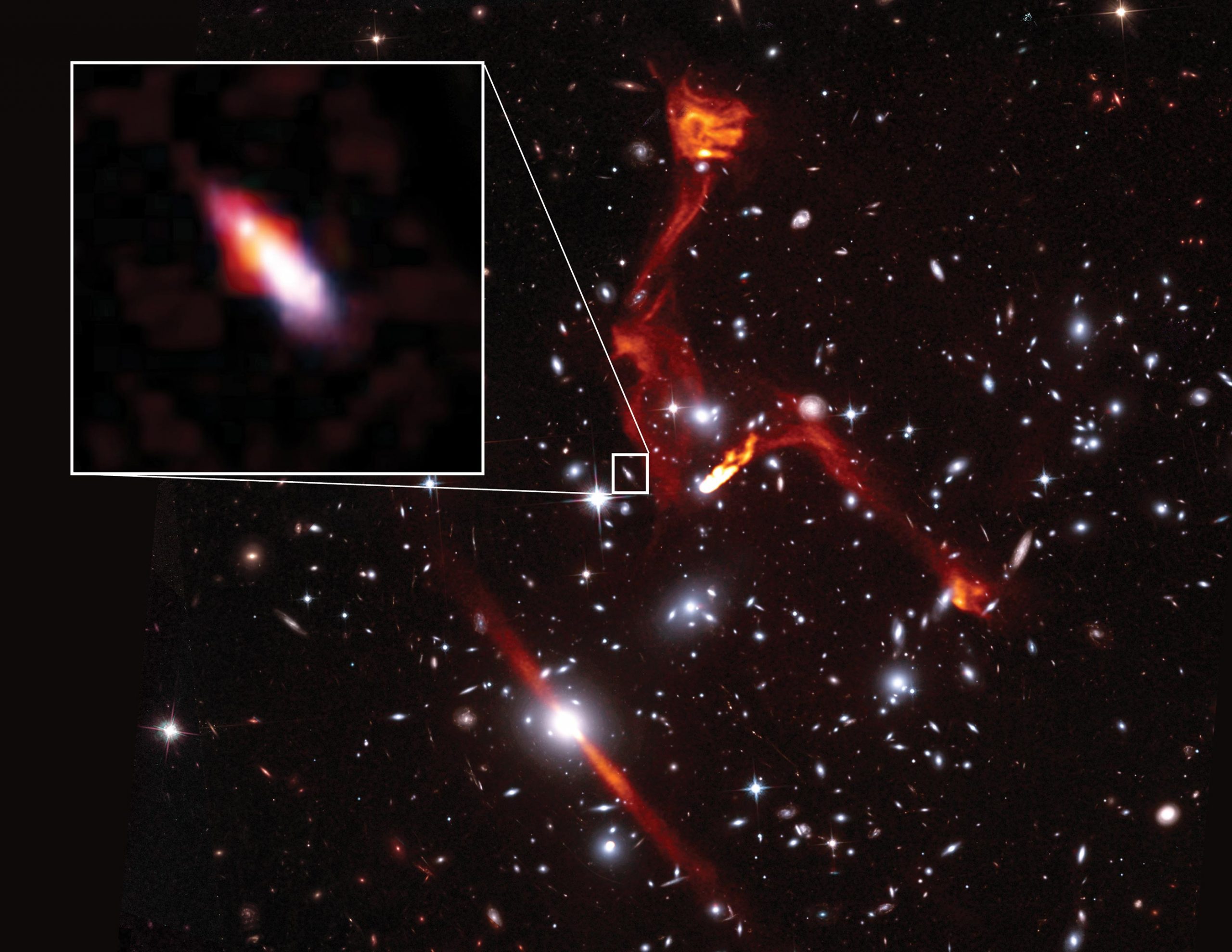
Using gravitational lensing and the VLA, astronomers discovered the faintest known radio galaxy, over 8 billion light-years away. It offers new clues about star formation in early, low-mass galaxies.
Radio telescopes are the world’s most sensitive radio receivers, capable of finding extremely faint wisps of radio emission coming from objects at the farthest reaches of the universe. Recently, a team of astronomers used the National Science Foundation’s Karl G. Jansky Very Large Array (VLA) to take advantage of a helping hand from nature to detect a distant galaxy that likely is the faintest radio-emitting object yet found.
The discovery was part of the VLA Frontier Fields Legacy Survey, led by NRAO Astronomer Eric Murphy, which used distant clusters of galaxies as natural lenses to study objects even farther away. The clusters served as gravitational lenses, using the gravitational pull of the galaxies in the clusters to bend and magnify light and radio waves coming from the more-distant objects.
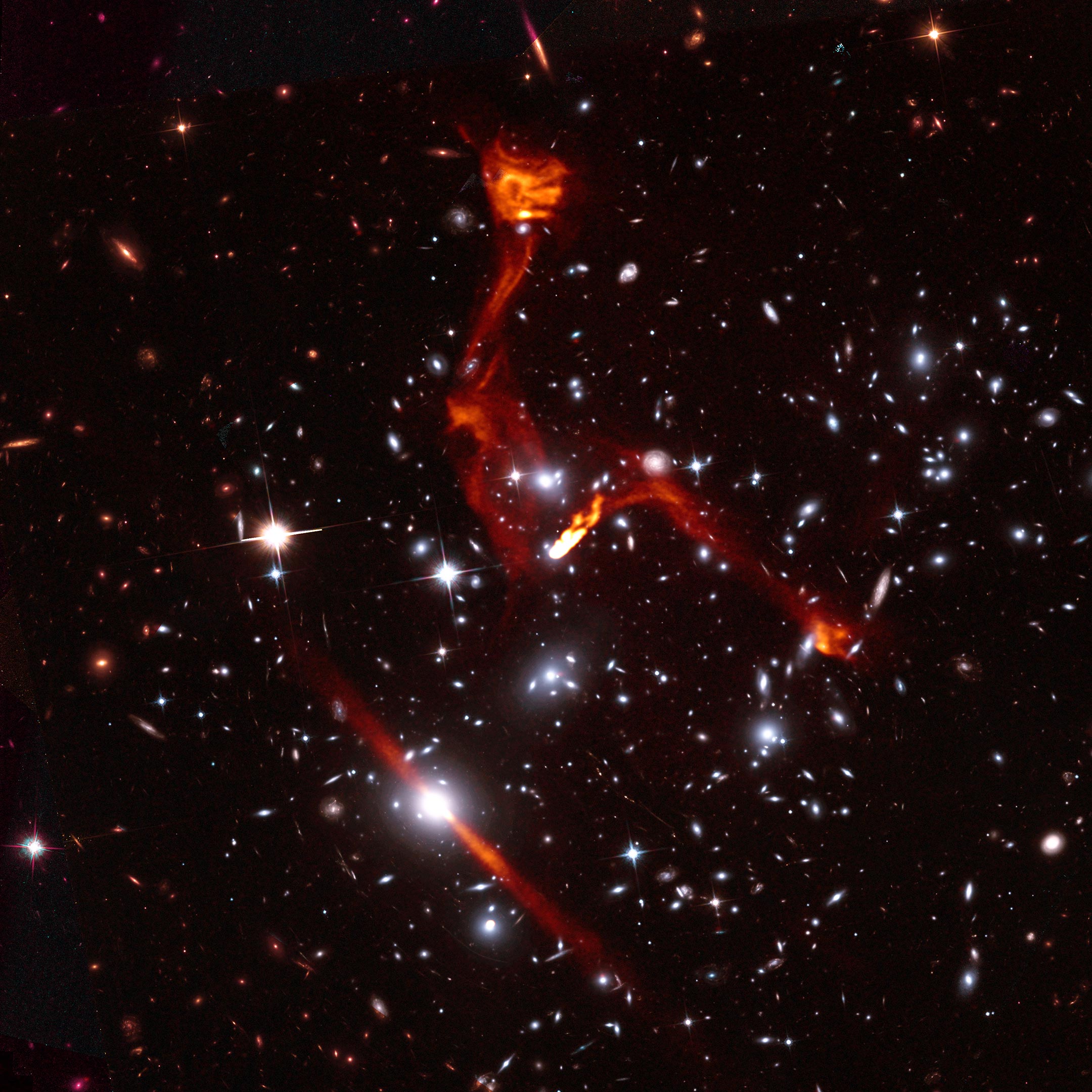
In this composite, a VLA radio image is superimposed on a visible-light image from the Hubble Space Telescope. The prominent red-orange objects are radio relics — large structures possibly caused by shock waves — inside the foreground galaxy cluster, called MACSJ0717.5+3745, which is more than 5 billion light-years from Earth.
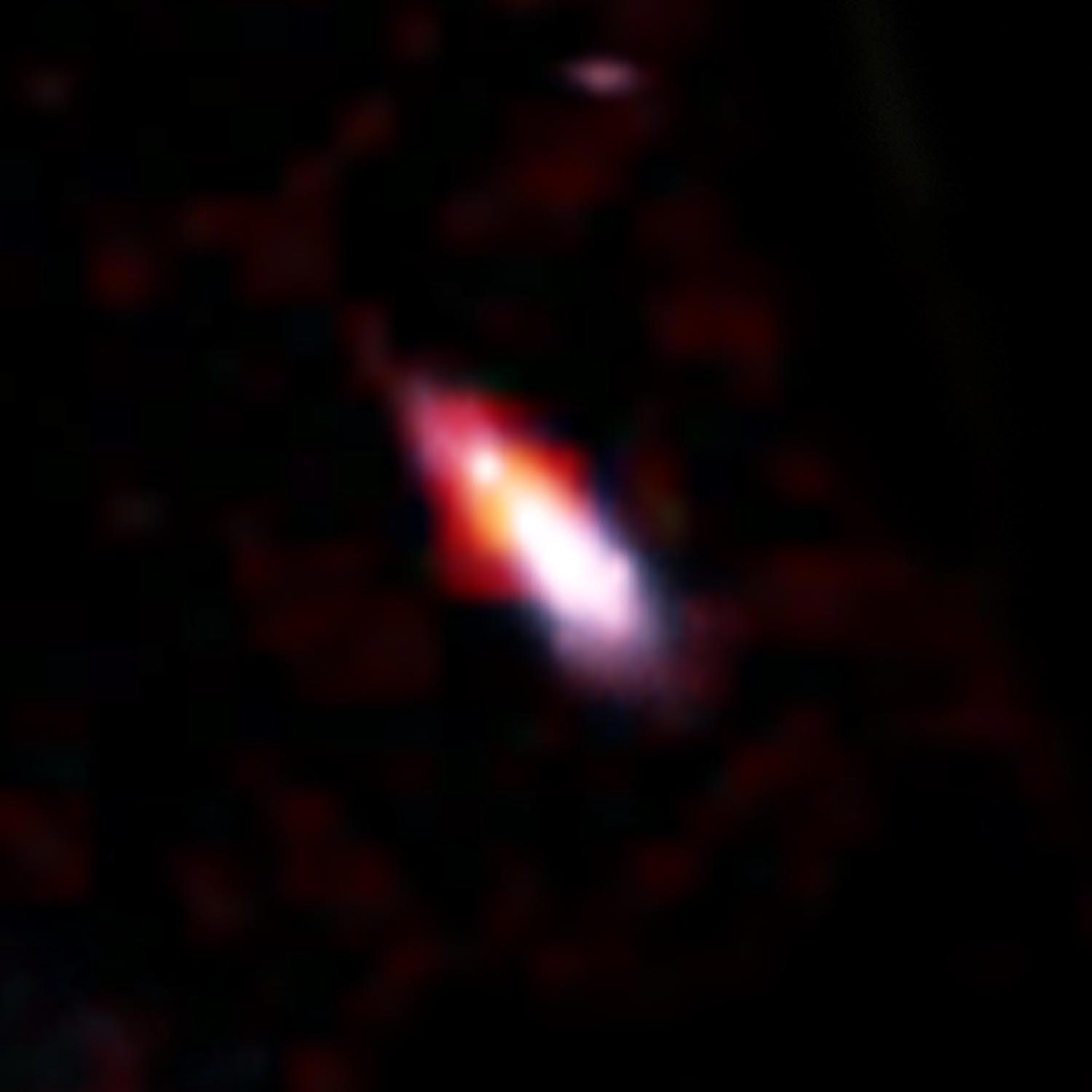
Detailed VLA observations showed that many of the galaxies in this image are emitting radio waves in addition to visible light. The VLA data revealed that one of these galaxies, shown in the pullout, is more than 8 billion light-years distant. Its light and radio waves have been bent by the intervening cluster’s gravitational-lensing effect.
The radio image of this distant galaxy, called VLAHFF-J071736.66+374506.4, has been magnified more than 6 times by the gravitational lens, the astronomers said. That magnification is what allowed the VLA to detect it.
“This probably is the faintest radio-emitting object ever detected,” said Ian Heywood, of Oxford University in the UK. “This is exactly why we want to use these galaxy clusters as powerful cosmic lenses to learn more about the objects behind them.”
“The magnification provided by the gravitational lens, combined with extremely sensitive VLA imaging, gave us an unprecedented look at the structure of a galaxy 300 times less massive than our Milky Way at a time when the universe was less than half its current age. This is giving us valuable insights on star formation in such low-mass galaxies at that time and how they eventually assembled into more massive galaxies,” said Eric Jimenez-Andrade, of NRAO.
The scientists are reporting their work in a pair of papers in the Astrophysical Journal.
References:
“The VLA Frontier Fields Survey: Deep, High-resolution Radio Imaging of the MACS Lensing Clusters at 3 and 6 GHz” by I. Heywood, E. J. Murphy, E. F. Jiménez-Andrade, L. Armus, W. D. Cotton, C. DeCoursey, M. Dickinson, T. J. W. Lazio, E. Momjian, K. Penner, I. Smail and O. M. Smirnov, 2 April 2021, The Astrophysical Journal.
DOI: 10.3847/1538-4357/abdf61
arXiv: 2103.07806
“The VLA Frontier Field Survey: A Comparison of the Radio and UV/Optical Size of 0.3 ≲ z ≲ 3 Star-forming Galaxies” by E. F. Jiménez-Andrade, E. J. Murphy, I. Heywood, I. Smail, K. Penner, E. Momjian, M. Dickinson, L. Armus and T. J. W. Lazio, 2 April 2021, The Astrophysical Journal.
DOI: 10.3847/1538-4357/abe876
arXiv: 2103.07807
The National Radio Astronomy Observatory is a facility of the National Science Foundation, operated under cooperative agreement by Associated Universities, Inc.
Never miss a breakthrough: Join the SciTechDaily newsletter.
Follow us on Google and Google News.
3 Comments
VLAHFF-JO71336.66+374506.4 galaxy is present 8billion ly. from our earth and was half of the time since big bang can be seen now is a practical possible phenomena.The fact is also obvious that dark matter started their formation right at that time.This galaxy has mass 1/300 parts can be observed in the form of radio wave lensing touches threshold limit.As dark matter with mass 8.7×10to the power_12 of electron mass has already been discovered.What about remaning 3 fold of mass is managed by 6 fold magnification of g wave by gravitational lansing of galaxies clustre MACS JO717.5+3745 in middle of path 5 billion ly. from earth.So here mere intensity desends to 2 fold.However from other obervations black holes or neutron starsmerge the fact is calculated that fraction of dark matter mass present in a galaxy to be 1/6of the normal common matter.For example two neutron stars afded to sum of 151 solar mass when merge can able to create dark matter of mass around 100 solar mass has been found out.So when calculated it is a fraction 4/6 is 2/6 to balance and correspod with Supermassive black hole at the centre of galaxy while further division by 2 is done to get balance with the total mass of galaxy gives a fŕaction 1/6 as resut.Hence, normal matter is 6 fold of dark matter is the ratio of magnification seen here.
Again, close and maybe the rest is language difficulties.
The average proportion of dark/standard matter is 6:1. but in the Milky Way the estimate is 5:1. (Though that is just a confirmation of average proportion near applicability in galaxies, not a general estimate.)
I’m not aware that any dark matter particle mass has been observed – it would make the news. References? The WIMP estimate was ~ 1-10 GeV, but WIMPs do not show up in LHC. The best estimate I know of from quantum gravity field considerations is ~ 1-10 MeV (if a purely gravitationally coupled simple scalar and finetuned for a habitable universe) [https://www.sciencedirect.com/science/article/pii/S0370269321000083?via%3Dihub ].
“For example, for singlet scalar dark matter, we find a mass range 10^-3 eV <= m_phi <= 10^7 eV. The lower bound comes from limits on fifth force type interactions and the upper bound from the lifetime of the dark matter candidate."
“The average proportion of dark/standard matter is 6:1. but in the Milky Way the estimate is 5:1” = The average proportion of dark/standard matter is 5:1. but in the Milky Way the estimate is 6:1.
Sorry, sleepy.