
Close Menu
    Facebook X (Twitter) Instagram
    SciTechDaily
    • Biology
    • Chemistry
    • Earth
    • Health
    • Physics
    • Science
    • Space
    • Technology
    Facebook X (Twitter) Pinterest YouTube RSS
    SciTechDaily
    Home»Space»Methane Surface on Pluto May be Sublimating Away Into the Atmosphere
    Space

    Methane Surface on Pluto May be Sublimating Away Into the Atmosphere

    By SciTechDailyMarch 11, 2016No Comments3 Mins Read
    Facebook Twitter Pinterest Telegram LinkedIn WhatsApp Email Reddit
    Share
    Facebook Twitter LinkedIn Pinterest Telegram Email Reddit
    What’s Eating Pluto's Surface
    underneath. Credit: NASA/JHUAPL/SwRI

    New Horizons provides scientists with a closer look at eh surface of Pluto.

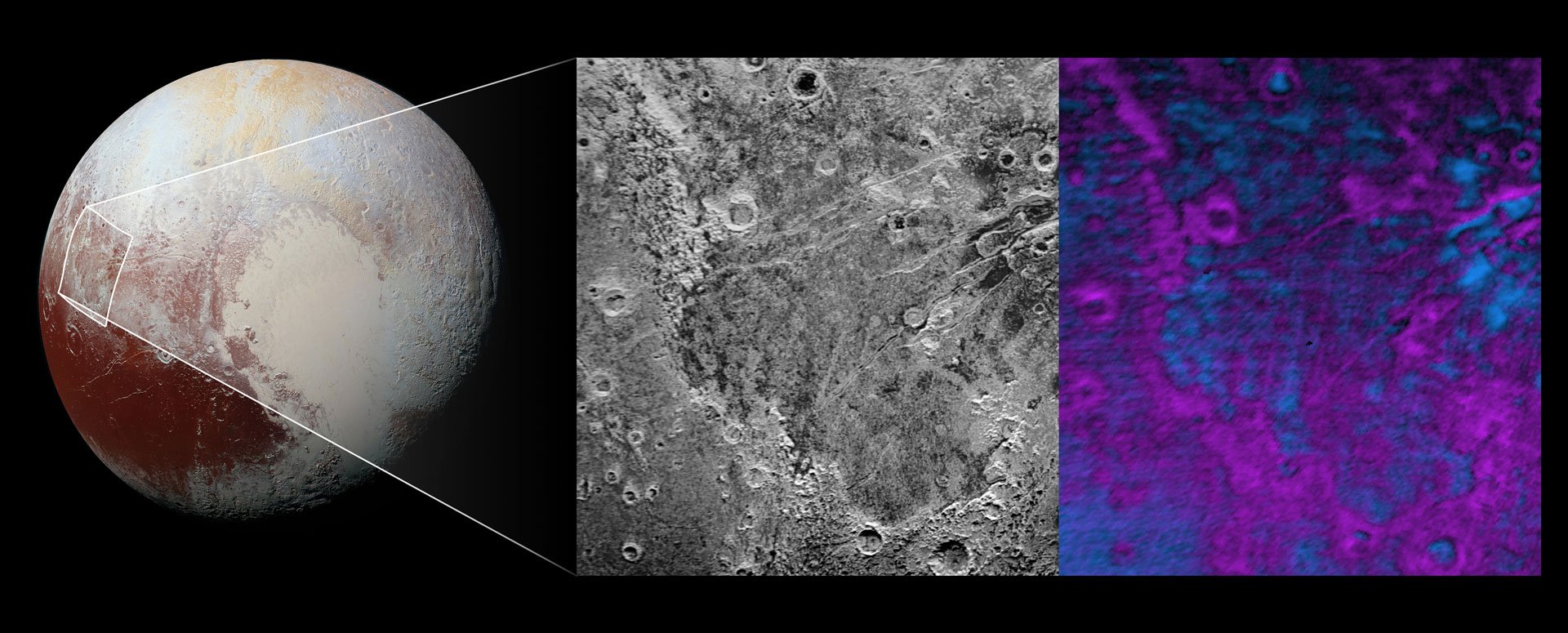
    Far in the western hemisphere, scientists on NASA’s New Horizons mission have discovered what looks like a giant “bite mark” on Pluto’s surface. They suspect it may be caused by a process known as sublimation — the transition of a substance from a solid to a gas. The methane ice-rich surface on Pluto may be sublimating away into the atmosphere, exposing a layer of water-ice underneath.
    New Horizons Reveals Sublimation Eating Away at Pluto’s Surface
    Credit: NASA/JHUAPL/SwRI

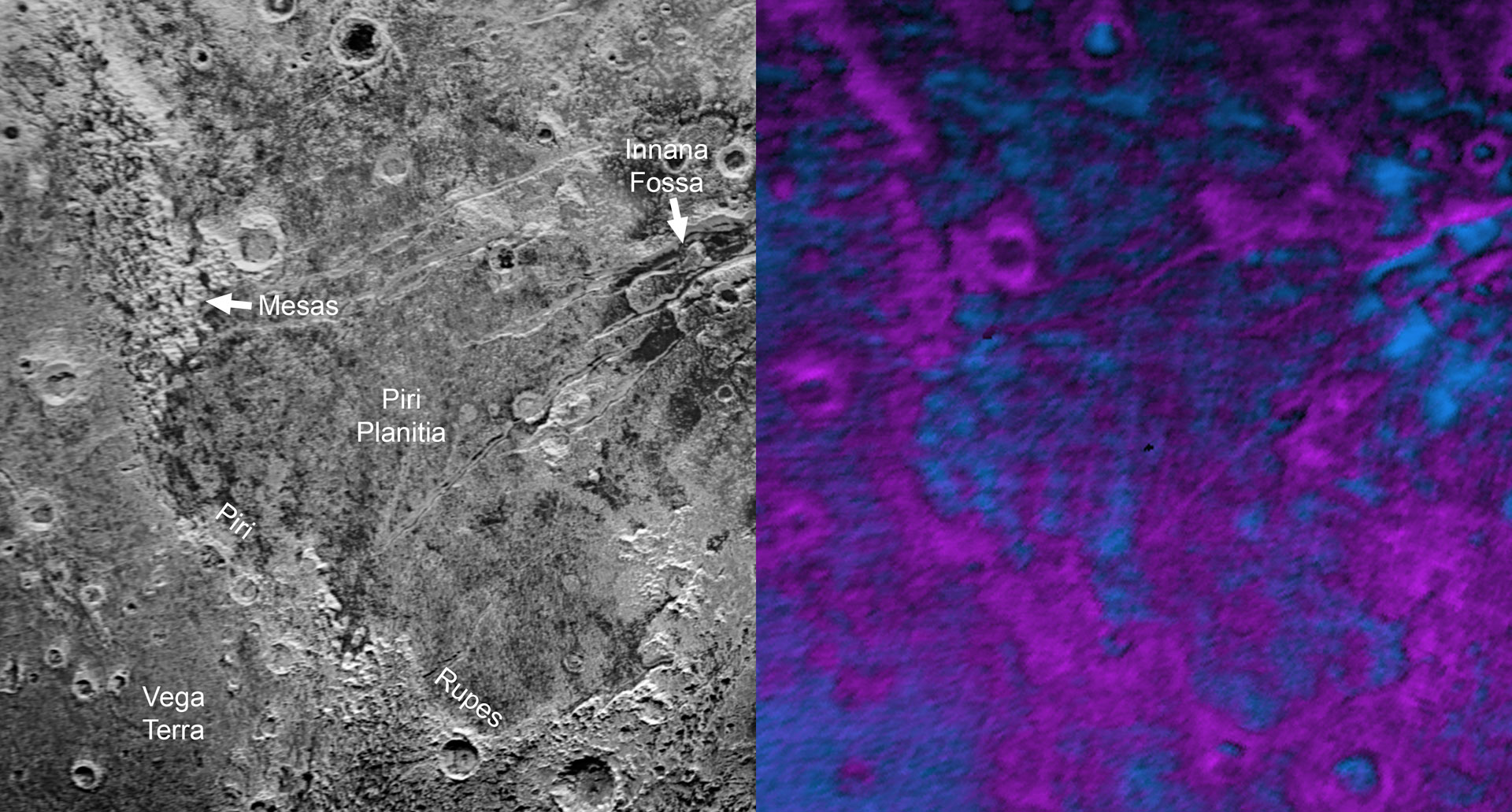
    In this image, north is up. The southern portion of the left inset above shows the cratered plateau uplands informally named Vega Terra (note that all feature names are informal). A jagged scarp, or wall of cliffs, known as Piri Rupes borders the young, nearly crater-free plains of Piri Planitia. The cliffs break up into isolated mesas in several places.

    Cutting diagonally across the mottled plans is the long extensional fault of Inanna Fossa, which stretches eastward 370 miles (600 kilometers) from here to the western edge of the great nitrogen ice plains of Sputnik Planum.

    Compositional data from the New Horizons spacecraft’s Ralph/Linear Etalon Imaging Spectral Array (LEISA) instrument, shown in the right inset, indicate that the plateau uplands south of Piri Rupes are rich in methane ice (shown in false color as purple). Scientists speculate that sublimation of methane may be causing the plateau material to erode along the face of the cliffs, causing them to retreat south and leave the plains of Piri Planitia in their wake.

    Compositional data also show that the surface of Piri Planitia is more enriched in water ice (shown in false color as blue) than the higher plateaus, which may indicate that Piri Planitia’s surface is made of water ice bedrock, just beneath a layer of retreating methane ice. Because the surface of Pluto is so cold, the water ice is rock-like and immobile. The light/dark mottled pattern of Piri Planitia in the left inset is reflected in the composition map, with the lighter areas corresponding to areas richer in methane – these may be remnants of methane that have not yet sublimated away entirely.

    The inset at left shows about 650 feet (200 meters) per pixel; the image measures approximately 280 miles (450 kilometers) long by 255 miles (410 kilometers) wide. It was obtained by New Horizons at a range of approximately 21,100 miles (33,900 kilometers) from Pluto, about 45 minutes before the spacecraft’s closest approach to Pluto on July 14, 2015.

    The LEISA data at right was gathered when the spacecraft was about 29,000 miles (47,000 kilometers) from Pluto; best resolution is 1.7 miles (2.7 kilometers) per pixel.

    Never miss a breakthrough: Join the SciTechDaily newsletter.
    Follow us on Google and Google News.

    Astronomy NASA New Horizons Planetary Science Pluto
    Share. Facebook Twitter Pinterest LinkedIn Email Reddit

    Related Articles

    New Horizons Reveals Signs of Pluto’s Geology

    NASA’s New Horizons Pluto Flyby Begins

    New Horizons Reflectance and Color Map of Pluto

    The Latest New Horizons Images of Dwarf Planet Pluto

    Dwarf Planet Pluto: The ‘Other’ Red Planet

    New Horizons Spacecraft Reveals Series of Spots on Pluto That Fascinate

    New Horizons Spacecraft Awakens for Encounter with Pluto System

    New ScienceCast Video Previews What New Horizons May See on Pluto

    New ScienceCast Video – Countdown to Pluto

    Leave A Reply Cancel Reply

    • Facebook
    • Twitter
    • Pinterest
    • YouTube

    Don't Miss a Discovery

    Subscribe for the Latest in Science & Tech!

    Trending News

    Why Popular Diabetes Drugs Like Ozempic Don’t Work for Everyone: The “Genetic Glitch”

    Scientists Stunned After Finding Plant Thought Extinct for 60 Years

    Scientists Discover Tiny New Spider That Hunts Prey 6x Its Size

    Natural Component From Licorice Shows Promise for Treating Inflammatory Bowel Disease

    Scientists Warn: Popular Sweetener Linked to Dangerous Metabolic Effects

    Monster Storms on Jupiter Unleash Lightning Beyond Anything on Earth

    Scientists Create “Liquid Gears” That Spin Without Touching

    The Simple Habit That Could Help Prevent Cancer

    Follow SciTechDaily
    • Facebook
    • Twitter
    • YouTube
    • Pinterest
    • Newsletter
    • RSS
    SciTech News
    • Biology News
    • Chemistry News
    • Earth News
    • Health News
    • Physics News
    • Science News
    • Space News
    • Technology News
    Recent Posts
    • Seeing the Invisible: Scientists Develop New Way To Track Particles in 3D
    • The Atomic Gap That Could Cost the Semiconductor Industry Billions
    • Earth’s Secret Advantage: Why Most Alien Worlds May Be Too Dry for Life
    • Ancient Bacteria Turned a DNA System Into a Cell Skeleton
    • Researchers Finally Solve 50-Year-Old Blood Group Mystery
    Copyright © 1998 - 2026 SciTechDaily. All Rights Reserved.
    • Science News
    • About
    • Contact
    • Editorial Board
    • Privacy Policy
    • Terms of Use

    Type above and press Enter to search. Press Esc to cancel.