
Close Menu
    Facebook X (Twitter) Instagram
    SciTechDaily
    • Biology
    • Chemistry
    • Earth
    • Health
    • Physics
    • Science
    • Space
    • Technology
    Facebook X (Twitter) Pinterest YouTube RSS
    SciTechDaily
    Home»Science»SLAC Synchrotron Reveals the Inner Workings of an Ancient Warship Battering Ram
    Science

    SLAC Synchrotron Reveals the Inner Workings of an Ancient Warship Battering Ram

    By SLAC National Accelerator LaboratoryJune 7, 2012No Comments3 Mins Read
    Facebook Twitter Pinterest Telegram LinkedIn WhatsApp Email Reddit
    Share
    Facebook Twitter LinkedIn Pinterest Telegram Email Reddit
    SLAC Synchrotron Reveals Core of Ancient Warship Battering Ram
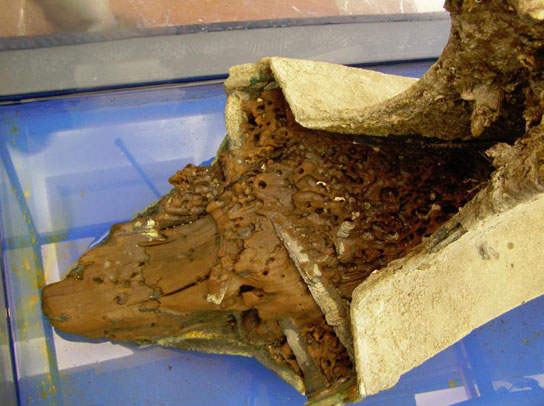
    Rostrum, or battering ram, from an ancient warship that last sailed about 260 B.C. X-rays from SSRL were used to help determine its core and how to preserve it. Credit: Francesco Caruso

    Scientists from SLAC National Accelerator Laboratory and the University of Palermo examined a weapon that an ancient warship used to ram enemy ships in the First Punic War using sulfur K-edge X-ray absorption spectroscopy (XAS) and gas chromatography/mass spectrometry (GC/MS).

    A recent study puts some finishing touches on the 2,300-year history of the beak-like weapon that an ancient warship used to ram enemy ships in the First Punic War, the conflict between ancient Rome and Carthage. The report, in the journal Analytical Chemistry, also identifies a major threat that conservators must address in preserving this archaeological treasure for future generations.

    Patrick Frank, a staff scientist at the Stanford Synchrotron Radiation Lightsource, and colleagues explain that the ram, called a rostrum, was found in 2008 under 22 feet (7 meters) of water, 150 feet (46 meters) offshore from Acqualadrone (which means “Bay of the Pirates”) in northeastern Sicily. The Acqualadrone rostrum is bronze, with a wooden core that was preserved because of burial beneath the seafloor.

    Carbon-14 dating suggests that the warship sank around 260 B.C. after being damaged in the battle of Mylae during the opening stages of the First Punic War, which may have been among the largest wars of its time. Earlier research localized the metals in the bronze to mines in Spain or Cyprus.

    The authors, from SLAC National Accelerator Laboratory and the University of Palermo, set out in the new research to learn more about the origin and condition of the rostrum wood. Their analysis of the acids and other substances in the wood showed that the strutwork of the rostrum was pine, and waterproofed with pine tar. Other woods – like juniper and oak – and other ancient marine sealants (like beeswax) were ruled out.

    Importantly, the research found copious sulfur in the wood that could turn into sulfuric acid, an extremely corrosive substance. Sulfuric acid is known to appear in recovered wooden marine archaeological treasures and can threaten their existence. The authors argue that iron and copper permeating the wood may catalyze that transformation, but they suggest that removing ozone from museum air could slow the conversion.

    Reference: “Ancient Wood of the Acqualadrone Rostrum: Materials History through Gas Chromatography/Mass Spectrometry and Sulfur X-ray Absorption Spectroscopy” by Patrick Frank, Francesco Caruso and Eugenio Caponetti, 30 April 2012, Analytical Chemistry.
    DOI: 10.1021/ac3001258

    Never miss a breakthrough: Join the SciTechDaily newsletter.
    Follow us on Google and Google News.

    Archaeology Carbon Dating SLAC National Accelerator Laboratory
    Share. Facebook Twitter Pinterest LinkedIn Email Reddit

    Related Articles

    Reproductive Cycle Put Dinosaurs at a Disadvantage

    Million-Year-Old Ash in South African Cave Yields Evidence of Cooking

    Exposing 8,000 Years of Civilization With Satellites

    Researchers Use LCLS to Examine Ferroelectric Materials Exposed to Light

    Humans Implicated in Africa’s Deforestation 3,000 Years Ago

    Researchers Focus on Using High-Energy Electrons to Treat Cancer

    SLAC Scientists Create First Atomic X-ray Laser

    Researchers Use X-ray Laser to Create 2-Million-Degree Matter

    Archaeologists Inch Closer to Understanding Stonehenge

    Leave A Reply Cancel Reply

    • Facebook
    • Twitter
    • Pinterest
    • YouTube

    Don't Miss a Discovery

    Subscribe for the Latest in Science & Tech!

    Trending News

    Millions Take These IBS Drugs, But a New Study Finds Serious Risks

    Scientists Unlock Hidden Secrets of 2,300-Year-Old Mummies Using Cutting-Edge CT Scanner

    Bread Might Be Making You Gain Weight Even Without Eating More Calories

    Scientists Discover Massive Magma Reservoir Beneath Tuscany

    Europe’s Most Active Volcano Just Got Stranger – Here’s Why Scientists Are Rethinking It

    Alzheimer’s Symptoms May Start Outside the Brain, Study Finds

    Millions Take This Popular Supplement – Scientists Discover a Concerning Link to Heart Failure

    The Universe Is Expanding Too Fast and Scientists Can’t Explain Why

    Follow SciTechDaily
    • Facebook
    • Twitter
    • YouTube
    • Pinterest
    • Newsletter
    • RSS
    SciTech News
    • Biology News
    • Chemistry News
    • Earth News
    • Health News
    • Physics News
    • Science News
    • Space News
    • Technology News
    Recent Posts
    • Doctors Surprised by the Power of a Simple Drug Against Colon Cancer
    • Why Popular Diabetes Drugs Like Ozempic Don’t Work for Everyone: The “Genetic Glitch”
    • Scientists Create Improved Insulin Cells That Reverse Diabetes in Mice
    • Scientists Stunned After Finding Plant Thought Extinct for 60 Years
    • A Common Diabetes Drug May Hold the Key to Stopping HIV From Coming Back
    Copyright © 1998 - 2026 SciTechDaily. All Rights Reserved.
    • Science News
    • About
    • Contact
    • Editorial Board
    • Privacy Policy
    • Terms of Use

    Type above and press Enter to search. Press Esc to cancel.