
Close Menu
    Facebook X (Twitter) Instagram
    SciTechDaily
    • Biology
    • Chemistry
    • Earth
    • Health
    • Physics
    • Science
    • Space
    • Technology
    Facebook X (Twitter) Pinterest YouTube RSS
    SciTechDaily
    Home»Science»Researchers Use X-ray Laser to Create 2-Million-Degree Matter
    Science

    Researchers Use X-ray Laser to Create 2-Million-Degree Matter

    By SLAC National Accelerator LaboratoryJanuary 25, 2012No Comments3 Mins Read
    Facebook Twitter Pinterest Telegram LinkedIn WhatsApp Email Reddit
    Share
    Facebook Twitter LinkedIn Pinterest Telegram Email Reddit
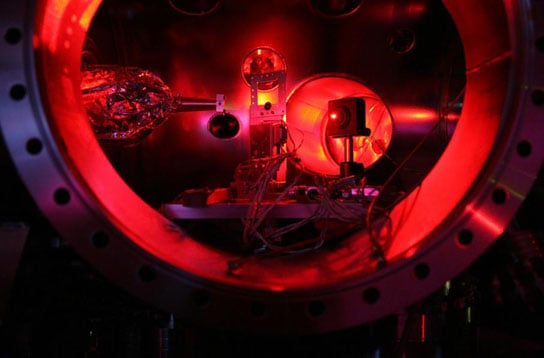
    Interior of a Linac Coherent Light Source experimental chamber at SLAC
    This photograph shows the interior of a Linac Coherent Light Source SXR experimental chamber, set up for an investigation to create and measure a form of extreme, 2-million-degree matter known as “hot, dense matter.” Credit: Sam Vinko, University of Oxford

    Experiments carried out at the U.S. Department of Energy’s (DOE) SLAC National Accelerator Laboratory allowed scientists to control a 2-million-degree piece of matter. Researchers used the world’s most powerful X-ray laser to create and probe this matter in an attempt to better understand extreme matter found in the hearts of stars and giant planets.

    Researchers working at the U.S. Department of Energy’s (DOE) SLAC National Accelerator Laboratory have used the world’s most powerful X-ray laser to create and probe a 2-million-degree piece of matter in a controlled way for the first time. This feat, reported today in Nature, takes scientists a significant step forward in understanding the most extreme matter found in the hearts of stars and giant planets, and could help experiments aimed at recreating the nuclear fusion process that powers the sun.

    The experiments were carried out at SLAC’s Linac Coherent Light Source (LCLS), whose rapid-fire laser pulses are a billion times brighter than those of any X-ray source before it. Scientists used those pulses to flash-heat a tiny piece of aluminum foil, creating what is known as “hot dense matter,” and took the temperature of this solid plasma – about 2 million degrees Celsius. The whole process took less than a trillionth of a second.

    “The LCLS X-ray laser is a truly remarkable machine,” said Sam Vinko, a postdoctoral researcher at Oxford University and the paper’s lead author. “Making extremely hot, dense matter is important scientifically if we are ultimately to understand the conditions that exist inside stars and at the center of giant planets within our own solar system and beyond.”

    Scientists have long been able to create plasma from gases and study it with conventional lasers, said co-author Bob Nagler of SLAC, an LCLS instrument scientist. But no tools were available for doing the same at solid densities that cannot be penetrated by conventional laser beams.

    “The LCLS, with its ultra-short wavelengths of X-ray laser light, is the first that can penetrate a dense solid and create a uniform patch of plasma – in this case a cube one-thousandth of a centimeter on a side – and probe it at the same time,” Nagler said.

    The resulting measurements, he said, will feed back into theories and computer simulations of how hot, dense matter behaves. This could help scientists analyze and recreate the nuclear fusion process that powers the sun.

    “Those 60 hours when we first aimed the LCLS at a solid were the most exciting 60 hours of my entire scientific career,” said Justin Wark, leader of the Oxford group. “LCLS is really going to revolutionize the field, in my view.”

    Never miss a breakthrough: Join the SciTechDaily newsletter.
    Follow us on Google and Google News.

    DOE Lasers Matter SLAC National Accelerator Laboratory
    Share. Facebook Twitter Pinterest LinkedIn Email Reddit

    Related Articles

    Unlocking the Secrets of the Past: New Study Reveals Shocking Similarities Between Dinosaur and Bird Feathers

    “Huge” Distortions – Researchers Create a New Type of Quantum Material

    Stronger Nuclear Fusion Materials May Be Possible Thanks to Photos of a Tiny Aluminum Crystal

    Physicists Startled To Discover a New Way To Shape a Material’s Atomic Structure With Light

    Snapshots of Ultrafast Switching in Quantum Electronics Could Lead to Faster Computing Devices

    Breakthrough in Artificial Photosynthetic System That Produces Clean and Renewable Energy From Sunlight and Water

    Scientists Invent Way to See Fastest Motions of Electrons That Drive Chemistry for the First Time

    Previously Unseen Phase of Matter Produced by Ultrafast Laser Pulses

    SLAC Scientists Create First Atomic X-ray Laser

    Leave A Reply Cancel Reply

    • Facebook
    • Twitter
    • Pinterest
    • YouTube

    Don't Miss a Discovery

    Subscribe for the Latest in Science & Tech!

    Trending News

    Your Blood Pressure Reading Could Be Wrong Because of One Simple Mistake

    Astronomers Stunned by Ancient Galaxy With No Spin

    Physicists May Be on the Verge of Discovering “New Physics” at CERN

    Scientists Solve 320-Million-Year Mystery of Reptile Skin Armor

    Scientists Say This Daily Walking Habit May Be the Secret to Keeping Weight Off After Dieting

    New Therapy Rewires the Brain To Restore Joy in Depression Patients

    Giant Squid Detected off Western Australia in Stunning Deep-Sea Discovery

    Popular Sugar-Free Sweetener Linked to Liver Disease, Study Warns

    Follow SciTechDaily
    • Facebook
    • Twitter
    • YouTube
    • Pinterest
    • Newsletter
    • RSS
    SciTech News
    • Biology News
    • Chemistry News
    • Earth News
    • Health News
    • Physics News
    • Science News
    • Space News
    • Technology News
    Recent Posts
    • Key Magic Mushroom Ingredient Increases Laziness and Reduces Aggression
    • Researchers Solve 15-Year Mystery Behind Cancer-Causing Gut Toxin
    • One of the World’s Most Popular Weedkillers May Be Fueling Deadly Superbugs
    • Scientists Create Laser “Whirlpools” That Spin Tiny Cells Without Touching Them
    • Scientists Discover “Hidden” Materials That Could Transform Clean Energy and Batteries
    Copyright © 1998 - 2026 SciTechDaily. All Rights Reserved.
    • Science News
    • About
    • Contact
    • Editorial Board
    • Privacy Policy
    • Terms of Use

    Type above and press Enter to search. Press Esc to cancel.