
Close Menu
    Facebook X (Twitter) Instagram
    SciTechDaily
    • Biology
    • Chemistry
    • Earth
    • Health
    • Physics
    • Science
    • Space
    • Technology
    Facebook X (Twitter) Pinterest YouTube RSS
    SciTechDaily
    Home»Technology»GaInP Cells Produce Useful Underwater Solar Energy
    Technology

    GaInP Cells Produce Useful Underwater Solar Energy

    By U.S. Naval Research LaboratoryJune 7, 2012No Comments2 Mins Read
    Facebook Twitter Pinterest Telegram LinkedIn WhatsApp Email Reddit
    Share
    Facebook Twitter LinkedIn Pinterest Telegram Email Reddit
    Photovoltaic Cells for Underwater Solar Energy
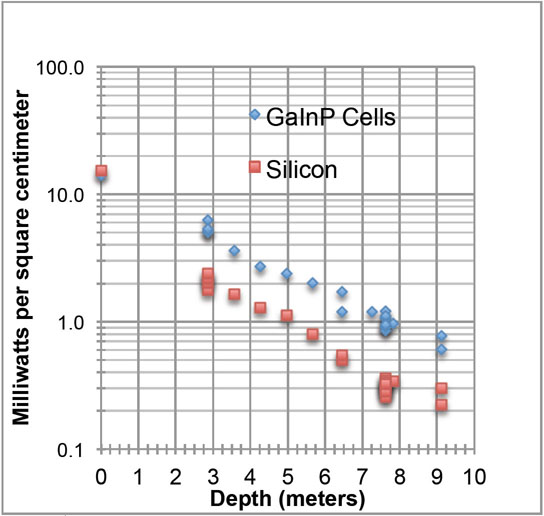
    Power density of GaInP and crystalline silicon cells, underwater, as a function of depth. Credit: U.S. Naval Research Laboratory

    New research from the U.S. Naval Research Laboratory shows that high-quality gallium indium phosphide (GaInP) cells produce useful solar power underwater, with initial results at a maximum depth of 9.1 meters revealing output to be 7 watts per square meter of solar cells.

    Scientists at the U.S. Naval Research Laboratory, Electronics Science and Technology Division, dive into underwater photovoltaic research to develop high bandgap solar cells capable of producing sufficient power to operate electronic sensor systems at depths of 9 meters.

    Underwater autonomous systems and sensor platforms are severely limited by the lack of long-endurance power sources. To date, these systems must rely on on-shore power, batteries, or solar power supplied by an above-water platform. Attempts to use photovoltaics have had limited success, primarily due to the lack of penetrating sunlight and the use of solar cells optimized more towards the unimpeded terrestrial solar spectrum.

    “The use of autonomous systems to provide situational awareness and long-term environment monitoring underwater is increasing,” said Phillip Jenkins, head, NRL Imagers and Detectors Section. “Although water absorbs sunlight, the technical challenge is to develop a solar cell that can efficiently convert these underwater photons to electricity.”

    Even though the absolute intensity of solar radiation is lower underwater, the spectral content is narrow and thus lends itself to high conversion efficiency if the solar cell is well matched to the wavelength range. Previous attempts to operate solar cells underwater have focused on crystalline silicon solar cells and more recently, amorphous silicon cells.

    High-quality gallium indium phosphide (GaInP) cells are well suited for underwater operation. GaInP cells have high quantum efficiency in wavelengths between 400 and 700 nanometers (visible light) and intrinsically low dark current, which is critical for high efficiency in low light conditions.

    The filtered spectrum of the sun underwater is biased toward the blue/green portion of the spectrum and thus higher bandgap cells such as GaInP perform much better than conventional silicon cells, states Jenkins.

    Preliminary results at a maximum depth of 9.1 meters reveal output to be 7 watts per square meter of solar cells, sufficient to demonstrate there is useful solar power to be harvested at depths commonly found in nearshore littoral zones.

    Never miss a breakthrough: Join the SciTechDaily newsletter.
    Follow us on Google and Google News.

    Green Technology Photovoltaics Solar Cells U.S. Naval Research Laboratory
    Share. Facebook Twitter Pinterest LinkedIn Email Reddit

    Related Articles

    Scientists Grow Inexpensive High-End Photovoltaic Compounds

    Squaraine Dye Improves Polymer Solar Cell Efficiency

    Layered Oxide Heterostructures Produce Efficient Solar Cells

    Princeton’s Nanomesh Triples Solar Cell Efficiency

    First All Carbon Solar Cell Made From Nanotubes and Buckyballs

    Highly Transparent Polymer Solar Cell Produces Energy by Absorbing Near-Infrared Light

    All-Carbon Photovoltaic Cell to Harness Infrared Light

    LED Styled Solar Cell Breaks Efficiency Record

    Researchers Develop IE2 for Analyzing Solar Cell Materials

    Leave A Reply Cancel Reply

    • Facebook
    • Twitter
    • Pinterest
    • YouTube

    Don't Miss a Discovery

    Subscribe for the Latest in Science & Tech!

    Trending News

    This Deadly Disease Was Wiping Out Humans 5,500 Years Ago

    Beyond DNA: Scientists Discover Inheritance That Breaks the Rules of Genetics

    Scientists Just Discovered the Eye Defies a Long-Held Rule of Vision

    What if Time Isn’t Fundamental? Physicists Just Tested the Idea in the Lab

    Scientists Say We’ve Been Wrong About the Aging Brain

    68 Quadrillion Miles: Scientists Map Earth’s Vast Hidden Fungal Network for the First Time

    Hidden Damage From Youth May Explode Into Disease Later in Life

    Climate Models May Be Wrong About How Trees Store Carbon

    Follow SciTechDaily
    • Facebook
    • Twitter
    • YouTube
    • Pinterest
    • Newsletter
    • RSS
    SciTech News
    • Biology News
    • Chemistry News
    • Earth News
    • Health News
    • Physics News
    • Science News
    • Space News
    • Technology News
    Recent Posts
    • Antarctica’s Future May Be More Predictable Than Scientists Thought
    • Sea Level Rise Is Swallowing Farmland at Alarming Rates
    • Scientists Have Found “The Heaven Sword” After Years of Looking
    • The Hottest Known Exoplanets May Hold Clues to Planetary Habitability
    • Astronomers Discover a Sleeping Giant: Ancient Black Hole 6 Billion Times the Sun’s Mass
    Copyright © 1998 - 2026 SciTechDaily. All Rights Reserved.
    • Science News
    • About
    • Contact
    • Editorial Board
    • Privacy Policy
    • Terms of Use

    Type above and press Enter to search. Press Esc to cancel.