

Ultracold atoms have successfully mimicked a fundamental quantum effect normally found in electronic circuits.
Josephson junctions enable ultra-precise measurements, define the standard unit of electrical voltage, and serve as core components in many quantum computers. Despite their widespread use, the quantum-scale processes inside superconductors are extremely difficult to observe directly.
To address this challenge, researchers at the RPTU University of Kaiserslautern-Landau carried out a quantum simulation of the Josephson effect. Instead of working with solid superconductors, they separated two Bose-Einstein condensates (BECs) using an exceptionally thin optical barrier. This barrier was created with a tightly focused laser beam and moved in a controlled, periodic way. Remarkably, the atomic system produced the same defining signatures seen in real Josephson junctions. These included Shapiro steps, which are voltage plateaus that appear at multiples of the driving frequency. Published in the journal Science, the study serves as a clear demonstration of how quantum simulation can reveal fundamental physics.
Why Josephson Junctions Are So Important
A Josephson junction has a deceptively simple design. It consists of two superconductors separated by a wafer-thin insulating layer. Even with this straightforward structure, the device produces a powerful quantum mechanical effect that plays a critical role in modern technology.
Josephson contacts form the backbone of many quantum computers and enable extremely sensitive measurements. One key application is the detection of very weak magnetic fields, which is essential for techniques such as magnetoencephalography (MEG), i.e., medical diagnostics that measure magnetic signals produced by the human brain.
Making Quantum Processes Visible
The behavior inside a Josephson junction unfolds at the level of individual quanta, making it nearly impossible to observe directly within a superconductor. To overcome this limitation, physicists rely on an approach known as quantum simulation.
In simple terms, quantum simulation involves recreating the behavior of a complex quantum system within a different system that is easier to study. By doing so, researchers can examine effects that are otherwise inaccessible in their original physical setting.
Simulating a Josephson Junction with Ultracold Atoms
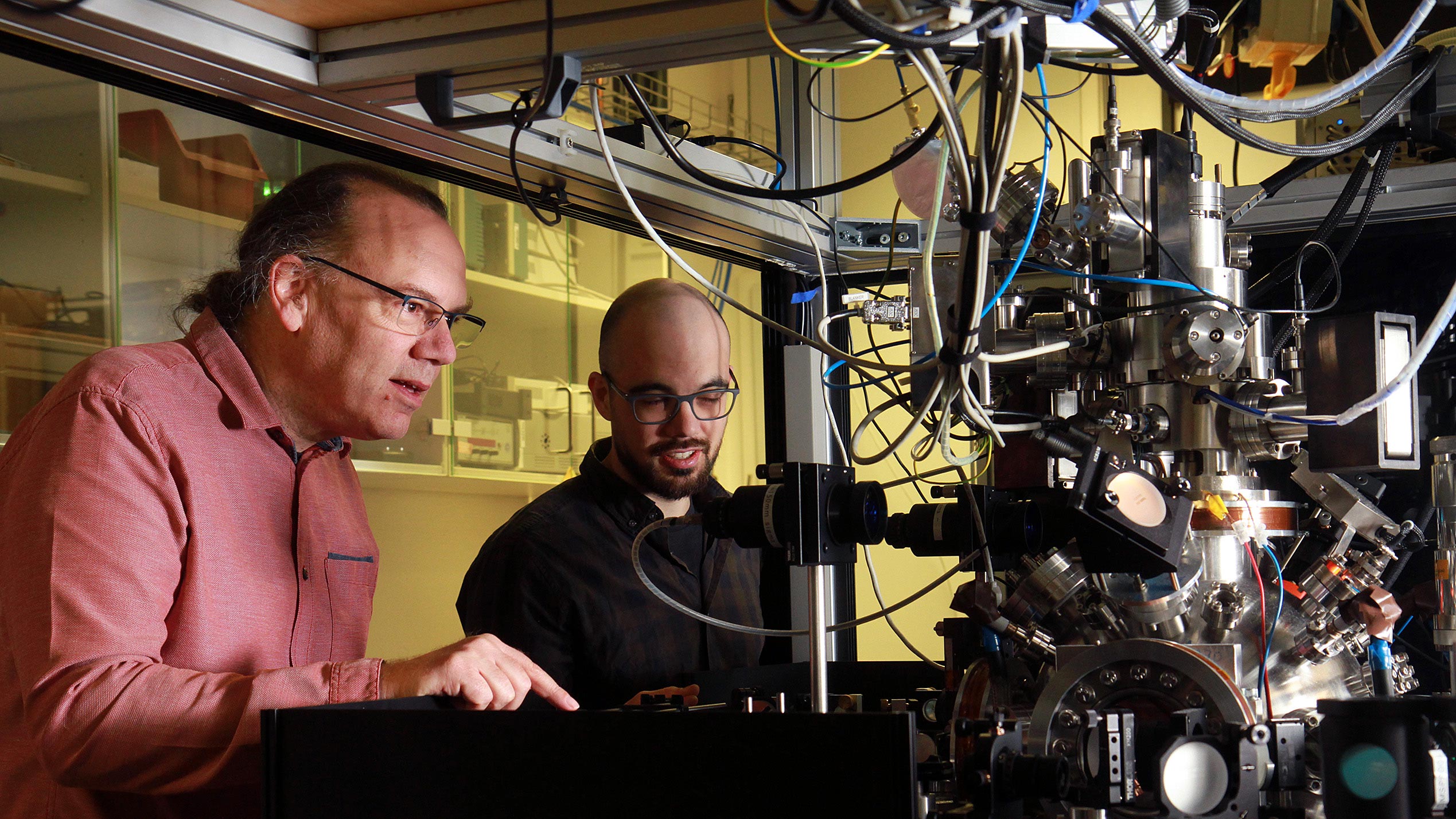
At RPTU, an experimental team led by Herwig Ott applied this strategy to the Josephson effect itself. Rather than using superconducting materials, the researchers worked with an ultracold gas of atoms known as a Bose-Einstein condensate. Two such condensates were separated by a very thin optical barrier formed by a focused laser beam that was moved periodically.
This setup allowed the team to replicate the conditions inside a superconducting Josephson junction exposed to microwave radiation. In conventional devices, microwave radiation generates an additional alternating current across the junction. In the atomic experiment, the moving laser barrier played the same role, enabling the researchers to closely mirror the electronic behavior using atoms.
Shapiro Steps Are a Universal Phenomenon
The outcome of the quantum simulation was striking. The atomic system displayed clear Shapiro steps, which are quantized voltage plateaus used worldwide to calibrate electrical voltage. These steps depend only on fundamental constants and the frequency of the modulation. As a result, they form the basis for how the voltage standard for the “volt” is realized globally.
“In our experiment, we were able to visualize the resulting excitations for the first time. The fact that this effect now appears in a completely different physical system – an ensemble of ultracold atoms – confirms that Shapiro steps are a universal phenomenon,” states Herwig Ott.
Bridging Electrons and Atoms
The study was carried out in collaboration with theory groups led by Ludwig Mathey at the University of Hamburg and Luigi Amico at the Technology Innovation Institute in Abu Dhabi. Together, the teams demonstrated that a quantum effect originally discovered in solid-state physics can be faithfully reproduced in a very different physical system.
The work stands as a textbook example of quantum simulation. As Herwig Ott explains, “A quantum mechanical effect from solid-state physics is transferred to a completely different system – and yet its essence remains the same. This builds bridges between the quantum worlds of electrons and atoms.“
Using Atoms to Build Quantum Circuits
Looking ahead, Ott and his colleagues plan to connect multiple atomic junctions together “to build real circuits for atoms.” In these systems, atoms would move through the circuit instead of electrons. This emerging research area is known as “atomtronics.”
“Such circuits are particularly well suited for observing coherent effects, i.e., wave-like effects,” says Erik Bernhart, who conducted the experiments as a doctoral student. Unlike electrons in solid materials, atoms in these circuits can be directly observed as they move. “We also want to replicate other fundamental components known from electronics for our atoms and understand them precisely at the microscopic level.”
Reference: “Observation of Shapiro steps in an ultracold atomic Josephson junction” by Erik Bernhart, Marvin Röhrle, Vijay Pal Singh, Ludwig Mathey, Luigi Amico and Herwig Ott, 11 December 2025, Science.
DOI: 10.1126/science.ads9061
Never miss a breakthrough: Join the SciTechDaily newsletter.
Follow us on Google and Google News.
4 Comments
A quantum mechanical effect from solid-state physics is transferred to a completely different system – and yet its essence remains the same.
VERY GOOD.
Please ask researchers to think deeply:
1. What is the physical essence of the quantum mechanical effect? What remains the same?
2. Is quantum mechanics mathematics or physical reality?
3. Is quantum high-dimensional spacetime matter or low dimensional spacetime matter?
In the officially constructed physical world of physics today, two sets of artificially counter rotating cobalt-60 are two mirror images of each other, the topological vortex and its anti vortex are completely different vortices, parity is not conserved, CP is violated, and so on. The prevalence of pseudoscience in physics today is closely related to the misleading and oversight of the American Physical Society and its publications.
In the officially constructed physical world of physics today, two sets of artificially counter rotating cobalt-60 are two mirror images of each other, the topological vortex and its anti vortex are completely different vortices, parity is not conserved, CP is violated, and so on. The prevalence of pseudoscience in physics today is closely related to the misleading and oversight of the American Physical Society and its publications.
Please ask researchers to think deeply:
How should we understand the quantum electronics?
Within Topological Vortex Theory (TVT) framework, the Pauli exclusion principle is interpreted as a geometric repulsion effect between topological defects in the configuration space of the background field, while electronic orbital transitions correspond to phase transitions in the collective motion of these defects. This perspective not only suggests a possible physical mechanism for the Pauli principle but also opens new pathways for the topological description of many-body quantum systems.
——Excerpted from https://zhuanlan.zhihu.com/p/1988901287748732614.