

What causes quasiparticle death?
In large systems of interacting particles in quantum mechanics, an intriguing phenomenon often emerges: groups of particles begin to behave like single particles. Physicists refer to such groups of particles as quasiparticles.
Understanding the properties of quasiparticles may be key to comprehending, and eventually controlling, technologically important quantum effects like superconductivity and superfluidity.
Unfortunately, quasiparticles are only useful while they live. It is thus particularly unfortunate that many quasiparticles die young, lasting far, far less than a second.
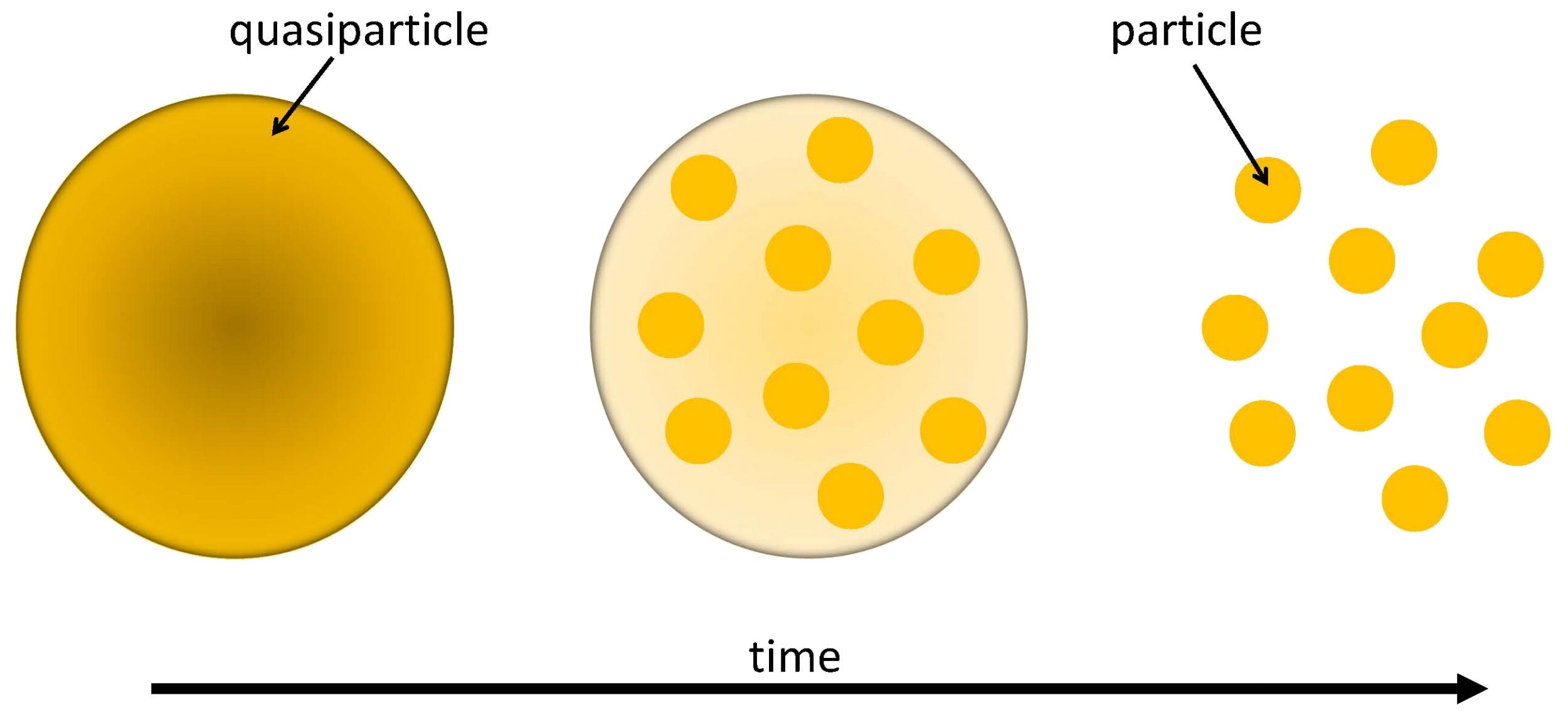
The authors of a new Monash University-led study published recently in Physical Review Letters investigate the crucial question: how do quasiparticles die?
Beyond the usual suspect—quasiparticle decay into lower energy states—the authors identify a new culprit: many-body dephasing.
Many body dephasing
Many-body dephasing is the disordering of the constituent particles in the quasiparticle that occurs naturally over time.
As the disorder increases, the quasiparticle’s resemblance to a single particle fades. Eventually, the inescapable effect of many-body dephasing kills the quasiparticle.
Far from a negligible effect, the authors demonstrate that many-body dephasing can even dominate over other forms of quasiparticle death.
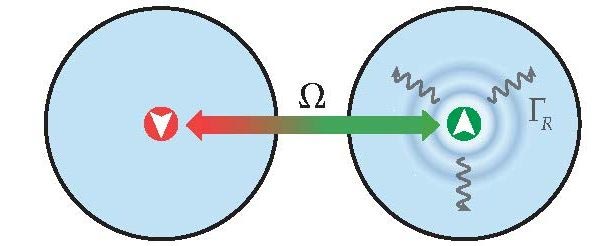
This is shown through investigations of a particularly ‘clean’ quasiparticle—an impurity in an ultracold atomic gas—where the authors find strong evidence of many-body dephasing in past experimental results.

The authors focus on the case where the ultracold atomic gas is a Fermi sea. An impurity in a Fermi sea gives rise to a quasiparticle known as the repulsive Fermi polaron.
The repulsive Fermi polaron is a highly complicated quasiparticle and has a history of eluding both experimental and theoretical studies.
Through extensive simulations and new theory, the authors show that an established experimental protocol—Rabi oscillations between impurity spin states—exhibits the effects of many-body dephasing in the repulsive Fermi polaron.
These previously unrecognized results provide strong evidence that many-body dephasing is fundamental to the nature of quasiparticles.
The study
Reference: “Quasiparticle Lifetime of the Repulsive Fermi Polaron” by Haydn S. Adlong, Weizhe Edward Liu, Francesco Scazza, Matteo Zaccanti, Nelson Darkwah Oppong, Simon Fölling, Meera M. Parish and Jesper Levinsen, 24 September 2020, Physical Review Letters.
DOI: 10.1103/PhysRevLett.125.133401
The study was led by the School of Physics and Astronomy, Monash University, with co-authors from the Istituto Nazionale di Ottica del Consiglio Nazionale delle Ricerche in Florence, Italy, and Ludwig-Maximilians-Universität in Munich, Germany.
As well as support from the Australian Research Council (Centre of Excellence and Future Fellowship programs), the authors acknowledge support from the International Max Planck Research School for Quantum Science and Technology, the European Research Council, the EU’s Horizon 2020 program, and Fondazione Cassa di Risparmio di Firenze.
Quasiparticles and cold-atom physics at FLEET
Haydn Adlong conducted the study in Dr. Jesper Levinsen and A/Prof Meera Parish’s group at Monash University, which investigates the behavior of large groups of interacting quantum particles, which can exhibit exotic behavior, such as superfluidity where they flow without encountering resistance.
This work expands our fundamental knowledge of quantum physics in systems ranging from cold atomic gases to solid-state semiconductors, and has the potential to underpin a new generation of near-zero resistance, ultra-low energy electronic devices, sought by FLEET.
Within FLEET, the study of ultracold atoms out of equilibrium falls under Research Theme 3.
Never miss a breakthrough: Join the SciTechDaily newsletter.
Follow us on Google and Google News.
1 Comment
… Yeah, is it like in genetics when some hybrids are made, some live long and prosper and other one can’t survive. For some it looks like it is never meant to be a long lasting prosper life.
How about, let’s see, Bose–Einstein condensate? …