
Close Menu
    Facebook X (Twitter) Instagram
    SciTechDaily
    • Biology
    • Chemistry
    • Earth
    • Health
    • Physics
    • Science
    • Space
    • Technology
    Facebook X (Twitter) Pinterest YouTube RSS
    SciTechDaily
    Home»Technology»How To Overcome Noise in Quantum Computations – A New Formula
    Technology

    How To Overcome Noise in Quantum Computations – A New Formula

    By University of AmsterdamApril 10, 2023No Comments4 Mins Read
    Facebook Twitter Pinterest Telegram LinkedIn WhatsApp Email Reddit
    Share
    Facebook Twitter LinkedIn Pinterest Telegram Email Reddit
    Artist Concept Quantum Computer
    Quantum computing is a field of study focused on developing computer technology based on the principles of quantum theory. It aims to use the unique properties of quantum systems, such as superposition and entanglement, to perform tasks that are beyond the capabilities of classical computers.

    Ludovico Lami of QuSoft and the University of Amsterdam and Mark M. Wilde of Cornell have achieved a major breakthrough in the field of quantum computing by developing a formula that predicts the impact of environmental noise. This formula is critical in the creation of quantum computers that can work in imperfect real-world conditions.

    The Choreography of Quantum Computing

    Quantum computing utilizes the laws of quantum mechanics for computation purposes. Unlike conventional computers that operate using bits that are either 0 or 1, quantum computers utilize quantum bits (qubits) which can be in a superposition of 0 and 1 simultaneously.

    This allows quantum computers to perform certain types of calculations much faster than classical computers. For example, a quantum computer can factor very large numbers in a fraction of the time it would take a classical computer.
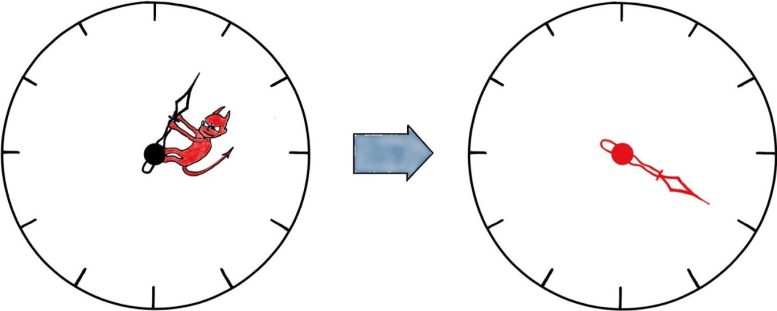
    Demon Changing a Quantum Phase
    Environmental noise, here represented as a little demon, can affect the state of a quantum computer by changing the phases of various branches of its wave function in an unpredictable fashion; we call this dephasing. Here, the position of the hand of the clock represents the phase of a particular branch of the wave function. Its modification, not known to us, will affect the delicate ballet of phase recombination which quantum computations rely on. Credit: L. Lami

    While one could naively attribute such an advantage to the ability of a quantum computer to perform numerous calculations in parallel, the reality is more complicated. The quantum wave function of the quantum computer (which represents its physical state) possesses several branches, each with its own phase. A phase can be thought of as the position of the hand of a clock, which can point in any direction on the clock face.

    At the end of its computation, the quantum computer recombines the results of all computations it simultaneously carried out on different branches of the wave function into a single answer. “The phases associated with the different branches play a key role in determining the outcome of this recombination process, not unlike how the timing of a ballerina’s steps plays a key role in determining the success of a ballet performance,” explains Lami.

    Disruptive Environmental Noise

    A significant obstacle to quantum computing is environmental noise. Such noise can be likened to a little demon that alters the phase of different branches of the wave function in an unpredictable way. This process of tampering with the phase of a quantum system is called dephasing and can be detrimental to the success of a quantum computation.
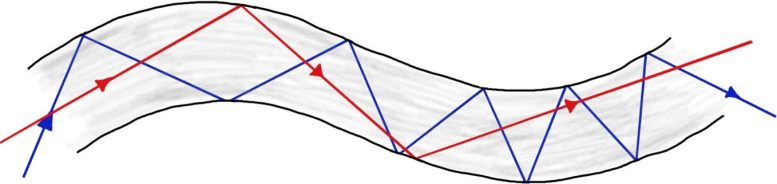
    Light Rays in an Optical Fiber
    Light can travel through an optical fiber via different paths. The impossibility of knowing the exact path a light ray has taken leads to an effective dephasing noise. Credit: L. Lami

    Dephasing can occur in everyday devices such as optical fibers, which are used to transfer information in the form of light. Light rays traveling through an optical fiber can take different paths; since each path is associated with a specific phase, not knowing the path taken amounts to an effective dephasing noise.

    In their new publication in Nature Photonics, Lami and Wilde analyze a model, called the bosonic dephasing channel, to study how noise affects the transmission of quantum information. It represents the dephasing acting on a single mode of light at a definite wavelength and polarisation.

    The number quantifying the effect of the noise on quantum information is the quantum capacity, which is the number of qubits that can be safely transmitted per use of a fiber. The new publication provides a full analytical solution to the problem of calculating the quantum capacity of the bosonic dephasing channel, for all possible forms of dephasing noise.

    Longer Messages Overcome Errors

    To overcome the effects of noise, one can incorporate redundancy in the message to ensure that the quantum information can still be retrieved at the receiving end. This is similar to saying “Alpha, Beta, Charlie” instead of “A, B, C” when speaking on the phone. Although the transmitted message is longer, the redundancy ensures that it is understood correctly.

    The new study quantifies exactly how much redundancy needs to be added to a quantum message to protect it from dephasing noise. This is significant because it enables scientists to quantify the effects of noise on quantum computing and develop methods to overcome these effects.

    Reference: “Exact solution for the quantum and private capacities of bosonic dephasing channels” by Ludovico Lami and Mark M. Wilde, 6 April 2023, Nature Photonics.
    DOI: 10.1038/s41566-023-01190-4

    Never miss a breakthrough: Join the SciTechDaily newsletter.
    Follow us on Google and Google News.

    Cornell University Quantum Computing University of Amsterdam
    Share. Facebook Twitter Pinterest LinkedIn Email Reddit

    Related Articles

    Cornell Scientists Have Discovered a Hidden Quantum State

    Yale Physicists Observe Quantum Information While Preserving Its Integrity

    Shape-Remembering Hydrogels Made Out of Synthetic DNA

    Photon Devices Could Outperform Traditional Computers

    Samarium Hexoboride Behaves Like a Topological Insulator

    Electronic Read-Out of the Quantum State of an Atom

    Electronic Device for the Perfect Bicep Curl

    Researchers Designing Autonomous Robots for Skyscraper Repairs

    Researchers Developing Handheld Pathogen Detector

    Leave A Reply Cancel Reply

    • Facebook
    • Twitter
    • Pinterest
    • YouTube

    Don't Miss a Discovery

    Subscribe for the Latest in Science & Tech!

    Trending News

    Scientists Discover Cheap, Natural Remedy for High Blood Pressure

    Earth’s Upper Atmosphere Is Cooling Fast and Scientists Finally Know Why

    32,000 Olympic Pools of Magma Nearly Erupted Beneath Atlantic Island

    Exercise Changes the Heart in a Way Researchers Never Expected

    Too Much Sleep May Age Your Body Faster, New Study Warns

    Scientists Uncover Promising New Strategy To Stop Parkinson’s in Its Tracks

    Experts Reveal the Surprising Cancer Link Behind a Common Vitamin

    This Strange “Golden Orb” Found 2 Miles Deep Stumped Scientists for Years

    Follow SciTechDaily
    • Facebook
    • Twitter
    • YouTube
    • Pinterest
    • Newsletter
    • RSS
    SciTech News
    • Biology News
    • Chemistry News
    • Earth News
    • Health News
    • Physics News
    • Science News
    • Space News
    • Technology News
    Recent Posts
    • The Type of Alcohol You Drink Could Affect How Long You Live
    • 19-Year Study Reveals the Surprising Truth About Sitting and Dementia
    • This Common Vitamin May Help Stop Prediabetes From Turning Into Diabetes
    • Canada’s Billion-Year-Old Rocks Could Hold the Future of Clean Energy
    • Climate Change Is Quietly Choking Rivers Across the Planet
    Copyright © 1998 - 2026 SciTechDaily. All Rights Reserved.
    • Science News
    • About
    • Contact
    • Editorial Board
    • Privacy Policy
    • Terms of Use

    Type above and press Enter to search. Press Esc to cancel.