
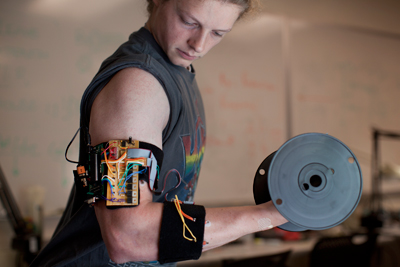
It used to be that only jocks were interested in building muscles and hitting the weights. Nowadays everyone knows the benefits of working out and it seems even scientists are getting involved. Research engineers from Cornell University have developed the perfect bicep building device, a simple electronic device that guides the user through a proper bicep curl.
To achieve buff biceps, proper form for strength-training exercises is key, and people often turn to professional trainers to correct them and prevent injury. Cornell student engineers have developed an alternative: A simple electronic device that guides the user through a proper bicep curl.
Michael Lyons ’11, M.Eng. ’12; and Greg Meess ’09, M.Eng. ’10, invented their “haptic exercise coach” for an electrical engineering class project in spring 2010. Their teacher for ECE 4760, senior lecturer Bruce Land, recognized the project’s uniqueness and encouraged the students to apply for a patent.
In September 2011, Lyons and Meess filed a provisional patent application for the device through Cornell Center for Technology Enterprise and Commercialization (CCTEC). The filing status is a yearlong placeholder to protect the intellectual property, giving CCTEC time to perform the necessary marketing and commercialization that will lead to a decision on whether to file a formal patent application.
The haptic exercise coach, which looks a bit like a blood pressure cuff, has two accelerometers that attach to the wrist and upper arm and track the wearer’s movements. A microcontroller takes data from the accelerometers. When the wearer’s form goes out of line with pre-calibrated specifications, the device vibrates in two places, alerting the wearer to adjust his or her form. By keeping proper form, the chance for injury diminishes, say the inventors.
Lyons said the project fuses two of his interests: electrical engineering and working out. He envisions such a device helping people cut down on the cost and time of a personal trainer.
“With personal trainers, everything is kind of subjective,” Lyons said. “With our device, you calibrate everything to kinesiology.” For the project, Lyons and Meess researched the scientific principles that guide proper exercise, as well as the many ways people exercise incorrectly. For example, they discovered that people often bring the weight too high or too rapidly, failing to maximize force on the targeted muscles.
“It’s basic physics combined with human anatomy,” Lyons said.
The possibilities reach far across the physical exercise spectrum; while working on the project, Lyons came across literature on rates of elbow injury in baseball players. “Easing those tendons back to life is something you want to do with very slow movements,” Lyons said. “Instead of someone telling you how to do it, you could have a machine tell you to go at a certain speed and angle.”
The bicep cuff was a proof of concept only. Meess envisions the same idea being applied to sensors for the legs, arms and torso, too. He is excited by the device’s potential in physical therapy applications.
“The potential to provide instant feedback and ensure proper form is valuable, but also the ability to collect data for detailed updates on improvements could provide a useful motivational tool, as well as giving a physical therapist a quantitative way to remotely check up on their patient’s progress,” Meess said.
Never miss a breakthrough: Join the SciTechDaily newsletter.
Follow us on Google and Google News.
1 Comment
I agree, proper form for strength training is part of the key for getting the desired results, but does a simple bicep curl really need to get to that level of granularity in the gym?