
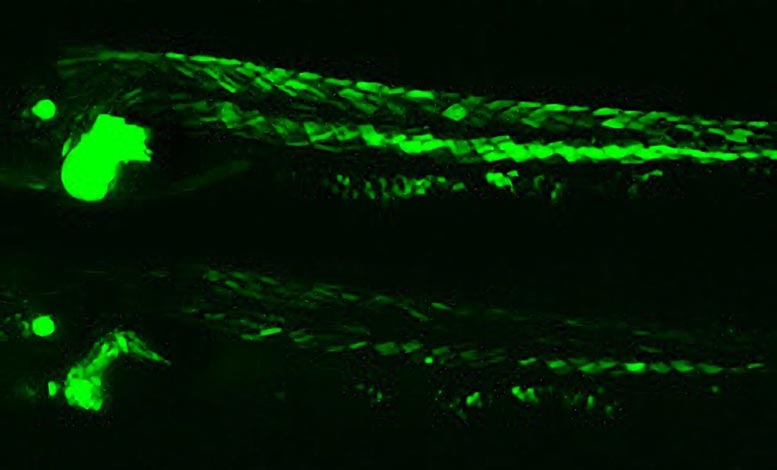
As population grows and consumption increases, so does waste and pollution. Scientists have been working on a way to better track and understand how pollution will affect wildlife and human health and have created glowing zebrafish to help with that process.
Understanding the damage that pollution causes to both wildlife and human health is set to become much easier thanks to a new green-glowing zebrafish.
Created by a team from the University of Exeter, the fish makes it easier than ever before to see where in the body environmental chemicals act and how they affect health.
The fluorescent fish has shown that oestrogenic chemicals, which are already linked to reproductive problems, impact on more parts of the body than previously thought.
The research by the University of Exeter and UCL (University College London) is published in the journal Environmental Health Perspectives.
Numerous studies have linked ‘endocrine-disrupting’ chemicals, used in a wide range of industrial products and contraceptive pharmaceuticals, to reproductive problems in wildlife and humans. Previous University of Exeter research identified the potential for a major group of ‘these chemicals to cause male fish to change gender. Human exposure to these chemicals, which can alter hormone signaling in the body, has been associated with decreases in sperm count and other health problems, including breast and testicular cancer.
Scientists worldwide are now working to find better ways of screening and testing for these chemicals in the body, to target the health risks to humans and wildlife. This new development, led by Dr. Tetsuhiro Kudoh and Professor Charles Tyler at the University of Exeter, gives the first comprehensive insight into the effects of these chemicals on the whole body. It shows that more organs and parts of the body react to environmental estrogens than previously thought.
The team created a new transgenic zebrafish, which when exposed to environmental estrogens shows where these chemicals work in the body through the production of green fluorescent signals. The research team tested the fish’s sensitivity to different chemicals known to affect estrogen hormone signaling, including ethinyloestradiol, used in the contraceptive pill and hormone replacement therapy treatments, nonylphenol, used in paints and industrial detergents, and Bisphenol A, which is found in many plastics.
Eventually, they produced a fish that was sufficiently sensitive to the chemicals to give fluorescent green signals to show which parts of its body were responding. This was done by placing a genetic system into the fish that amplifies the response to estrogens producing the fluorescent green signal.
In the laboratory, PhD student Okhyun Lee exposed the fish to chemicals at levels found in wastewater that are discharged into our rivers. She was then able to observe the effects of the exposure on the fish, in real-time, watching specific organs or areas of tissue glow green, in response to the chemicals.
The team identified responses in parts of the body already associated with these chemicals: for example, the liver and, in the case of Bisphenol A, the heart. They also witnessed responses in tissues that were not previously known to be targeted by these chemicals, including the skeletal muscle and eyes.
Corresponding author Professor Charles Tyler of Biosciences at the University of Exeter said: “This is a very exciting development in the international effort to understand the impact of oestrogenic chemicals on the environment and human health. This zebrafish gives us a more comprehensive view than ever before of the potential effects of these hormone-disrupting chemicals on the body.
“By being able to localize precisely where different environmental estrogens act in the body, we will be able to more effectively target health effects analyses for these chemicals of concern. While it is still early days, we are confident that our zebrafish model can help us better understand the way the human body responds to these pollutants.”
Reference: “Biosensor Zebrafish Provide New Insights into Potential Health Effects of Environmental Estrogens” by Okhyun Lee, Aya Takesono, Masazumi Tada, Charles R. Tyler and Tetsuhiro Kudoh, 1 July 2012, Environmental Health Perspectives.
DOI: 10.1289/ehp.1104433
Never miss a breakthrough: Join the SciTechDaily newsletter.
Follow us on Google and Google News.