
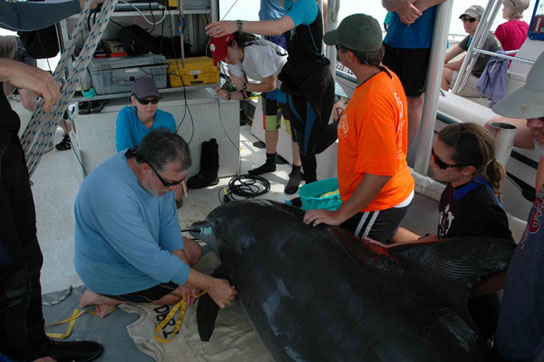
According to new data from 2011 NOAA tests, bottlenose dolphins in the Gulf of Mexico are underweight, anemic, have low blood sugar and/or some symptoms of liver and lung disease. The research is part of the process of studying the effects of the Deepwater Horizon oil spill.
Bottlenose dolphins in Barataria Bay, Louisiana, are showing signs of severe ill health, according to NOAA marine mammal biologists and their local, state, federal, and other research partners.
Barataria Bay, located in the northern Gulf of Mexico, received heavy and prolonged exposure to oil during the Deepwater Horizon oil spill.
Based on comprehensive physicals of 32 live dolphins from Barataria Bay in the summer of 2011, preliminary results show that many of the dolphins in the study are underweight, anemic, have low blood sugar and/or some symptoms of liver and lung disease. Nearly half also have abnormally low levels of the hormones that help with stress response, metabolism, and immune function.
Researchers fear that some of the study dolphins are in such poor health that they will not survive. One of these dolphins, which was last observed and studied in late 2011, was found dead in January 2012.
NOAA and its local, state, and federal partners started the Barataria Bay dolphin study in 2011 as part of the Natural Resource Damage Assessment (NRDA), the process for studying the effects of the Deepwater Horizon oil spill.
NOAA is sharing the preliminary results from the study so that stranding responders and veterinarians can better care for live stranded dolphins and look for similar health conditions.
Investigation of Dolphin Strandings in the Northern Gulf Continues
Since February 2010, more than 675 dolphins have stranded in the northern Gulf of Mexico (Franklin County, Florida, to the Louisiana/Texas border)–a much higher rate than the usual average of 74 dolphins per year, prompting NOAA to declare an Unusual Mortality Event (UME) and investigate the cause of death for as many of the dolphins as possible. The vast majority of stranded dolphins have been found dead; however, 33 have stranded alive and seven have been taken to facilities for rehabilitation.
In the spring, it is typical to see some newborn, fetal and stillborn dolphins strand, and there has been an increase in strandings of this younger age class during this UME in 2010 and 2011. Yet all age classes continue to strand at high levels. NOAA is working with a team of marine mammal health experts to investigate the factors that may be contributing to the dolphin mortalities.
Gulf Seafood Safety
Since the 2010 oil spill, the Food and Drug Administration, NOAA and the Gulf Coast states have used an agreed-upon protocol to test seafood and ensure that it is free of harmful oil and dispersant residues. NOAA opened federal waters to fishing after extensive testing, and the Gulf states continue to use the protocol to routinely test finfish and shellfish to ensure all seafood reaching the consumer is safe. Some waters in the northern Barataria Basin, a larger area that includes Barataria Bay, remain closed to commercial fishing, as visible oil is still present along the shoreline where the closures are in place. The joint protocol directs seafood safety testing to begin only after visible oil is gone.
NOAA and its state and federal partners are researching multiple ways Gulf dolphins may have been exposed to oil, including through ingestion, inhalation or externally. Dolphins could have routinely ingested oil from sediments or water while feeding or by eating whole fish, including internal organs and fluids such as liver and bile, which can harbor chemical contaminants. These are not likely routes of exposure for most people.
Never miss a breakthrough: Join the SciTechDaily newsletter.
Follow us on Google and Google News.