
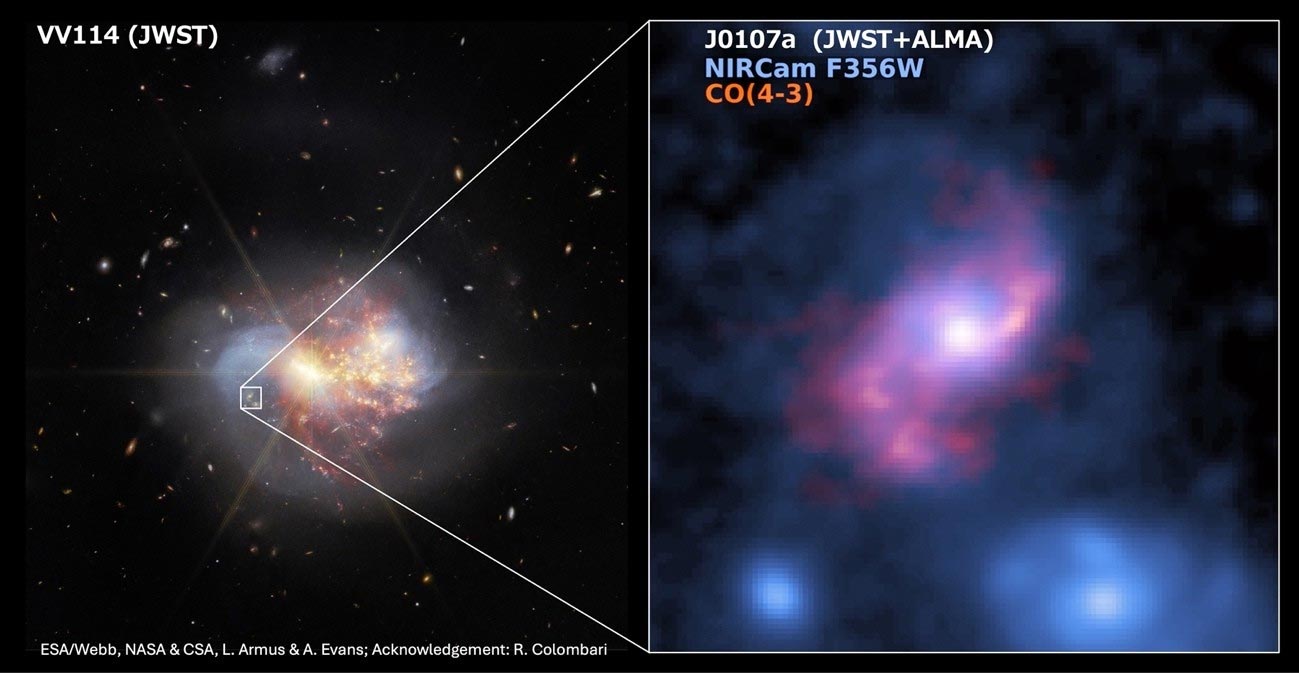
A massive barred spiral galaxy from the early Universe has stunned astronomers by forming stars at 300 times the rate of the Milky Way, without signs of a galactic collision.
Using Webb and ALMA, researchers discovered that its bar structure, rich in gas and similar in shape to modern spirals, is likely triggering intense central starbursts. This defies previous assumptions that monster galaxies evolve only through violent mergers, hinting at a calmer but equally dramatic process driven by cosmic web gas inflows and bar-induced dynamics.
Starburst Galaxies in the Early Universe
More than 10 billion years ago, the early Universe was buzzing with activity. Enormous “monster galaxies” were forming stars at breathtaking rates—almost 300 times faster than our own Milky Way. Today, only a few galaxies show this kind of extreme star formation, and nearly all of them are crashing into or merging with other galaxies. That led scientists to believe these ancient starbursts were also triggered by violent collisions that sent gas rushing into galactic centers, eventually turning the galaxies into massive, featureless elliptical giants once the fuel ran out.
Webb Reveals Dust-Hidden Giants
These monster galaxies are incredibly distant and wrapped in thick clouds of dust from all that star-forming chaos. This dust blocks visible light, making them nearly invisible to traditional telescopes. For years, their structure—and what powered their explosive star-making—remained a mystery. But thanks to the infrared vision of the James Webb Space Telescope, astronomers are now peering through the dust and discovering something unexpected.
Many of these galaxies don’t look like chaotic merger remnants at all. Instead, they have well-formed disk shapes, like calm spiral galaxies. So why are these peaceful-looking galaxies producing stars at such wild rates?

A Surprising Discovery: J0107a
In an exciting breakthrough, a team led by astronomer Shuo Huang studied a galaxy named J0107a, located 11.1 billion light-years away. This cosmic giant was first spotted back in 2014 by chance, while researchers were observing another galaxy. When Webb’s detailed near-infrared images were released in 2023, they revealed something stunning. J0107a is more than ten times as massive as the Milky Way and forms stars about 300 times faster. Even more remarkable, it has a nearly perfect barred spiral shape, just like modern galaxies such as the Milky Way. In fact, it’s one of the most well-defined barred spiral structures ever seen from this early time in the Universe.
Understanding how such a calm-looking galaxy could host such extreme star formation remains challenging. Spectroscopic measurements of the gas dynamics are needed to dig deeper, but observing the internal motions of such a dust-shrouded galaxy is still incredibly difficult, even for Webb.
Bar Structures Drive Intense Star Formation
The research team then used ALMA to observe the emission lines of carbon monoxide and neutral carbon atoms and discovered that J0107a closely resembles modern barred spiral galaxies, such as the Milky Way, in terms of the shape of its bar structure as well as the distribution and movement of the associated gas.
On the other hand, the team also found that while the proportion of gas in the bar structure of a modern galaxy is less than 10% of the total mass, that of J0107a is very high at around 50%. The data shows that J0107a’s bar structure, which consists of stars and gas with a mass far greater than that of modern galaxies, stirs up the disk, creating a gas flow at a speed of several hundred kilometers per second over a radius of 20,000 light years around the center of the galaxy, which is equivalent to the distance from the center of the Milky Way to the Solar System.
Some of this gas falls into the center of the galaxy, resulting in intense star formation. No previous theoretical studies of galaxy formation predicted the existence of a monster galaxy with such a bar structure.
Challenging Classic Galaxy Formation Theories
This is the first successful direct observation of a burst of star formation induced by gas inflow from a bar structure in the early Universe. The conventional theories of monster galaxy formation and evolution assumed that intense star formation occurs due to galactic collisions and mergers, or gravitational instability in their disks, subsequently turning them into elliptical galaxies over the course of hundreds of millions of years.
Meanwhile, J0107a is assumed to have developed a shape resembling that of a modern barred spiral galaxy, while retaining the extreme physical properties of a monster galaxy, over hundreds of millions of years in the early Universe, just 2.6 billion years after the Big Bang. The detailed data on gas distribution and kinematics obtained from this observation will provide important clues for not only the origin of monster galaxies, but also for research into the formation and evolution of bar structures in other galaxies, because we are witnessing the bar structure formation process in the early Universe.
Cosmic Web Fuels Galactic Growth
Shuo Huang, the leader of the research team, says, “The substantial amount of gas required for the growth of giant galaxies is supplied by galactic mergers or inflows from the cosmic web. While there is no sign of a galactic merger, a large gas disk has been detected around J0107a.
“This gas disk has a diameter of approximately 120,000 light years, which is twice the diameter of the main body of the galaxy visible as stars, and its motion roughly follows that of the galaxy itself. Based on this, we assume that it was created from a large amount of gas that is spiraling towards the galaxy from the cosmic web (see note below).
“This is a new picture of a monster galaxy, in which a disk galaxy is formed from a cosmic-scale gas flow, followed by the emergence of a bar structure during the galactic evolution, leading to rapid galactic-scale gas flows and bursts of star formation. We will continue our observational studies with ALMA to look into this further.”
Note: These gas flows are predicted theoretically and referred to as “cold streams.”
Reference: “Large gas inflow driven by a matured galactic bar in the early Universe” by Shuo Huang, Ryohei Kawabe, Hideki Umehata, Kotaro Kohno, Yoichi Tamura and Toshiki Saito, 21 May 2025, Nature.
DOI: 10.1038/s41586-025-08914-2
This research is supported by Grants-in-Aid from the Japan Society for the Promotion of Science (KAKENHI: Nos. JP22H04939, JP23K20035, and JP24H00004) and the ALMA Joint Scientific Research Program (No. 2024-26A).
Key observations were carried out using the Atacama Large Millimeter/submillimeter Array, better known as ALMA. This world-class observatory is located high in the Chilean Andes and is operated through a global partnership that includes the European Southern Observatory, the U.S. National Science Foundation, and Japan’s National Institutes of Natural Sciences, all working closely with the Republic of Chile.
Funding and scientific contributions also come from Canada, Taiwan, and South Korea, making ALMA one of the most collaborative and powerful astronomical facilities on the planet. The observatory is jointly operated by teams in Europe, North America, and East Asia, with the Joint ALMA Observatory coordinating its management and operations across all regions. This international effort enables astronomers to explore the cosmos with remarkable precision.
Never miss a breakthrough: Join the SciTechDaily newsletter.
Follow us on Google and Google News.
6 Comments
Monster energy already filed a lawsuit against it
Data of the observation of the galaxy J0107a at red shift,z = 2.433 is quite consistent with modern standard cosmology,Galaxy Dynamics due to rotation along the time axis taking equal half part in the evolution process.Thus,supporting the Dynamic Big Bang,revised version of origin and evolution model of the universe.
“Thus, supporting the Dynamic Big Bang, revised version of origin and evolution model of the universe”. The “revised version”? Oh, you must be refering to the standard model, but now with lots of make-up, mascara, and lipstick. Here is yet another highly evolved galaxy found at a red shift where the standard model of the BBT says it should not exist (assuming that the currently accepted age of the universe – 13.8 billion years- is correct).
Something about these articles that report on astronomical phenomena writing in the present tense, if an observation is made of something 11.1 billion light years away, it isn’t happening in our current time.
More observation of galaxy J0107a,can suffix missing data,like hot radiation and gas feedback from the supermassive black hole present at the center of galaxy,with right proportion.Yet,present works are sufficient to establish the mentioned evolution facts.
Bull crap.