

Long-term satellite measurements show that Earth’s magnetic field is changing faster and more unevenly than expected, driven by dynamic processes deep within the planet’s core.
Drawing on 11 years of magnetic field data collected by the European Space Agency’s Swarm satellite constellation, researchers have found that a weak zone in Earth’s magnetic field over the South Atlantic, called the South Atlantic Anomaly, has grown by an area nearly half the size of continental Europe since 2014.
Earth’s magnetic field plays a crucial role in sustaining life. This constantly changing force shields the planet from harmful cosmic radiation and streams of charged particles emitted by the Sun.
The field is generated deep inside Earth by a vast layer of molten, moving iron in the outer core, located about 3000 km below the surface. As this liquid metal circulates, it produces electrical currents that give rise to Earth’s electromagnetic field, although the underlying processes are far more intricate than simple analogies suggest.
Swarm is an Earth Explorer mission developed under ESA’s Earth Observation FutureEO program. It consists of three identical satellites that make highly precise measurements of magnetic signals originating from Earth’s core, mantle, crust, and oceans, as well as from the ionosphere and magnetosphere.
These detailed observations are allowing scientists to better separate the different sources of magnetism and to understand why the magnetic field is weakening in some regions while becoming stronger in others.
The South Atlantic Anomaly was first recognized in the nineteenth century, southeast of South America, as an area where Earth’s magnetic field is unusually weak.
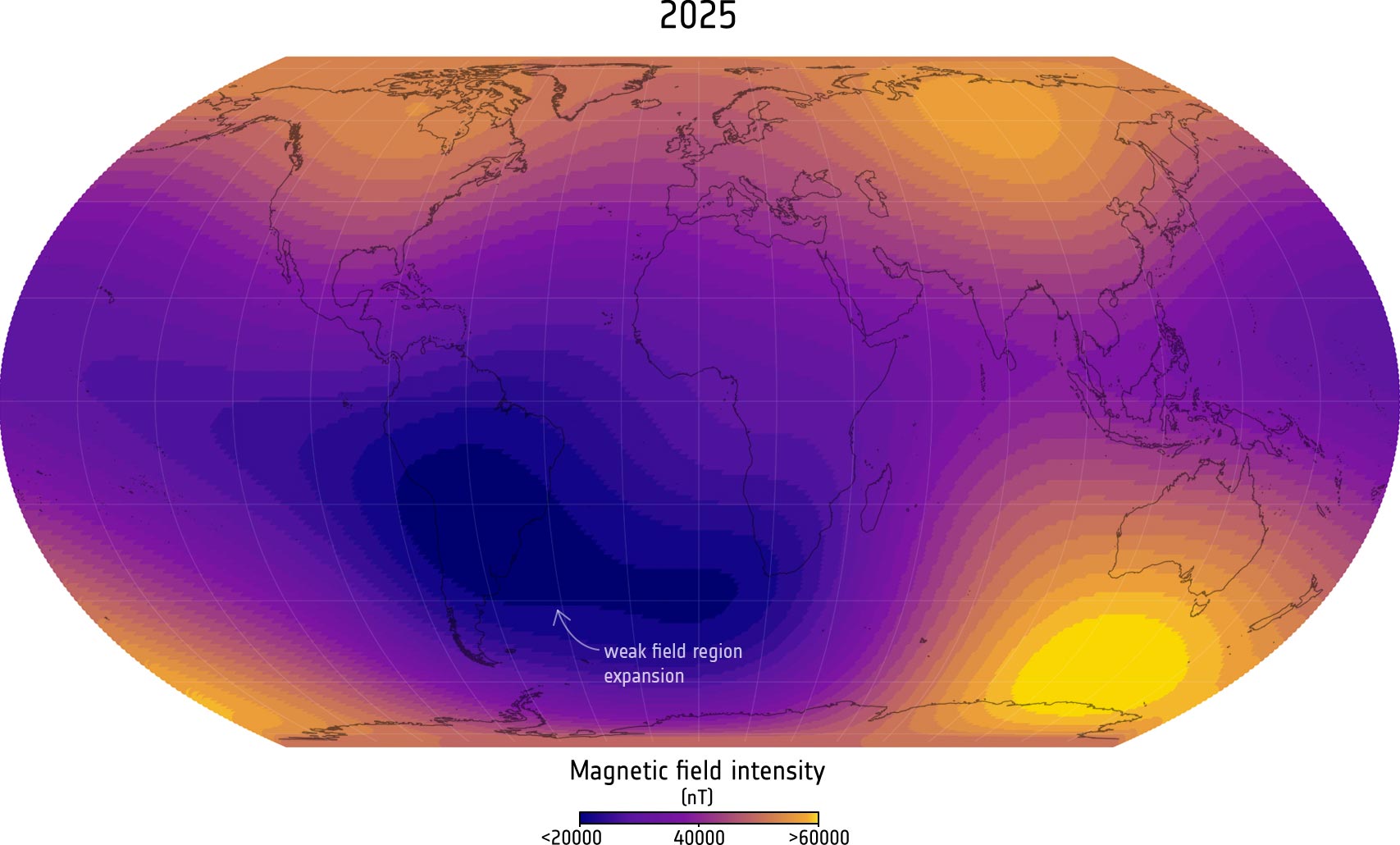
Today, the anomaly is especially important for space safety. Satellites that pass through this region are exposed to increased levels of radiation, which can cause malfunctions, damage sensitive components, or even lead to temporary blackouts.
According to results published in Physics of the Earth and Planetary Interiors, data from the Swarm mission show that the South Atlantic Anomaly expanded steadily between 2014 and 2025. The study also reveals that since 2020, the magnetic field has weakened even more rapidly in a region of the Atlantic Ocean southwest of Africa.
“The South Atlantic Anomaly is not just a single block,” says lead author Chris Finlay, Professor of Geomagnetism at the Technical University of Denmark. “It’s changing differently towards Africa than it is near South America. There’s something special happening in this region that is causing the field to weaken in a more intense way.”
This behavior is linked to strange patterns in the magnetic field at the boundary between Earth’s liquid outer core and its rocky mantle, known as reverse flux patches.
Prof. Finlay explains, “Normally, we’d expect to see magnetic field lines coming out of the core in the southern hemisphere. But beneath the South Atlantic Anomaly, we see unexpected areas where the magnetic field, instead of coming out of the core, goes back into the core. Thanks to the Swarm data, we can see one of these areas moving westward over Africa, which contributes to the weakening of the South Atlantic Anomaly in this region.”
Swarm’s record-breaking 11 years
The latest model of Earth’s core-generated magnetic field marks a new milestone for ESA’s Swarm satellites, which have now provided the longest continuous record of magnetic field measurements from space.
The satellites were launched on 22 November 2013 as the fourth Earth Explorer mission, pioneering satellites that form a key component of ESA’s forward-looking FutureEO program.
Conceived as demonstrators of innovative Earth observation technologies, these missions have long outlived their original design lifetime, become integral to long-term records, provided data for critical operational services, and have paved the way for future generations of satellites.
Swarm data underpin the global magnetic models used for navigation, monitor space weather hazards, and allow unprecedented insights into our Earth system from its core through to the outer reaches of Earth’s atmosphere.
Earth’s magnetic field strengthens over Siberia
The latest Swarm results highlight the dynamic nature of Earth’s magnetism. For example, in the Southern Hemisphere there is one point where the magnetic field is particularly strong, and in the Northern Hemisphere there are two – one around Canada and the other around Siberia.
“When you’re trying to understand Earth’s magnetic field, it’s important to remember that it’s not just a simple dipole, like a bar magnet. It’s only by having satellites like Swarm that we can fully map this structure and see it changing,” said Prof. Finlay.
However, since Swarm has been in orbit the magnetic field over Siberia has strengthened while it has weakened over Canada. The Canadian strong field region has shrunk by 0.65% of Earth’s surface area, which is almost the size of India, while the Siberian region has grown by 0.42% of Earth’s surface area, which is comparable to the size of Greenland.
This shift, which is caused by complex processes going on in Earth’s turbulent core, is associated with the northern magnetic pole moving towards Siberia in recent years. This shift is important for navigation, which is affected by the dance between these two areas of strong magnetic fields.
ESA’s Swarm Mission Manager, Anja Stromme, said, “It’s really wonderful to see the big picture of our dynamic Earth thanks to Swarm’s extended time series. The satellites are all healthy and providing excellent data, so we can hopefully extend that record beyond 2030, when the solar minimum will allow more unprecedented insights into our planet.”
Reference: “Core field changes from eleven years of Swarm satellite observations” by C.C. Finlay, C. Kloss and N. Gillet, 18 September 2025, Physics of the Earth and Planetary Interiors.
DOI: 10.1016/j.pepi.2025.107447
This work was supported by ESA under the EO Science for Society programme, through contract 4000127193/19/NL/IA (Swarm +4D Deep Earth: Core).
Never miss a breakthrough: Join the SciTechDaily newsletter.
Follow us on Google and Google News.
6 Comments
That mysterious week spot in Earths magnetic Field is no mystery for me, its caused by cars that use electricity to run, it is not clean, renewable energy!
Probably caused by Venezuelan narco-terrorists who want to destroy electric cars!
It is a waste of time and effort because it is well-known that EVs self-destruct frequently. Even when they don’t physically self-destruct, their re-sale value inevitably implodes, leaving the owner with the problem of safely disposing of a toxic pile of difficult-to-recycle materials that no one has yet found a use for other than to speed up the filling of large holes in the ground. 🙂
We have evidence from the geological record of previous cyclical geomagnetic excursions. Perhaps we need to look up and out, not down, to find controlling forces of the geomagnetic dynamics.
Possible pole flip scenario?
Probably not a full flip. Likely just an “excursion”.