
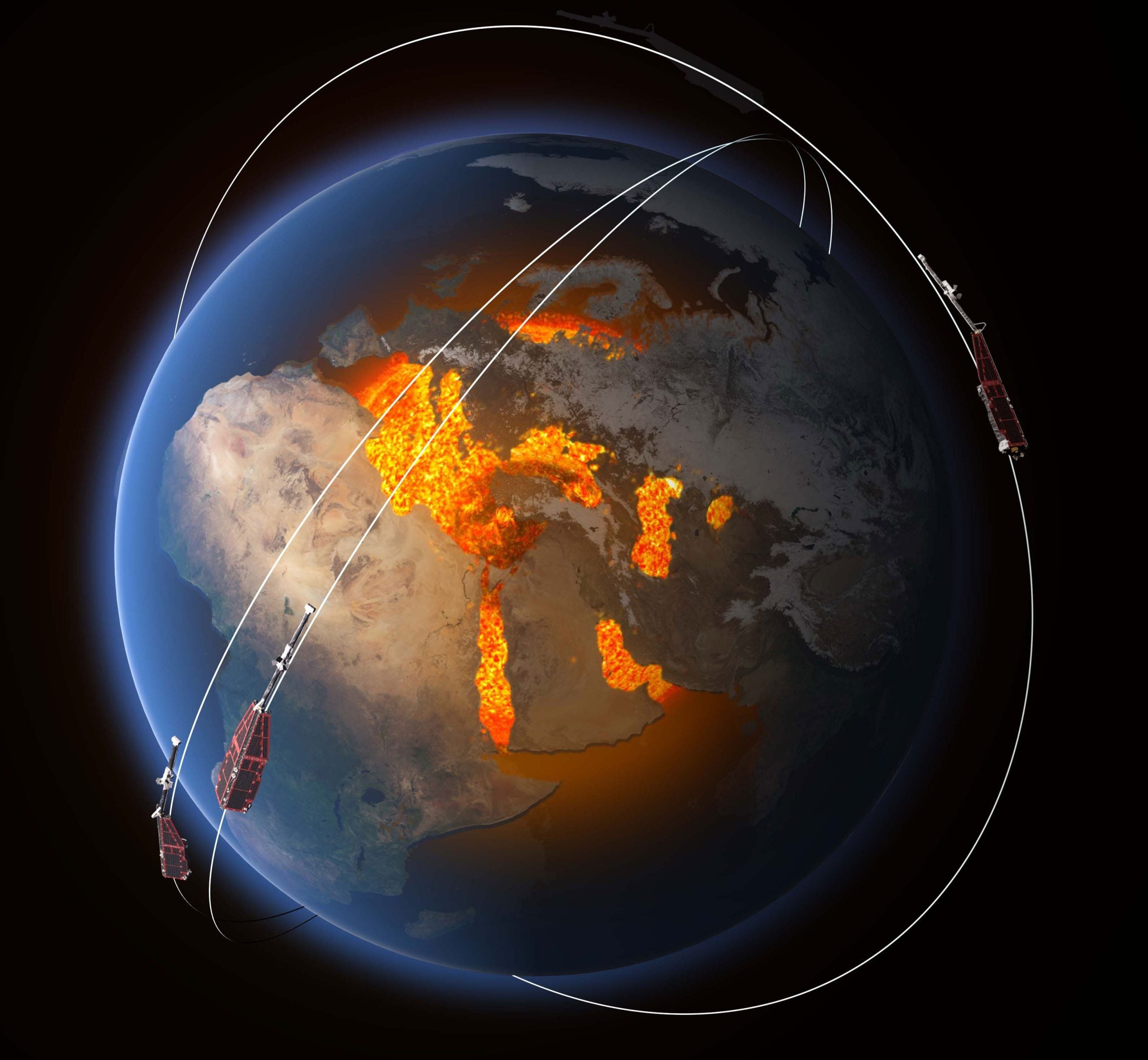
A surprising reversal in molten iron flow beneath the Pacific is giving scientists a sharper view of how Earth’s magnetic field evolves.
Earth’s magnetic field, the invisible shield that protects the planet from charged particles streaming from the Sun, is powered by a churning ocean of molten iron hidden thousands of kilometers beneath our feet.
Although this deep interior is inaccessible, its slow-moving currents leave subtle fingerprints in the magnetic field above the surface. A new study has now revealed that one of those currents behaved in a way scientists did not expect, abruptly reversing direction beneath the Pacific Ocean and providing fresh clues about the hidden engine driving Earth’s magnetic field.
The discovery challenges the long-standing view that large-scale flow in the outer core changes only gradually over decades. By combining nearly 30 years of ground-based measurements with satellite observations, researchers reconstructed how a vast region of liquid iron suddenly changed course, offering one of the clearest views yet of the dynamic processes unfolding roughly 2,200 km (1,370 miles) beneath Earth’s surface.
A reversal beneath the Pacific
In 2010, a broad region of iron-rich fluid deep beneath the equatorial Pacific switched from moving weakly westward to flowing strongly eastward. Scientists still do not know what triggered the reversal, but newly analyzed data from ESA’s Swarm and CryoSat missions, together with observations from the German CHAMP and Danish Ørsted satellites, allowed researchers to examine the event in unprecedented detail.
Published in the Journal of Studies of Earth’s Deep Interior, the study combines satellite observations with ground-based magnetic measurements spanning 1997 to 2025. The findings suggest that Earth’s outer core may be considerably more dynamic than previously thought, raising new questions about how the planet’s deepest layers interact and how the magnetic field evolves over time.
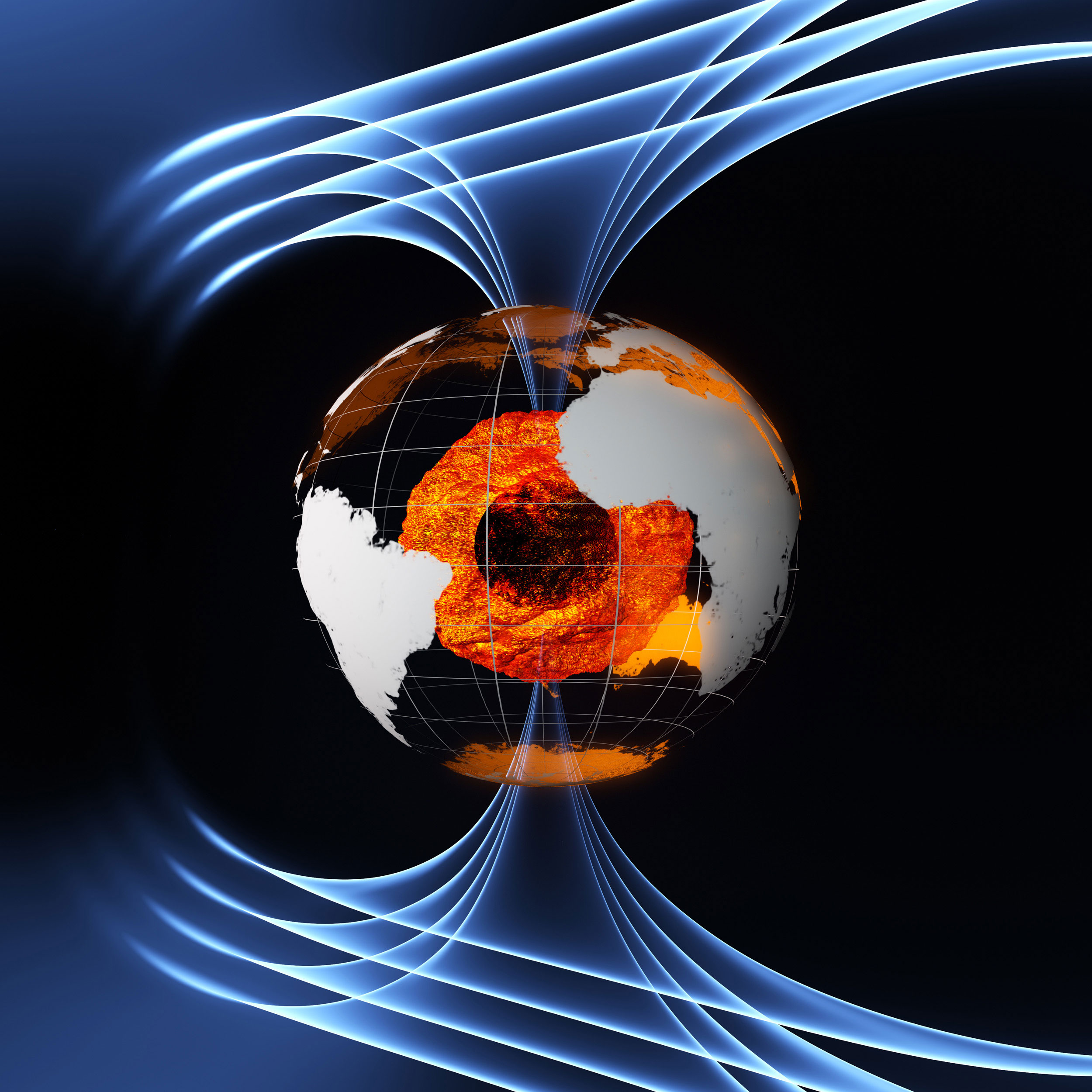
Scientists had previously viewed the outer core as a system with relatively stable movement. This major shift suggests its circulation can change much more abruptly than expected. The study offers new clues about the turbulent processes that create Earth’s magnetic field and may point to connections between motion in the outer core and changes taking place even deeper inside Earth.
Lead author of the study, Frederik Dahl Madsen, of the University of Edinburgh, School of Geosciences, said, “The large-scale flow reversal beneath the Pacific raises new questions about the behavior of Earth’s deep interior. Scientists now want to understand whether the reversal represents a short-lived fluctuation, part of a repeating oscillation, or a new stable equilibrium for core circulation. Continued monitoring will be essential to determine how the flow evolves over the coming years.”
Frederik also explained that the model used in the research suggests that the Pacific eastward flow has weakened since 2020, adding, “The rise of the strong eastward flow in the Pacific is contemporary with a change in behaviour in the inner core, as inferred from geodesy and seismology, and we hypothesize that these changes in the deep interior are associated with the changes in flow beneath the Pacific.”
Change in Earth’s molten core flow 1997–2025. Credit: ESA (data source: Madsen et al, 2026)
Earth’s molten core detected from space
Earth’s magnetic field comes from motion in the liquid outer core, where electrically conducting molten iron moves around the solid inner core. This process, known as the geodynamo, is always changing, although many of its larger flow patterns have seemed fairly persistent across decades of observation.
ESA launched the three Swarm satellites in 2013. Each carries highly sensitive magnetometers that can map Earth’s magnetic field with exceptional precision. Because the satellites fly in carefully coordinated orbits, they can help separate magnetic signals from the core from those produced by the crust, oceans, ionosphere and magnetosphere.
Those measurements allowed researchers to reconstruct changing flow patterns at the boundary between the core and mantle. They also helped identify the sudden changes linked to the Pacific reversal and the 2017 geomagnetic jerk.
According to ESA’s Swarm Mission Manager, Anja Stromme, the long-term dataset from Swarm was important to the study. She noted, “Although Swarm was launched after the dramatic reversal event of 2010, it has provided high-precision data that tells us about Earth’s inner core in the period that followed.
“Importantly, Swarm provides continuous global coverage over many years, allowing scientists to track how core dynamics evolve over time rather than relying only on ground-based magnetic observatories. Long-duration satellite magnetic measurements allow researchers to follow changes in the geodynamo in near-real time and improve models of Earth’s magnetic field evolution. Future observations from missions such as Swarm will play a crucial role.”
Satellite observations also helped researchers spot wave-like accelerations and rapidly shifting flow structures that could have been lost in noisier datasets. The study further indicates that the eastward flow may now be weakening after reaching a peak several years ago, which raises the possibility that the reversal was a temporary oscillation or part of a longer natural cycle in core dynamics.
Understanding our Earth system
These processes happen far beneath Earth’s surface and do not threaten people or the climate. Even so, they are essential to understanding how the planet functions. Motion in the liquid iron outer core generates Earth’s magnetic field, which helps protect the planet from charged particles streaming from the Sun. Without that shield, Earth’s atmosphere and technological systems would face much greater exposure to harmful solar radiation.
Earth’s magnetic field is constantly evolving. As flow in the core changes, the field slowly shifts as well, with effects that matter for navigation systems, spacecraft operations, and models of near Earth space weather. For that reason, understanding changes in the core is important both for basic science and for practical applications.
According to Elisabetta Iorfida, ESA’s Swarm Mission Scientist, the Pacific reversal challenges the idea that the outer core is mainly controlled by stable westward circulation. She noted, “This study shows that regional changes can emerge rapidly within just a decade. The findings may also help scientists investigate possible interactions between Earth’s outer core, inner core, lower mantle, and, therefore, give more insights into the core-mantle boundary, which is a critical region for deep Earth dynamics.
“This research raises intriguing questions about how Earth’s deepest layers are dynamically connected. As the magnetic field continues to evolve, satellite missions are providing an increasingly detailed view of the dynamic processes unfolding deep inside our planet, revealing that Earth’s core may be far more variable and complex than once believed.”
Reference: “Principal component analysis of the 2010 reversal of core-surface flow beneath the Pacific Ocean” by Frederik Dahl Madsen, Isobel Howard, William Brown and Kathryn Whaler, 6 May 2026, Journal of Studies of Earth’s Deep Interior.
DOI: 10.46298/jsedi.17268
Never miss a breakthrough: Join the SciTechDaily newsletter.
Follow us on Google and Google News.
8 Comments
Wow…that’s kinda scary but interesting. What’s up with the reversal?
Earths’ magnetic poles have ‘swapped ends’ many, many times in our geologic history, and we’re due for another. Perhaps this is the process that kicks it off?
The warming of the earth is causing a rise in the temperature of the oceans. This in turn causes an increase in the evaporation of ocean water which results in an increase in rainfall and snow at the poles. Increased snowfall at the poles causes greater weight pushing down toward the center of the earth, which could cause a squeezing effect on the liquid iron located more than 1000 miles beneath the earth’s surface. Increased rainfall on the other hand removes water from the ocean which would cause a decrease in the force of the ocean water’s weight pushing toward the center of the earth which would be equivalent to a force pushing away from earth’s center in those areas and likewise resulting in movements of the liquid iron deep under the crust . These two factors working together could result in a rearrangement of the shape of the volume of liquid iron that moves under the surface of the earth.
Your conjecture (Thankfully we have the word “could” in the English language.) doesn’t really address why the DIRECTION of the liquid core has suddenly changed. Do you have evidence that you can cite to prove that polar precipitation has increased suddenly in the last 16 years?
There is, of course, probably a time lag before any crustal deformation would work its way through the crust and mantle. If we assume that the deformation (isostatic adjustment) is propagated inward at the rate of about 25mm/year, it should take about 120 million years for the deformation from your speculated load of climate warming-caused ice and snow to reach the outer core 3,000 km below; if we use an estimate of the isostatic adjustment rate of the glacial fore-bulge from the last glaciation, it will take about 10X longer . That means that what is affecting the outer-core today would have had to be a surface event that took place 60 million years before the asteroid that caused the extinction of the dinosaurs. Recent warming could not have been a factor.
Incidentally, the Cretaceous Period was a lot warmer than what it is today, and the continents were not in the same place as they are today. There is evidence that the poles were ice-free during the Cretaceous.
Interesting guess! 👍
I want to know what they are doing about it! I pay taxes! 😉
что то нет связи с Солнечной активностью. Геодинамо, это здорово. Но внешняя магнитная броня планеты на приводе от солнца. Не отрицаю что мантия важна как сердечник трансформатора. Но ток дает внешняя обмотка и сердечник откликается.
Apparently you read English, because you seem to understand the gist of the article. When I used my browser’s built-in translator and translated what you wrote, some of it made sense but it seems that some things got lost in the translation. Might I suggest that in the future, you use a translation program for what you write, and see if it makes sense. If necessary, make some changes, and then respond with that corrected English text.