
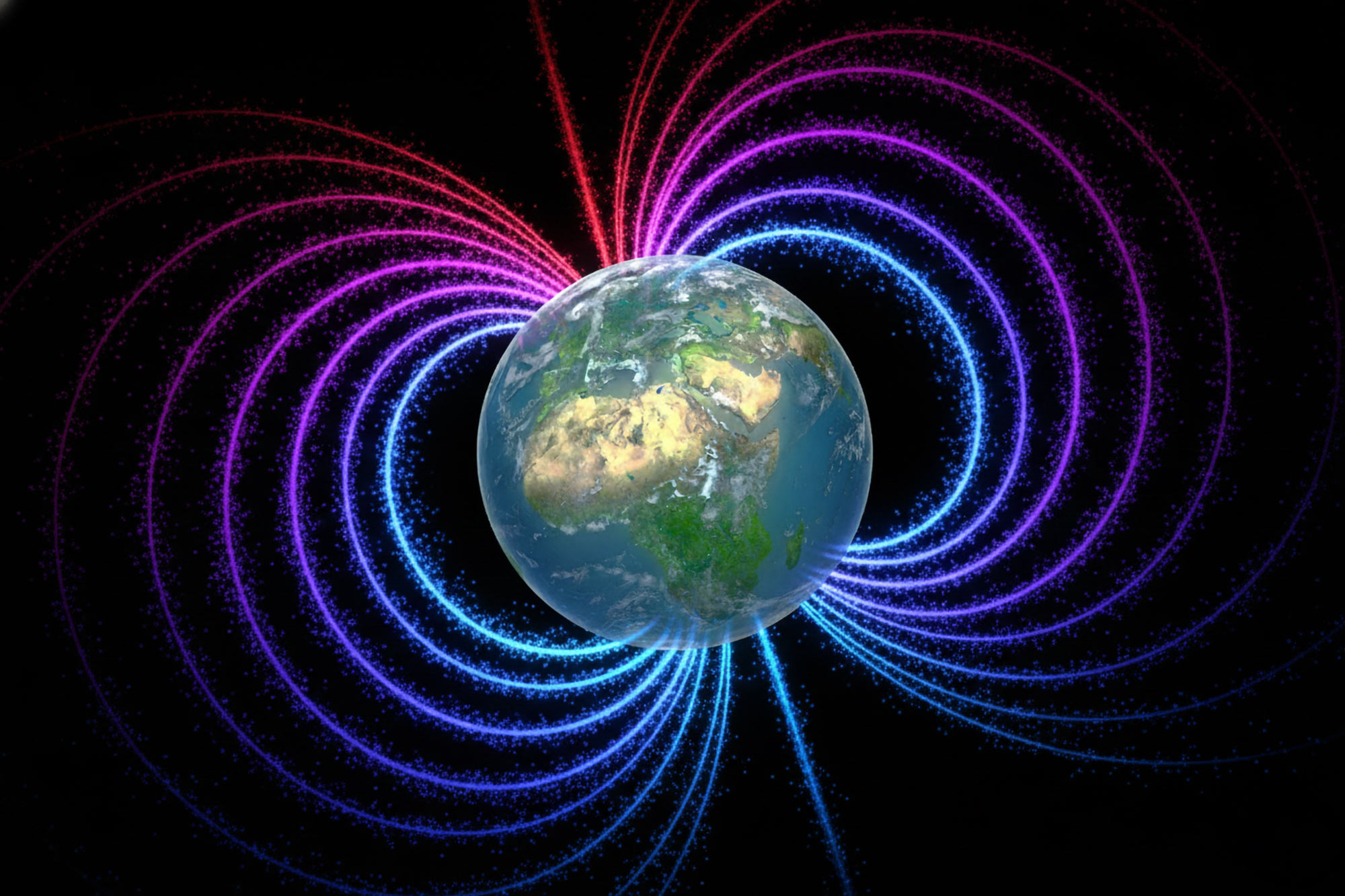
Deep beneath the ocean floor, ancient sediments hint that Earth’s magnetic field sometimes changed far more slowly than expected.
Deep beneath our feet, a restless ocean of molten metal helps keep Earth livable. The planet’s magnetic field forms as liquid iron and nickel circulate through the outer core, generating electric currents that create a global magnetic shield. That shield is powerful, but it is not permanently locked in place.
From time to time, Earth’s magnetic north and south poles trade positions in events called geomagnetic reversals. The story of those flips is written into the planet itself. As sediments settle on the seafloor and rocks cool, tiny magnetic minerals can align with the field at that moment, preserving a snapshot that scientists can read millions of years later. These reversals are not quick switches. They typically unfold over several thousand years as the field weakens, becomes erratic, and the poles drift across the globe before stabilizing again with the opposite orientation.
Over the last 170 million years, researchers have documented about 540 reversals, and many were thought to take roughly 10,000 years to complete.
A new study led by a University of Utah geoscientist, working with collaborators from France and Japan, suggests that some reversals moved at a very different pace. The team identified examples from about 40 million years ago in which the transition stretched far longer, in some cases lasting more than 70,000 years. That extended timeline reshapes how scientists think about the magnetic field that surrounds Earth and helps block solar radiation and harmful particles from space.
Potential Impacts on Life and Climate
A prolonged weak phase could matter because the magnetic field acts like a planetary filter. When it falters, more charged particles can reach the upper atmosphere, potentially altering chemical reactions there and changing how energy moves through the climate system. Some effects could also reach the biosphere, especially for species that rely on magnetic cues.
According to co author Peter Lippert, an associate professor in the U Department of Geology & Geophysics, long intervals of reduced geomagnetic shielding likely influenced atmospheric chemistry, climate processes and the evolution of living organisms.
“The amazing thing about the magnetic field is that it provides the safety net against radiation from outer space, and that radiation is observed and hypothesized to do all sorts of things. If you are getting more solar radiation coming into the planet, it’ll change organisms’ ability to navigate,” said Lippert, who heads the Utah Paleomagnetic Center. “It’s basically saying we are exposing higher latitudes in particular, but also the entire planet, to greater rates and greater durations of this cosmic radiation and therefore it’s logical to expect that there would be higher rates of genetic mutation. There could be atmospheric erosion.”
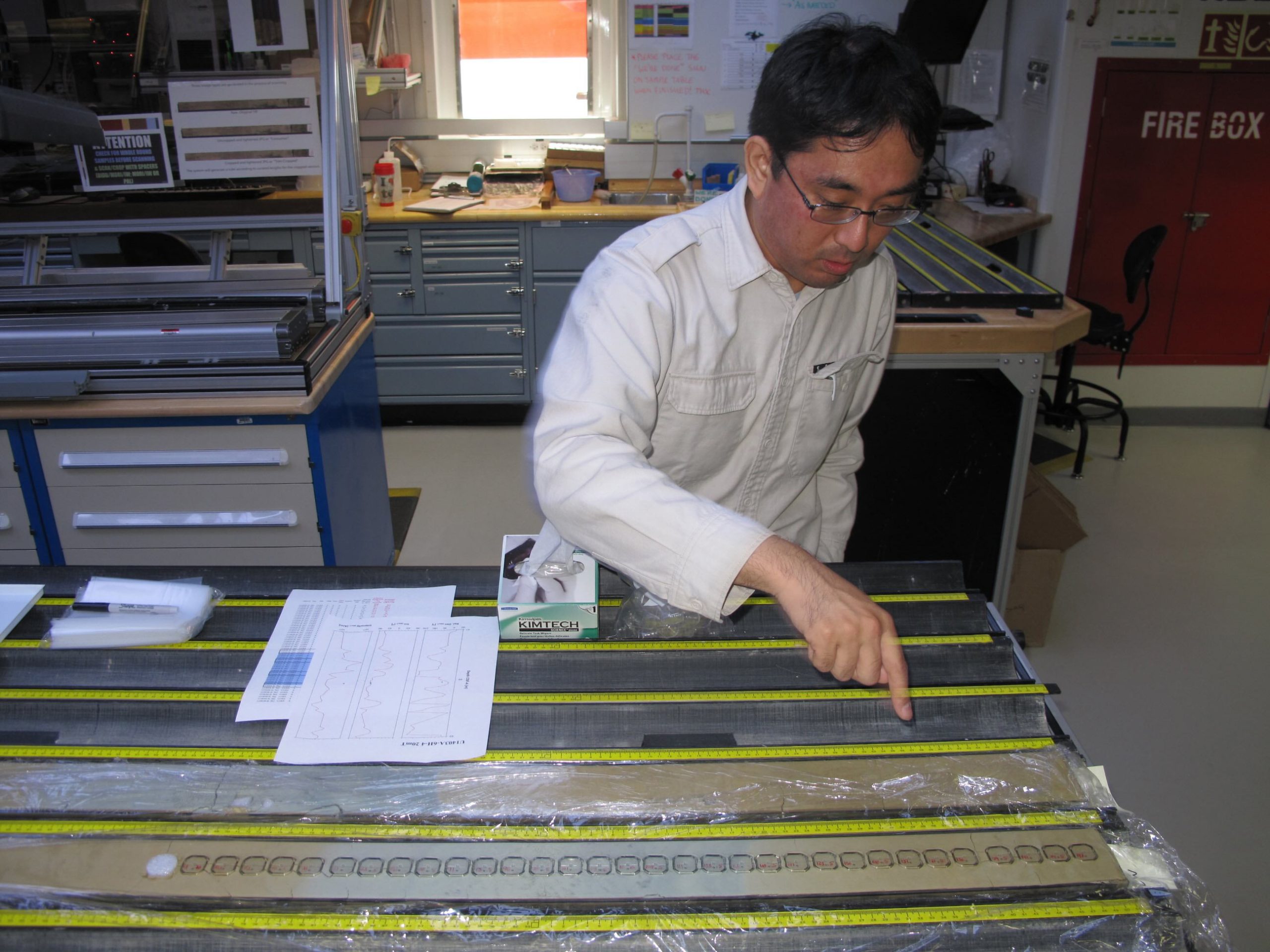
The results appear in Nature Communications Earth & Environment. The lead author is Yuhji Yamamoto of Japan’s Kochi University.
“This finding unveiled an extraordinarily prolonged reversal process, challenging conventional understanding and leaving us genuinely astonished,” Yamamoto wrote in a summary posted by Springer Nature.
The research builds on work Yamamoto and Lippert conducted during a 2012 scientific drilling expedition in the North Atlantic. The project focused on reconstructing climate conditions during the Eocene Epoch, which lasted from 56 to 34 million years ago. The two-month mission was carried out as part of the Integrated Ocean Drilling Program’s Expedition 342. Researchers drilled beneath the seafloor off the coast of Newfoundland, recovering sediment cores from depths of up to 300 meters. These layered deposits preserve a detailed history of Earth’s past, formed slowly over millions of years.
Reading Earth’s Ancient Magnetism
As paleomagnetists, Yamamoto and Lipperts’ job was to “measure the direction and the intensity of the magnetization that’s preserved in those cores,” Lippert said. “We don’t know what triggers a reversal. Individual reversals don’t last the same amount of time, so that creates this unique barcode. We can use the magnetic directions preserved in the sediments and correlate them to the geologic timescale.”
These sediments carry a reliable magnetic signal locked in by tiny crystals of magnetite produced by ancient microorganisms and from dust and erosion from the continents. Like a compass, the direction they point reveals Earth’s polarity at the time the sediments were deposited.
One 8-meter-thick layer took the scientists by surprise, appearing to record prolonged geomagnetic reversals in incredible detail.
“Yuhji noticed, while looking at some of the data when he was on shift, this one part of the Eocene had really stable polarity in one direction and really stable polarity in another direction,” Lippert said. “But the interval between them—of unstable polarity when it went to the other direction—was spread out over many, many centimeters.”
Capturing a Slow-Motion Flip
They realized this was no ordinary flip and collected extra samples at extremely fine spacing, just a few centimeters apart, to capture the sediments’ story in high resolution.
To achieve this resolution and to test if the strange magnetic behavior was due to changes in the magnetic field or the sediments. In subsequent analysis of these cores over several years, Lippert and his colleagues confirmed this was recording changes in the magnetic field and constructed high-precision timelines for two reversals, one lasting 18,000 years and another for 70,000 years.
While the finding was a surprise, it may not have been unexpected, according to the study. Computer models of Earth’s geodynamo—in the swirling outer core that generates the electrical currents supporting the magnetic field—had indicated reversals’ durations vary, with many short ones, but also occasional long, drawn-out transitions, some lasting up to 130,000 years.
In other words, Earth’s geomagnetism may have always had this unpredictable streak, but scientists hadn’t caught it in the rocks until now.
Reference: “Extraordinarily long duration of Eocene geomagnetic polarity reversals” by Yuhji Yamamoto, Slah Boulila, Futoshi Takahashi and Peter C. Lippert, 20 January 2026, Communications Earth & Environment.
DOI: 10.1038/s43247-026-03205-8
Funding: Japan Agency for Marine-Earth Science and Technology, Japan Society for the Promotion of Science
Never miss a breakthrough: Join the SciTechDaily newsletter.
Follow us on Google and Google News.
7 Comments
Extremely interesting . I I read this right. This could mean a reversal of the north and south poles.
Yes, that is exactly what the authors are saying.
https://en.wikipedia.org/wiki/Geomagnetic_reversal
But what does this reversal look/feel like to humans (aside from climate change) ?
Ever cataclysmic? Change Earth’s topography??
It would be very helpful to try to eliminate the “Lines of Force” depiction in favor of shaded potentials.
Please explain what you mean by “shaded potential,” and how it would be helpful. A reference would be useful.
But what does this reversal look/feel like to humans (aside from climate change) ?
Ever cataclysmic? Change Earth’s topography??
Not duplicate.
This BOT just bumped me out
See above…