
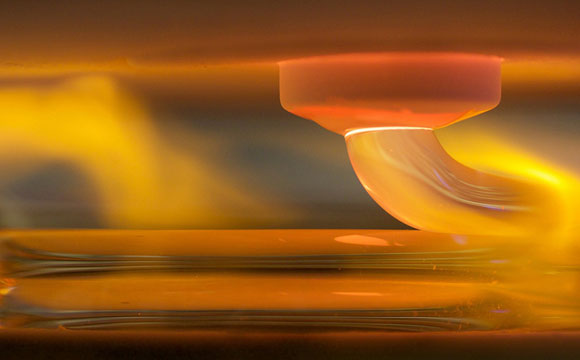
Engineers from MIT have developed a new system to print transparent glass in 3-D. This new system is the first to create strong, solid glass structures from computerized designs.
The technology behind 3-D printing — which initially grew out of work at MIT — has exploded in recent years to encompass a wide variety of materials, including plastics and metals. Simultaneously, the cost of 3-D printers has fallen sufficiently to make them household consumer items.
Now a team of MIT researchers has opened up a new frontier in 3-D printing: the ability to print optically transparent glass objects.
The new system, described in the Journal of 3D Printing and Additive Manufacturing, was developed by Neri Oxman, an associate professor at the MIT Media Lab; Peter Houk, director of the MIT Glass Lab; MIT researchers John Klein and Michael Stern; and six others.
Other groups have attempted to 3-D print glass objects, but a major obstacle has been the extremely high temperature needed to melt the material. Some have used tiny particles of glass, melded together at a lower temperature in a technique called sintering. But such objects are structurally weak and optically cloudy, eliminating two of glass’s most desirable attributes: strength and transparency.
Additive Manufacturing of Optically Transparent Glass developed by the Mediated Matter Group at the MIT Media Lab in collaboration with the Glass Lab at MIT. Ancient yet modern, enclosing yet invisible, glass was first created in Mesopotamia and Ancient Egypt 4,500 years ago. Precise recipes for its production – the chemistry and techniques – often remain closely guarded secrets. Glass can be molded, formed, blown, plated or sintered; its formal qualities are closely tied to techniques used for its formation. From the discovery of core-forming process for bead-making in ancient Egypt, through the invention of the metal blow pipe during Roman times, to the modern industrial Pilkington process for making large-scale flat glass; each new breakthrough in glass technology occurred as a result of prolonged experimentation and ingenuity, and has given rise to a new universe of possibilities for uses of the material. This show unveils a first of its kind optically transparent glass printing process called G3DP.
The high-temperature system developed by the MIT team retains those properties, producing printed glass objects that are both strong and fully transparent to light. Like other 3-D printers now on the market, the device can print designs created in a computer-assisted design program, producing a finished product with little human intervention.
In the present version, molten glass is loaded into a hopper at the top of the device after being gathered from a conventional glassblowing kiln. When completed, the finished piece must be cut away from the moving platform on which it is assembled.
In operation, the device’s hopper, and a nozzle through which the glass is extruded to form an object, are maintained at temperatures of about 1,900 degrees Fahrenheit (1,040 degrees Celsius), far higher than the temperatures used for other 3-D printing. The stream of glowing molten glass from the nozzle resembles honey as it coils onto a platform, cooling and hardening as it goes.
One challenge the researchers faced was keeping the filament of glass hot enough so the next layer of the structure would adhere to it, but not so hot that the structure would collapse into a shapeless lump. They ended up producing three separate components that can independently be heated to the required temperatures: the upper reservoir for the stock of molten glass, the nozzle at the bottom of that chamber, and a lower chamber where the printed object is built up.
The concept began as a project in a course on additive manufacturing, Klein says; he and others decided to refine the concept when initial work showed the idea had promise. But it was still a long and laborious process, with a lot of trial and error.
“Glass is inherently a very difficult material to work with,” Klein says: Its viscosity changes with temperature, requiring precise control of temperature at all stages of the process.
The new process could allow unprecedented control over the glass shapes that can be produced, Oxman says.
“We can design and print components with variable thicknesses and complex inner features — unlike glassblowing, where the inner features reflect the outer shape,” Oxman explains. For example, she adds, “We can control solar transmittance. … Unlike a pressed or blown-glass part, which necessarily has a smooth internal surface, a printed part can have complex surface features on the inside as well as the outside, and such features could act as optical lenses.”
Oxman adds that she foresees the process being adapted to create much larger structures.
“Could we surpass the modern architectural tradition of discrete formal and functional partitions, and generate an all-in-one building skin that is at once structural and transparent?” she asks. “Because glass is at once structural and transparent, it is relatively easy to consider the integration of structural and environmental building performance within a single integrated skin.”
Houk cites several additional directions for pushing the research further. One is adding pressure to the system — either through a mechanical plunger or compressed gas — to produce a more uniform flow, and thus a more uniform width to the extruded filament of glass. Additional work will focus on the use of colors in the glass, which the team has already demonstrated in limited testing.
Klein says the printing system is an example of multidisciplinary work facilitated by MIT’s flexible departmental boundaries — in this case, involving team members from the Media Lab, the Department of Mechanical Engineering, and the MIT Glass Lab, which is part of the Department of Materials Science and Engineering.
At MIT, members of the research team also included Markus Kayser, Chikara Inamura, and Shreya Dave. They were joined by James Weaver of Harvard University’s Wyss Institute for Biologically Inspired Engineering and Giorgia Franchin and Paolo Colombo of the University of Padova in Italy.
Reference: “Additive Manufacturing of Optically Transparent Glass” by John Klein, Michael Stern, Giorgia Franchin, Markus Kayser, Chikara Inamura, Shreya Dave, James C. Weaver, Peter Houk, Paolo Colombo, Maria Yang and Neri Oxman, 21 September 2015, Journal of 3D Printing and Additive Manufacturing.
DOI: 10.1089/3dp.2015.0021
Never miss a breakthrough: Join the SciTechDaily newsletter.
Follow us on Google and Google News.
3 Comments
This is amazing, a real advancement!
I am really getting interested in 3D printing now a days because it express more soundly than other kind of printing.
Engineers from MIT have developed a new system to print transparent glass in 3-D. This new system is the first to create strong, solid glass structures from computerized designs.