
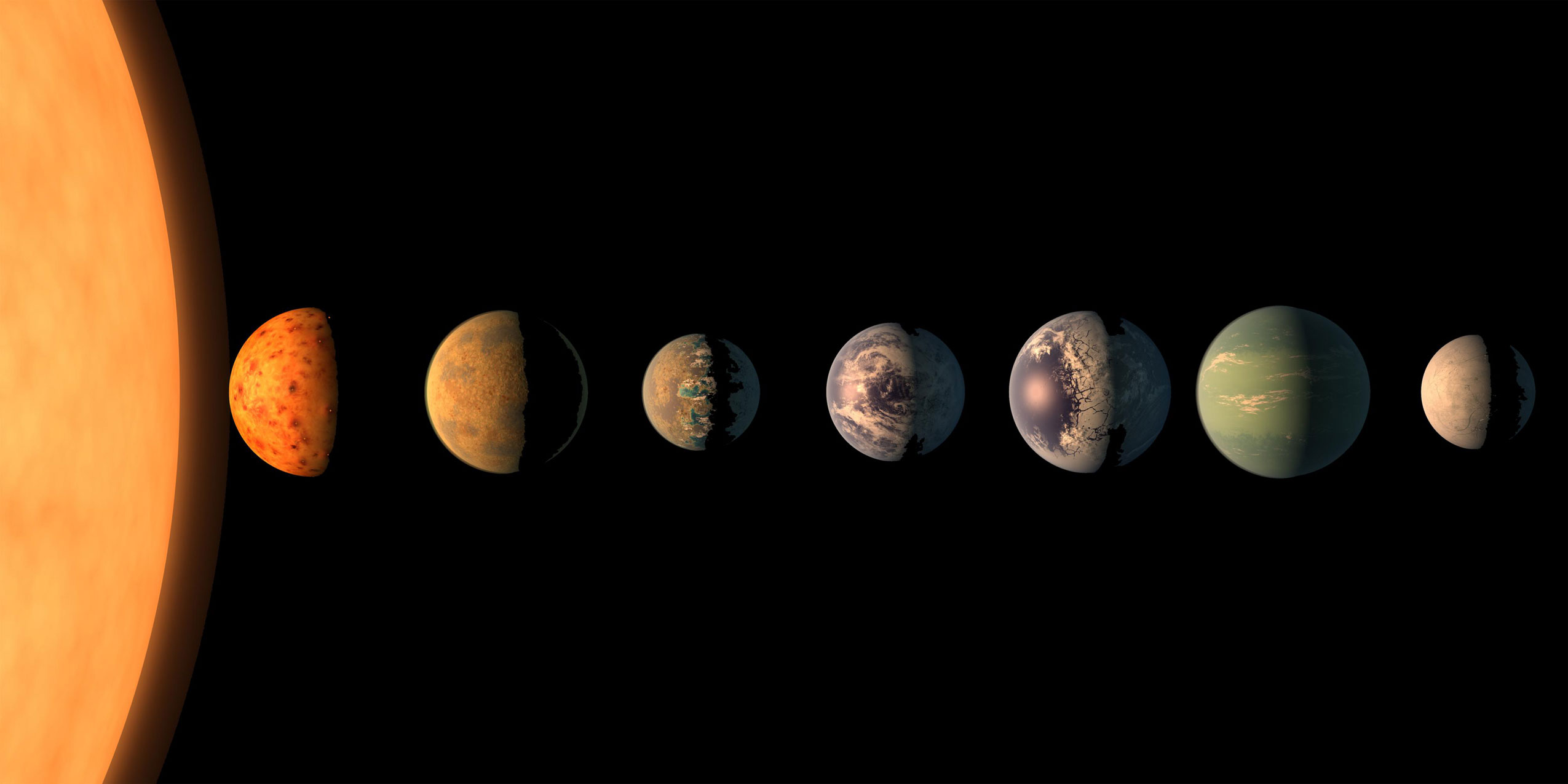
University of Chicago postdoctoral scholar Sebastiaan Krijt asks the question: If a life form existed on one of the TRAPPIST-1 planets, could space debris carry it to another?
NASA announced in February the discovery of the TRAPPIST-1 system – a solar system with seven planets – three of which were deemed potentially habitable. Following this discovery, Krijt and fellow University of Chicago astronomers conclude that life forms, such as bacteria or single-cell organisms, could travel through the newly discovered TRAPPIST-1 – an unusual solar system that presents an exciting new place in the Milky Way to search for extraterrestrial life. They published their research in Astrophysical Journal Letters.
“Frequent material exchange between adjacent planets in the tightly packed TRAPPIST-1 system appears likely,” said Krijt, the study’s lead author. “If any of those materials contained life, it’s possible they could inoculate another planet with life.”
For this to happen, an asteroid or comet would have to hit one of the planets, launching debris into space large enough to insulate the life form from the hazards of space travel. The material would have to be ejected fast enough to break away from the planet’s gravitational pull but not so fast that it would destroy the life form. And the journey would have to be relatively short so the life form could survive.
The team ran several simulations for TRAPPIST-1 and found that the process could occur over a period as short as 10 years. Most of the mass transferred between planets that would be large enough for life to endure irradiation during transfer and heat during re-entry would be ejected just above escape velocity, they concluded.
“Given that tightly packed planetary systems are being detected more frequently, this research will make us rethink what we expect to find in terms of habitable planets and the transfer of life—not only in the TRAPPIST-1 system, but elsewhere,” said Fred Ciesla, UChicago professor of geophysical sciences and a co-author of the paper. “We should be thinking in terms of systems of planets as a whole, and how they interact, rather than in terms of individual planets.”
Number of discovered exoplanets exploding
The first exoplanet, a planet orbiting a star other than the sun, was confirmed in 1992. Today, more than 3,600 exoplanet candidates have been discovered, with at least 3,000 additional candidates waiting to be confirmed. In addition, more than 600 multiple exoplanetary systems have been confirmed.
“The relatively new field of exoplanetology is exploding and being considered more seriously than ever,” Ciesla said. “If we took the solar system as a model, we could never have imagined the things we’re finding, such as the recent discovery of a planet that orbits two suns.”
The push now is not so much to discover new exoplanets but rather to characterize them, determine how they evolved and understand how they interact, Krijt said.
Exoplanetary systems serve as laboratories to help scientists comprehend the solar system, Ciesla said, noting that 40,000 tons of space debris fall to Earth each year. “Material from Earth must be floating around out there, too, and it’s conceivable that some of it might be carrying life. Some forms of life are very robust and could survive space travel.”
Reference: “Fast Litho-Panspermia in the Habitable Zone of the TRAPPIST-1 System” Sebastiaan Krijt, Timothy Bowling, Richard Lyons and Fred Ciesla, April 14, 2017, The Astrophysical Journal Letters.
DOI: 10.3847/2041-8213/aa6b9f
Never miss a breakthrough: Join the SciTechDaily newsletter.
Follow us on Google and Google News.
1 Comment
Fascinating! We are living in an astonishing new era!