
Close Menu
    Facebook X (Twitter) Instagram
    SciTechDaily
    • Biology
    • Chemistry
    • Earth
    • Health
    • Physics
    • Science
    • Space
    • Technology
    Facebook X (Twitter) Pinterest YouTube RSS
    SciTechDaily
    Home»Space»Cassini Completes Dive Between Saturn and Its Rings, Back in Contact with Astronomers
    Space

    Cassini Completes Dive Between Saturn and Its Rings, Back in Contact with Astronomers

    By Preston Dyches, Jet Propulsion LaboratoryApril 27, 20172 Comments4 Mins Read
    Facebook Twitter Pinterest Telegram LinkedIn WhatsApp Email Reddit
    Share
    Facebook Twitter LinkedIn Pinterest Telegram Email Reddit
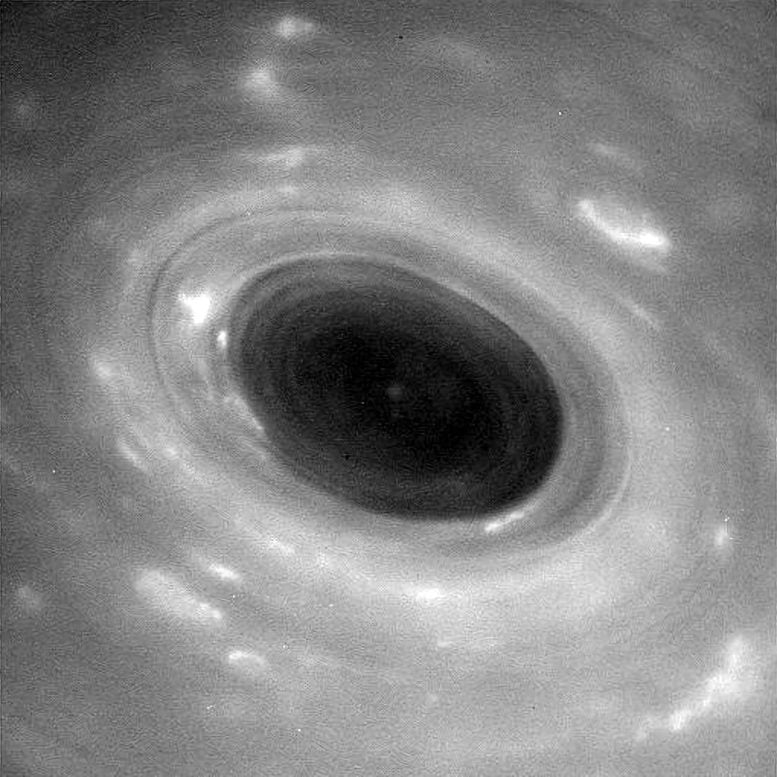
    NASA Spacecraft Dives Between Saturn and Its Rings
    This unprocessed image shows features in Saturn’s atmosphere from closer than ever before. The view was captured by NASA’s Cassini spacecraft during its first Grand Finale dive past the planet on April 26, 2017. Credit: NASA/JPL-Caltech/Space Science Institute

    NASA’s Cassini Spacecraft is back in contact with astronomers after completing its first-ever dive through the narrow gap between the planet Saturn and its rings. The spacecraft is in the process of beaming back science and engineering data collected during its passage, via NASA’s Deep Space Network Goldstone Complex in California’s Mojave Desert.

    “In the grandest tradition of exploration, NASA’s Cassini Spacecraft has once again blazed a trail, showing us new wonders and demonstrating where our curiosity can take us if we dare,” said Jim Green, director of the Planetary Science Division at NASA Headquarters in Washington.

    As it dove through the gap, Cassini came within about 1,900 miles (3,000 kilometers) of Saturn’s cloud tops (where the air pressure is 1 bar — comparable to the atmospheric pressure of Earth at sea level) and within about 200 miles (300 kilometers) of the innermost visible edge of the rings.
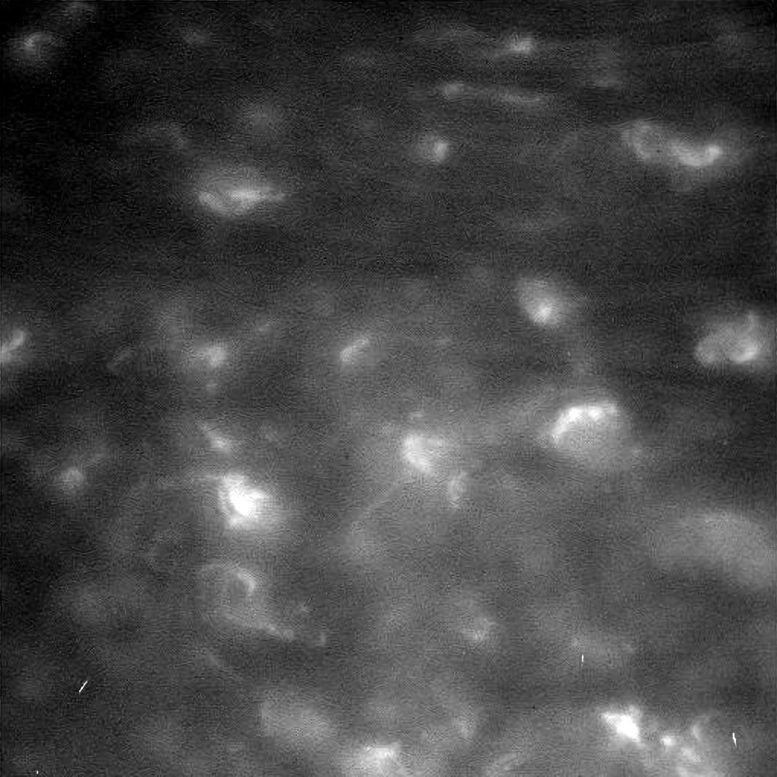
    Cassini Completes Dive Between Saturn and Its Rings
    This unprocessed image shows features in Saturn’s atmosphere from closer than ever before. The view was captured by NASA’s Cassini spacecraft during its first Grand Finale dive past the planet on April 26, 2017. Credit: NASA/JPL-Caltech/Space Science Institute

    While mission managers were confident Cassini would pass through the gap successfully, they took extra precautions with this first dive, as the region had never been explored.

    “No spacecraft has ever been this close to Saturn before. We could only rely on predictions, based on our experience with Saturn’s other rings, of what we thought this gap between the rings and Saturn would be like,” said Cassini Project Manager Earl Maize of NASA’s Jet Propulsion Laboratory in Pasadena, California. “I am delighted to report that Cassini shot through the gap just as we planned and has come out the other side in excellent shape.”
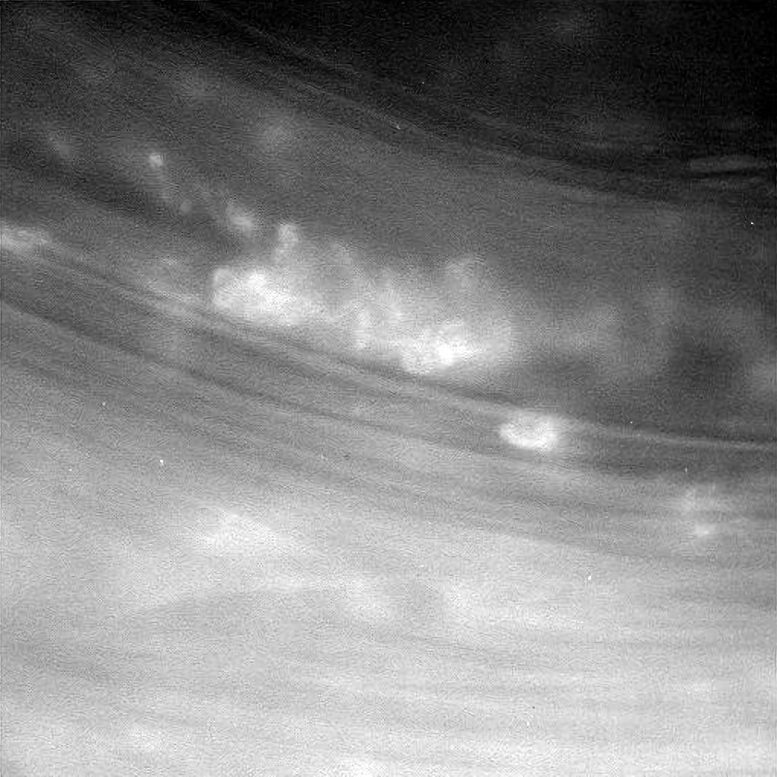
    NASA Cassini Spacecraft Dives Between Saturn and Its Rings
    This unprocessed image shows features in Saturn’s atmosphere from closer than ever before. The view was captured by NASA’s Cassini spacecraft during its first Grand Finale dive past the planet on April 26, 2017. Credit: NASA/JPL-Caltech/Space Science Institute

    The gap between the rings and the top of Saturn’s atmosphere is about 1,500 miles (2,000 kilometers) wide. The best models for the region suggested that if there were ring particles in the area where Cassini crossed the ring plane, they would be tiny, on the scale of smoke particles. The spacecraft zipped through this region at speeds of about 77,000 mph (124,000 kph) relative to the planet, so small particles hitting a sensitive area could potentially have disabled the spacecraft.


    After the first-ever dive through the narrow gap between the planet Saturn and its rings, NASA’s Cassini spacecraft called home to mission control at NASA’s Jet Propulsion Laboratory in Pasadena, California. See highlights from the scene at JPL on April 26-27, 2017, and some of the first raw images the spacecraft sent back from its closest-ever look at Saturn’s atmosphere.

    As a protective measure, the spacecraft used its large, dish-shaped high-gain antenna (13 feet or 4 meters across) as a shield, orienting it in the direction of oncoming ring particles. This meant that the spacecraft was out of contact with Earth during the ring-plane crossing, which took place at 2 a.m. PDT (5 a.m. EDT) on April 26. Cassini was programmed to collect science data while close to the planet and turn toward Earth to make contact about 20 hours after the crossing.

    Cassini’s next dive through the gap is scheduled for May 2.

    Never miss a breakthrough: Join the SciTechDaily newsletter.
    Follow us on Google and Google News.

    Astronomy Cassini-Huygens Mission Planetary Science Popular Saturn
    Share. Facebook Twitter Pinterest LinkedIn Email Reddit

    Related Articles

    New Cassini Image Shows Tethys Dwarfed by Saturn and Its Rings

    Cassini Views Water Jets from Enceladus

    Cassini Reveals a Gored Clump in Saturn’s F Ring

    Cassini Spacecraft to Begin Flyby of Saturn’s Moon Enceladus

    Cassini Reveals Global Ocean in Saturn’s Moon Enceladus

    Cassini Reveals Incomplete Cooling Down of Saturn’s A Ring at Solar Equinox

    Activity on Enceladus Could Be ‘Curtain Eruptions’

    Scientists Pinpoint the Position of Saturn

    Storm Spawns the Largest Tropospheric Vortex Ever Seen on Saturn

    2 Comments

    1. BSnow on April 27, 2017 1:13 pm

      Freaking the most amazing thing… why isn’t this the leading story in every news outlet in the world??? Not that there haven’t been other such freakin’ amazing similar things… but, are we all asleep? do people simply lack the knowledge to be able to appreciate this kind of amazing event?

      Reply
    2. Farhad mokhberi on April 29, 2017 1:28 am

      I’ve got to say in general that your site is amazing,i love it. I’m very very very thankful.

      Reply
    Leave A Reply Cancel Reply

    • Facebook
    • Twitter
    • Pinterest
    • YouTube

    Don't Miss a Discovery

    Subscribe for the Latest in Science & Tech!

    Trending News

    Massive Study Warns Marijuana Use in Teens Is Linked to Serious Mental Illness

    Scientists Discover a Completely Unexpected Way T Cells Kill Cancer

    Scientists Just Found the Solar System’s Original “Planet Factory”

    Study Warns Widely Used Food Preservatives Linked to High Blood Pressure and Heart Disease

    New Treatment Could Reverse Osteoarthritis Within Weeks

    Physicists Have Measured “Negative Time” in Bizarre Quantum Experiment

    The Deadly Tapeworm Spreading Across America Has Reached the Pacific Northwest

    Could Low Vitamin D Be Making Your Pain Worse?

    Follow SciTechDaily
    • Facebook
    • Twitter
    • YouTube
    • Pinterest
    • Newsletter
    • RSS
    SciTech News
    • Biology News
    • Chemistry News
    • Earth News
    • Health News
    • Physics News
    • Science News
    • Space News
    • Technology News
    Recent Posts
    • Scientists Discover Mysterious Creature Living in the Great Salt Lake – and It Exists Nowhere Else on Earth
    • It’s Alive? Surprising Discovery Changes What We Know About Fog
    • Simple Family Routines May Be the Secret to a Smoother Start at School
    • Brain Study Overturns Long-Held Beliefs About How Humans Learn Speech
    • Ancient Goose Fossil Challenges Long-Held Theories About New Zealand Birds
    Copyright © 1998 - 2026 SciTechDaily. All Rights Reserved.
    • Science News
    • About
    • Contact
    • Editorial Board
    • Privacy Policy
    • Terms of Use

    Type above and press Enter to search. Press Esc to cancel.