
Close Menu
    Facebook X (Twitter) Instagram
    SciTechDaily
    • Biology
    • Chemistry
    • Earth
    • Health
    • Physics
    • Science
    • Space
    • Technology
    Facebook X (Twitter) Pinterest YouTube RSS
    SciTechDaily
    Home»Space»Cassini Spacecraft Set to Dive Through the Gap Between Saturn and Its Rings
    Space

    Cassini Spacecraft Set to Dive Through the Gap Between Saturn and Its Rings

    By Preston Dyches, Jet Propulsion LaboratoryApril 26, 2017No Comments2 Mins Read
    Facebook Twitter Pinterest Telegram LinkedIn WhatsApp Email Reddit
    Share
    Facebook Twitter LinkedIn Pinterest Telegram Email Reddit
    Cassini Spacecraft Set to Make Its First Dive Through Saturn and Its Rings
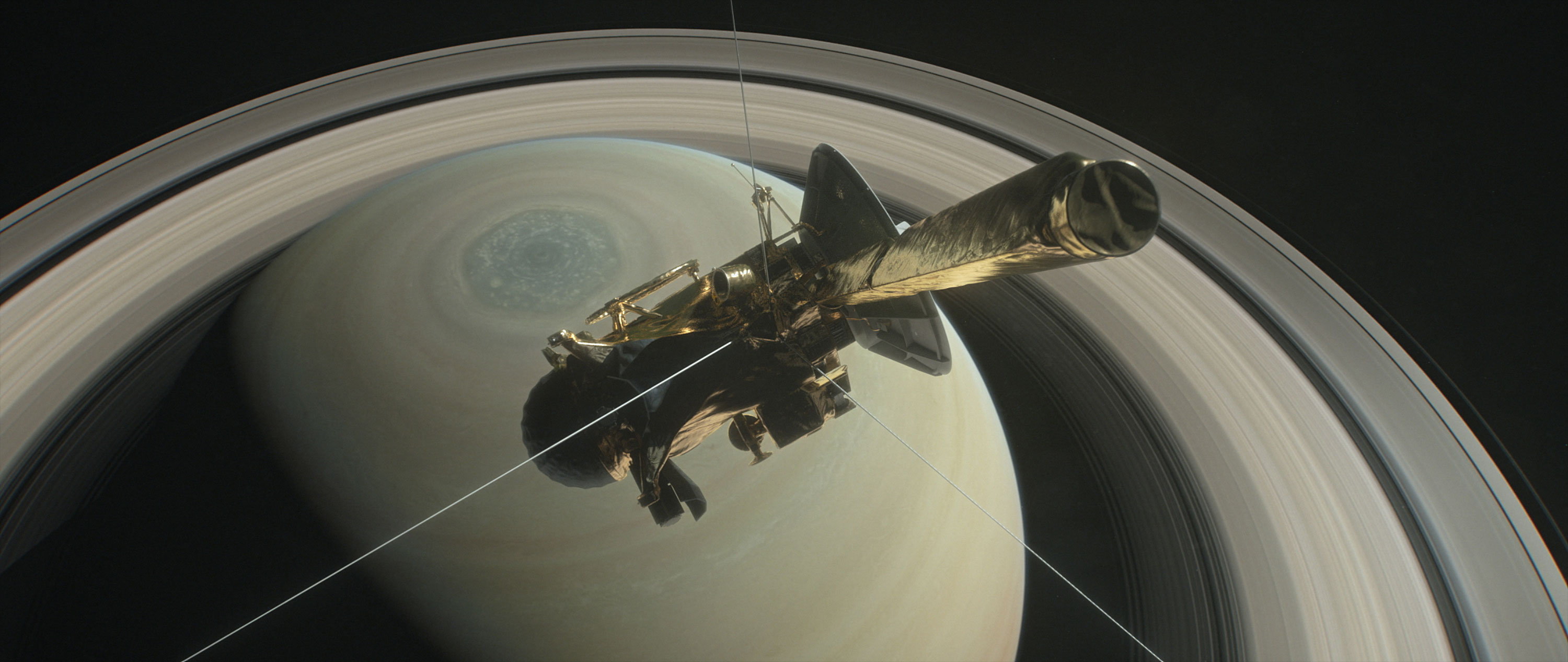
    This artist’s rendering shows NASA’s Cassini spacecraft above Saturn’s northern hemisphere, heading toward its first dive between Saturn and its rings on April 26, 2017.

    On April 26 NASA’s Cassini spacecraft will make its first dive through the narrow gap between Saturn and its rings. This is a region no spacecraft has ever explored – so Cassini will use its dish-shaped high-gain antenna (13 feet or 4 meters across) as a protective shield while passing through the ring plane. Astronomers expect no particles larger than smoke particles, but are taking the precautionary measure being that it is the first dive through this gap.

    The Cassini team will use data collected by one of the spacecraft’s science instruments (the Radio and Plasma Wave Subsystem, or RPWS) to ascertain the size and density of ring particles in the gap in advance of future dives. As a result of its antenna-forward orientation, the spacecraft will be out of contact with Earth during the dive.

    Below is a list of milestones expected to occur during the event, if all goes as planned:

    • 5 p.m. PDT (8 p.m. EDT) on April 25: Cassini is approaching Saturn over the planet’s northern hemisphere in advance of its first of 22 planned dives through the gap between the planet and its rings.
    • 1:34 a.m. PDT (4:34 a.m. EDT) on April 26: As it passes from north to south over Saturn, Cassini begins a 14-minute turn to point its high-gain antenna into the direction of oncoming ring particles. In this orientation, the antenna acts as a protective shield for Cassini’s instruments and engineering systems.
    • 2 a.m. PDT (5 a.m. EDT) on April 26: Cassini crosses the ring plane during its dive between the rings and Saturn. The spacecraft’s science instruments are collecting data, but Cassini is not in contact with Earth at this time.
    • No earlier than around midnight PDT on April 26 (3 a.m. EDT on April 27): Earth has its first opportunity to regain contact with Cassini as the giant, 230-foot (70-meter) Deep Space Network antenna at Goldstone, California, listens for the spacecraft’s radio signal.
    • Likely no earlier than 12:30 a.m. PDT (3:30 a.m. EDT) on April 27: Images are scheduled to become available from the spacecraft.

    As Cassini engineers monitor the status of the spacecraft, updates to these milestones will be added at: http://saturn.jpl.nasa.gov/grandfinale-milestones

    Never miss a breakthrough: Join the SciTechDaily newsletter.
    Follow us on Google and Google News.

    Astronomy Cassini-Huygens Mission Planetary Science Popular Saturn
    Share. Facebook Twitter Pinterest LinkedIn Email Reddit

    Related Articles

    New Cassini Image Shows Tethys Dwarfed by Saturn and Its Rings

    Cassini Views Water Jets from Enceladus

    Cassini Reveals a Gored Clump in Saturn’s F Ring

    Cassini Spacecraft to Begin Flyby of Saturn’s Moon Enceladus

    Cassini Reveals Global Ocean in Saturn’s Moon Enceladus

    Cassini Reveals Incomplete Cooling Down of Saturn’s A Ring at Solar Equinox

    Activity on Enceladus Could Be ‘Curtain Eruptions’

    Scientists Pinpoint the Position of Saturn

    Storm Spawns the Largest Tropospheric Vortex Ever Seen on Saturn

    Leave A Reply Cancel Reply

    • Facebook
    • Twitter
    • Pinterest
    • YouTube

    Don't Miss a Discovery

    Subscribe for the Latest in Science & Tech!

    Trending News

    Scientists Built a Programmable Chip That Can Slow Light on Command

    The Backyard “Silly Sprinkler” That Cracked One of Physics’ Biggest Puzzles

    This Common Sleep Habit Could Be Making You Gain Weight

    Mathematician Offers New Solution to a Fundamental Cosmic Paradox

    Scientists Turn Plastic Waste Into Clean Hydrogen Fuel

    Long COVID Brain Scans Reveal Damage to Dopamine Neurons

    Scientists Warn a Silent Oxygen Crisis Is Spreading Through Earth’s Waters

    James Webb Telescope Discovers Hidden Giant Planet in Famous Star System

    Follow SciTechDaily
    • Facebook
    • Twitter
    • YouTube
    • Pinterest
    • Newsletter
    • RSS
    SciTech News
    • Biology News
    • Chemistry News
    • Earth News
    • Health News
    • Physics News
    • Science News
    • Space News
    • Technology News
    Recent Posts
    • Scientists Discover Two Competing Memories in Matter
    • Quantum Heat Waves Spotted at Room Temperature for the First Time
    • Invisible Black Holes Could Be Triggering Supernovae
    • Scientists Test Natural Compounds Against Sarcoma: Which One Shows the Most Promise?
    • Singapore Has the World’s Longest, Healthiest Lives – but It Comes With a Hidden Cost
    Copyright © 1998 - 2026 SciTechDaily. All Rights Reserved.
    • Science News
    • About
    • Contact
    • Editorial Board
    • Privacy Policy
    • Terms of Use

    Type above and press Enter to search. Press Esc to cancel.