
Individual human neurons may be far more powerful computing units than previously understood.
Inside the human cortex, a single neuron may be doing far more than simply deciding whether to send a signal. New research suggests that one brain cell can carry out computations complex enough to rival the work of a deep artificial neural network.
That possibility changes where scientists might look for the origins of human abilities such as language, mathematics, imagination, and invention. Intelligence may depend not only on the enormous scale of the brain, but also on what each of its individual cells can accomplish.
For decades, researchers largely explained the brain’s power through its size and connectivity. The human brain contains close to 100 billion neurons, linked through a vast network. Research published in the Proceedings of the National Academy of Sciences (PNAS), however, indicates that the exceptional abilities of the human brain may also arise from the unusually sophisticated processing performed within individual neurons.
Intelligence may begin inside single neurons
Neurons from the human cortex, the brain’s outer layer involved in advanced thought, appear to function as unusually complex information processing units (“microchips”). Rather than merely collecting signals and producing a simple response, they can combine incoming information through intricate internal processes.
This possibility could help explain how the human cortex supports cognitive abilities that exceed those of other mammals. If each cell performs more computation, the brain gains additional processing power before information even moves through its wider network.
The research was led by Hebrew University Profs. Idan Segev and Mickey London, along with PhD students Ido Aizenbud and Daniela Yoeli at the Edmond and Lily Safra Center for Brain Sciences (ELSC). Prof. Chris de Kock of the Free University, Amsterdam, also collaborated on the work.
“People often think of a neuron as a simple switch that either turns on or off,” said Segev. “What we show is that a single human neuron is itself an extraordinarily sophisticated computing device.”
AI reveals each neuron’s computing power
The researchers first needed a consistent way to compare the computational abilities of neurons from different mammals. Simply examining a cell’s size or shape would not reveal how much information it could process.

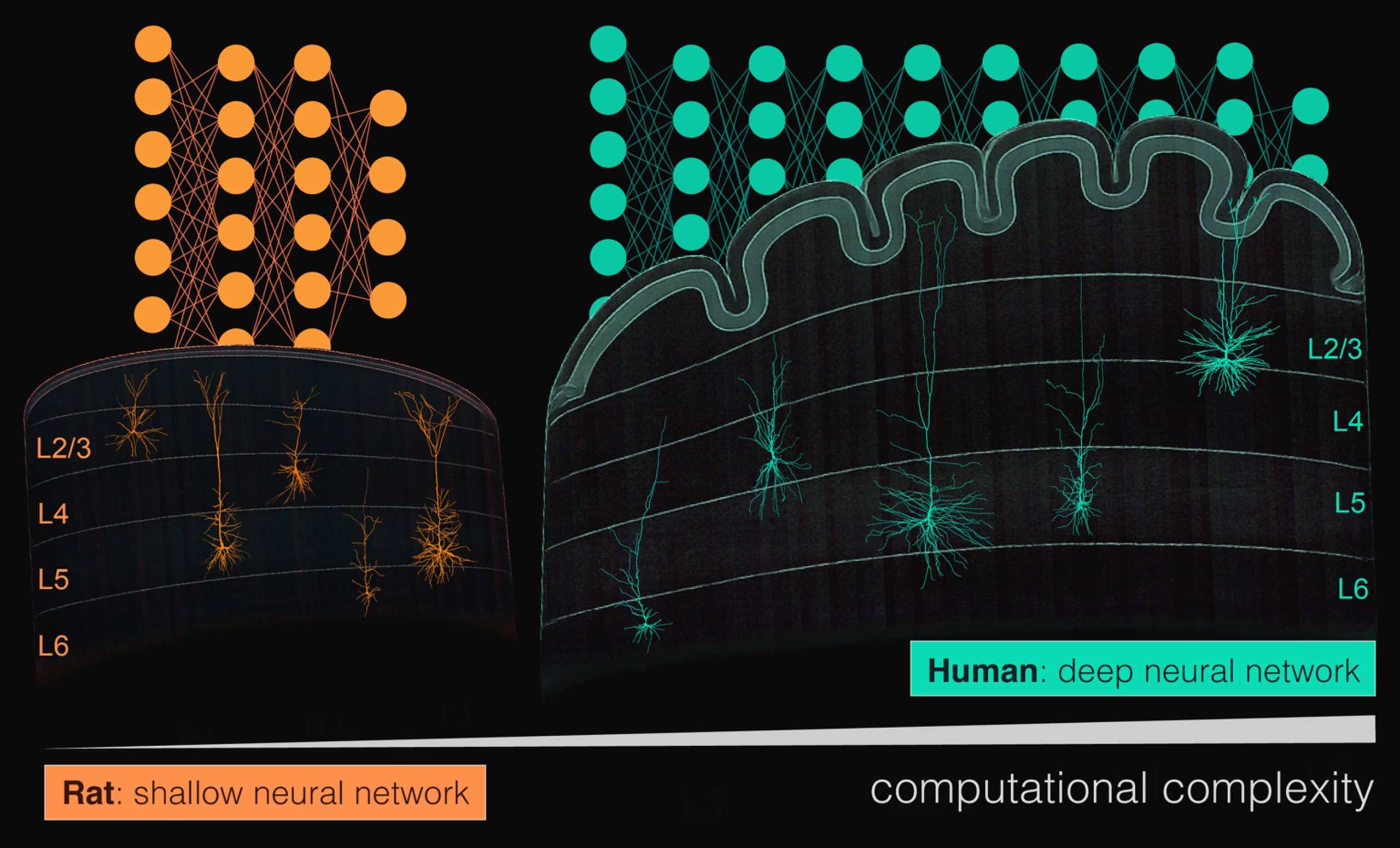
They approached the problem by building a digital imitator for each neuron. Using computer modeling and artificial intelligence, they tested how difficult it was for an artificial neural network (ANN) to learn the relationship between the signals entering a biological neuron and the response coming out.
A relatively simple neuron could be copied by a small artificial model. A more capable biological cell required a deeper and more elaborate network before the artificial version could reproduce its behavior accurately.
This imitation test gave the researchers a practical measure of neuronal complexity. The more difficult the neuron was to reproduce, the greater its apparent computational power.
Human neurons outperform other mammals
Human cortical neurons consistently required more complex artificial networks to imitate their behavior than neurons from other mammals. Their advantage appears to arise partly from their richly branched dendritic trees, the structures that receive signals from neighboring cells, and from their distinctive electrical characteristics.
Those features allow a neuron to analyze combinations of incoming signals instead of simply adding them together. In principle, this could support demanding distinctions within sensory information (e.g., distinguishing between images of cats versus dogs).
The results portray a human cortical neuron as much more than an “on-off” component. One cell can operate as a layered computing system with capabilities comparable to those of a deep neural network.

That conclusion challenges the long-standing assumption that human intelligence depends mainly on neuron count and the number of connections among cells. The sophistication built into individual neurons may also have contributed to the evolution of human cognition.
Smarter artificial neurons could reshape AI
The researchers also introduced a general framework for connecting the physical features of a neuron with the computations it can perform. That approach could help scientists investigate how cellular structure contributes to learning, thought, and other forms of cognition.
The findings may also influence the design of brain-inspired AI. Most current systems are assembled from highly simplified artificial units, even when the resulting networks contain many layers.
Future models could instead use artificial components with more processing ability inside each unit. Such systems would more closely resemble biological neurons and could offer a different path for developing state-of-the-art machine-learning technology.
Reference: “Dendritic morphology and synaptic nonlinearities enhance functional complexity in human cortical neurons” by Ido Aizenbud, Daniela Yoeli, David Beniaguev, Christiaan P. J. de Kock, Michael London and Idan Segev, 7 July 2026, Proceedings of the National Academy of Sciences.
DOI: 10.1073/pnas.2533168123
This work was supported by the Office of Naval Research Grant Award No. N00014-24-1-2055 and Grant Award No. N00014-23-1-2051.
Never miss a breakthrough: Join the SciTechDaily newsletter.
Follow us on Google and Google News.
6 Comments
Over a decade ago I attended a talk in which a scientist described the fine structure of a mouse neuron. They had sectioned it, took electron micrographs, and then assembled the images into a 3D model. He said there were all sorts of structures operating at the neuron, some firing at picosecond levels, such that we barely knew what neurons were doing.
Google reports that each human cell (most every kind of cell, not just brain cells) undergoes ~1,000,000 chemical reactions every second. Complexity in every cell, then.
Wow, the complexity of the neuron is incredible..anyone out there who still believes in evolution is literally clueless..unable to see truth displayed in front of them.. Glory to God
There’s no God
What physical reality (science) is their modeling of a single neuron based on? Hunches? Probes? Other models? Inquiring neurons want to know.
Very well written article! Thank you for sharing your findings.