
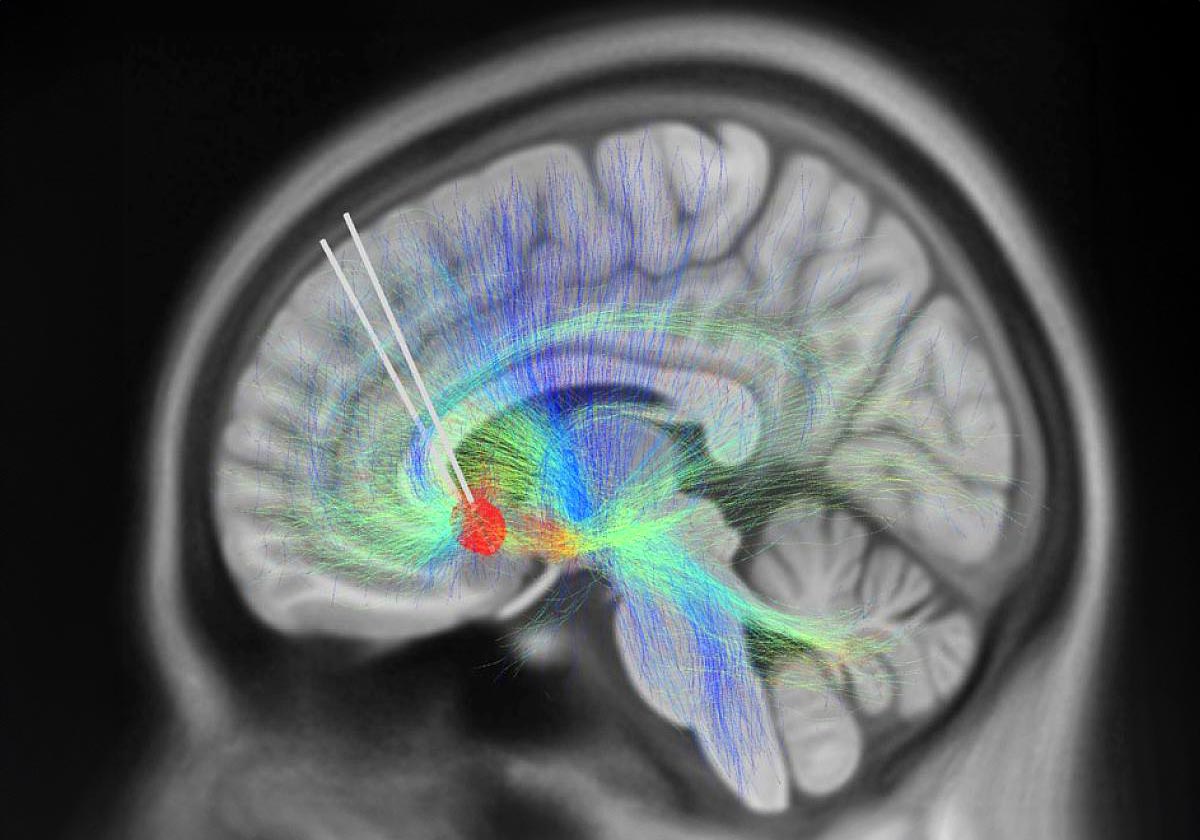
New deep brain stimulation device coupled with powerful AI may improve therapy for treatment-resistant depression.
Using a novel deep brain stimulation (DBS) device capable of recording brain signals, researchers have identified a pattern of brain activity or “biomarker” related to clinical signs of recovery from treatment-resistant depression. The findings from this small study are an important step towards using brain data to understand a patient’s response to DBS treatment. The study was published in Nature and supported by the National Institutes of Health’s Brain Research Through Advancing Innovative Neurotechnologies® Initiative, or The BRAIN Initiative®.
Clinical Application of DBS
Although the approach is still experimental, clinical research shows that DBS can be used safely and effectively to treat cases of depression in which symptoms have not improved with antidepressant medications, referred to as treatment-resistant depression. People receiving DBS undergo surgery to have a thin metal electrode implanted into specific brain areas to deliver electrical impulses that modulate brain activity. How exactly DBS improves symptoms in people with depression is not well understood, which has made it difficult for researchers to objectively track patients’ response to treatment and adjust as needed.
The small study enrolled 10 adults with treatment-resistant depression, all of whom underwent DBS therapy for six months. Each participant received the same stimulation dose to begin and then stimulation levels were increased once or twice. Later, researchers used artificial intelligence (AI) tools to analyze collected brain data from six patients and observed a common brain activity signature or biomarker that correlated with patients self-reporting feeling symptoms of depression or stable as they recovered. In one patient, researchers identified the biomarker and were retrospectively able to predict that a patient would fall back into a major depressive episode four weeks before clinical interviews showed they were at risk of a relapse occurring.
Refining DBS Therapy
“This study demonstrates how new technology and a data-driven approach can refine DBS therapy for severe depression, which can be debilitating,” said John Ngai, Ph.D., director of the BRAIN Initiative. “It’s this type of collaborative work made possible by the BRAIN Initiative that moves promising therapies closer to clinical use.”
In the study, patients received DBS targeting the subcallosal cingulate cortex (SCC), a brain region that regulates emotional behavior and is involved in feelings of sadness. DBS of the SCC is an emerging therapy that can provide stable, long-term relief from depressive symptoms for years. However, using DBS to treat depression remains challenging because each patient’s path to stable recovery looks different. Clinicians also must rely on subjective self-reports from patient interviews and psychiatric rating scales to track symptoms, which can fluctuate over time. This makes it hard to distinguish between normal mood variations and more serious situations requiring a tweak in stimulation. In addition, changes in symptoms in response to DBS can take weeks or months to occur, making it difficult to tell how well the therapy is working.
“This biomarker suggests that brain signals can be used to help understand a patient’s response to DBS treatment and adjust the treatment accordingly,” said Joshua A. Gordon, M.D., Ph.D., director of NIH’s National Institute of Mental Health. “The findings mark a major advance in translating a therapy into practice.”
Patient Response and Technology’s Role
The patients in the study responded well to DBS therapy; after six months, 90% showed a significant improvement in depression symptoms, and 70% were in remission or no longer depressed. This high response rate was a unique opportunity to look back and examine how each patient’s brain responded differently to the stimulation during treatment.
Christopher Rozell, Ph.D., Julian T. Hightower Chair and professor of electrical and computer engineering at Georgia Tech in Atlanta, and his colleagues used a technique called explainable artificial intelligence to understand these subtle changes in brain activity. The algorithm used brain data to distinguish between depressive versus stable recovery states and was able to explain what activity changes in the brain were the main drivers of this transition. Importantly, the biomarker also distinguished between normal day-to-day transient mood changes and sustained worsening symptoms. This algorithm could provide clinicians with an early warning signal that a patient is moving toward a highly depressive state and requires a DBS adjustment and extra clinical care.
Further Insights and Future Steps
“Nine out of 10 patients in the study got better, providing a perfect opportunity to use a novel technology to track the trajectory of their recovery,” said Helen Mayberg, M.D., director of the Nash Family Center for Advanced Circuit Therapeutics at Icahn Mount Sinai in New York City and co-senior author of the study. “Our goal is to identify an objective, neurological signal to help clinicians decide when, or when not, to make a DBS adjustment.”
“We showed that by using a scalable procedure with single electrodes in the same brain region and informed clinical management, we can get people better,” said Dr. Rozell, co-senior author of the study. “This study also gives us an amazing scientific platform to understand the variation between patients, which is key to treating complex psychiatric disorders like treatment-resistant depression.”
Further Insights and Future Steps
Next, the team analyzed data from MRI brain scans collected from patients before surgery. The results revealed structural and functional abnormalities in the specific brain network targeted by the DBS therapy. More severe white matter deficits were related to longer recovery times.
Researchers also used AI tools to analyze changes in facial expression extracted from videos of participant interviews. In a clinical setting, a patient’s facial expression can reflect the severity of their depression symptoms, a change that psychiatrists likely pick up on in routine clinical evaluations. They found patterns in individual patient expressions that coincided with their transition from illness to stable recovery. This could serve as an additional tool and new behavioral marker to track recovery in DBS therapy. More research is needed to determine whether the video analysis can reliably predict current and future disease states.
Both the observed facial expression changes and anatomical deficits correlated with cognitive states captured by the biomarker, supporting the use of this biomarker in managing DBS therapy for depression.
The research team, including Drs. Mayberg and Rozell, and Patricio Riva-Posse, M.D., at Emory University School of Medicine in Atlanta, is now confirming their findings in a second cohort of patients at Mount Sinai. Future studies will continue to explore the antidepressant effects of DBS by using a next-generation device to study the neural basis of moment-to-moment changes in mood.
According to the research team, this study represents a significant advance in early-stage DBS therapy for various mental disorders, including severe depression, obsessive-compulsive disorder, post-traumatic stress disorder, binge eating disorder, and substance use disorder. Other DBS studies have identified brain biomarkers for chronic pain, but using brain data to successfully treat patients is still under development.
For more on this research:
Reference: “Cingulate dynamics track depression recovery with deep brain stimulation” by Sankaraleengam Alagapan, Ki Sueng Choi, Stephen Heisig, Patricio Riva-Posse, Andrea Crowell, Vineet Tiruvadi, Mosadoluwa Obatusin, Ashan Veerakumar, Allison C. Waters, Robert E. Gross, Sinead Quinn, Lydia Denison, Matthew O’Shaughnessy, Marissa Connor, Gregory Canal, Jungho Cha, Rachel Hershenberg, Tanya Nauvel, Faical Isbaine, Muhammad Furqan Afzal, Martijn Figee, Brian H. Kopell, Robert Butera, Helen S. Mayberg and Christopher J. Rozell, 20 September 2023, Nature.
DOI: 10.1038/s41586-023-06541-3
The study was supported by the NIH BRAIN Initiative (UH3NS103550), the National Science Foundation, the Hope for Depression Research Foundation, and the Julian T. Hightower Chair at Georgia Tech.
Never miss a breakthrough: Join the SciTechDaily newsletter.
Follow us on Google and Google News.
4 Comments
I don’t even think a brain surgeon knows how the brain functions. Now, you want to insert a thin, silver plate in people’s brain? I’ve struggled with depression my whole life, and 20+ years ago I diagnosed myself with Tardive dyskinesia and akathisia. So, tell me, what is the actual percentage of this “thin plate” actually working? I doubt if any “practicing brain surgeon” would know, or even try, to answer my concern.
You seem to have forgotten a very important fact : this is Research. Second : it is not a “plate” of metal; it is 2 thin electrodes, i.e. rods. If you can’t even read an article correctly, why, on Earth, would you think you’re qualified to self diagnose??? EVEN DOCTORS, WHO ARE SMART, SEE ANOTHER DOCTOR WHEN THEY ARE ILL. You’re one of the many people who, since the development of the internet, seem to think that you’re as well equipped as a physician who has had years, and years, of medical school, aa couple of years of internship, and, usually, additional educational experience, or researchers, who, in most cases, have, at the very least, 1 ph.d because you’ve read an article- not even in a professional journal, but in a magazine or internet zine published for the masses, like this one, for example, or have looked up something on Wikipedia – the worst source available for information on absolutely anything!
You, clearly, didn’t notice that this is a Very small research study. It is not even close to being provided, clinically. These people are not you, my friend, they are at this stage because years of other research and education has come before this stage.
Also, how would you know what the average brain surgeon would say to your concern? Does you know any brain surgeons? Have you seen a neurologist? You seem to “self diagnose,” so me thinks you, most likely, would not answer most of my questions in the affirmative.
I understand what you’re going through, having suffered from severe, chronic, long term depression since my early 20s, so, if you’re interested in trying new treatments, you should subscribe to the NAMI newsletter in your area. I will say that some are better than others, but, hopefully, yours is good – honestly, some small or rural areas will surprise you with how good they are. The newsletter will tell you all the latest information on treatments, as well as give you any information on research/studies, in case you might want to participate. It’s been very helpful to me. It’s, generally for families, treatment providers of those with mental illness, but I have found it to be a great resource for information. It refers to us as “consumers” of treatments, for example, but I think you’re probable able to read and understand it, obviously. NAMI stands for the National Alliance of the Mentally Ill, which is why, in my opinion, it’s strange that it isn’t, specifically, for us “consumers,” but I think it’s because many people who are severely mentally ill, i.e. schizophrenic, etc., might have a hard time processing it…? I don’t know, other than that, why it would be.
Sandy, I do apologize for sounding snarky in my response. That was not my intent, and sounds unkind. I apologize. I Definitely should have, at least, scanned it before posting.
I hope the NAMI information will be of some help… I genuinely do know what you’re going through.
I hope it gets better, for both of us – somehow.
Sandy, I do apologize for sounding snarky in my response. That was not my intent, and sounds unkind. I apologize. I Definitely should have, at least, scanned it before posting.