
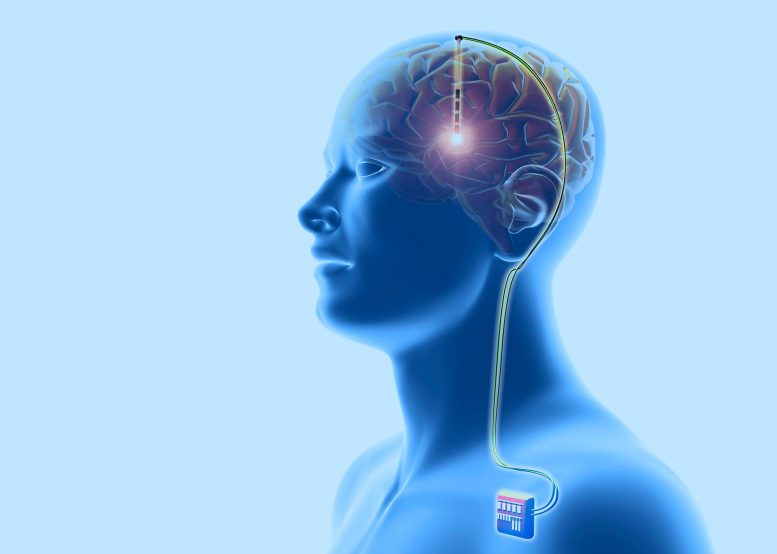
A study to be published online on Friday, October 4, 2019, in the American Journal of Psychiatry found that deep brain stimulation (DBS) of an area in the brain called the subcallosal cingulate (SCC) provides a robust antidepressant effect that is sustained over a long period of time in patients with treatment-resistant depression—the most severely depressed patients who have not responded to other treatments.
The long-term data presented in this study, conducted at Emory University and led by Helen S. Mayberg, MD, now Professor of Neurology, Neurosurgery, Psychiatry, and Neuroscience, and Founding Director of the Nash Family Center for Advanced Circuit Therapeutics at the Icahn School of Medicine at Mount Sinai, validates earlier work conducted by the research team and lays the foundation for additional studies to refine and optimize DBS for these patients.
Deep brain stimulation, currently approved by the U.S. Food and Drug Administration to treat essential tremor, Parkinson’s disease, epilepsy, and obsessive-compulsive disorder, is a neurosurgical procedure involving the placement of a neurostimulator (sometimes referred to as a “brain pacemaker”), which sends high-frequency electrical impulses through implanted electrodes deep in the brain to specific brain areas responsible for the symptoms of each disorder.
Dr. Mayberg led the first trial of DBS of the subcallosal cingulate white matter, known as Brodmann Area 25, for treatment-resistant depression patients in 2005, demonstrating that it could have clinical benefit. Subsequent small open-label trials produced similarly favorable results, yet despite these encouraging open-label results, a multi-center, randomized trial was halted early due to a lack of statistically significant antidepressant response at the designated, six-month a priori time point.
“Despite the fact that larger trials were halted early, what my colleagues and I were seeing as we continued to follow patients from our initial trials was that over time, they were getting better, and not only that, they were staying better. So we stayed the course,” says Dr. Mayberg. “Over eight years of observation, most of our study participants experienced an antidepressant response to the deep brain stimulation of Area 25 that was robust and sustained. Given that patients with treatment-resistant depression are highly susceptible to recurrent depressive episodes, the ability of DBS to support long-term maintenance of antidepressant response and prevention of relapse is a treatment advance that can mean the difference between getting on with your life or always looking over your shoulder for your next debilitating depressive episode.”
Specifically, the study documents the long-term outcome data (4-8 years) for 28 patients who were enrolled in an open-label clinical trial of SCC DBS for treatment-resistant depression. Response and remission rates were maintained at or above 50 percent and 30 percent, respectively, through years 2-8 of the follow-up period. Three-quarters of all participants met the treatment response criterion for more than half of their participation in the study, with 21 percent of all participants demonstrating continuous response to treatment from the first year forward. Of 28 participants, 14 completed at least eight years of follow-up, 11 others completed at least four years, and three dropped out prior to eight years of participation. Data presented through this study support the long-term safety and sustained efficacy of SCC DBS for treatment-resistant depression.
“While clinical trials generally are structured to compare active and placebo treatments over the short term, our research results suggest that the most important strength of DBS in this hard-to-treat clinical population lies in its sustained effects over the long term,” says Andrea Crowell, MD, Assistant Professor of Psychiatry and Behavioral Health Sciences at Emory University School of Medicine. “For people suffering from inescapable depression, the possibility that DBS can lead to significant and sustained improvement in depressive symptoms over several years will be welcome news.”
All study participants met the criteria for either major depressive disorder or bipolar disorder type 2 and were in a current depressive episode of at least 12 months duration with non-response to at least four antidepressant treatments, psychotherapy, and electroconvulsive therapy. All study participants underwent SCC DBS surgery at Emory University School of Medicine with the same surgeon and received the same device. The first 17 participants were implanted between 2007-2009 in an open-label trial with a one-month, single-blind, stimulation-off, lead-in period. An additional 11 participants with major depressive disorder were implanted using tractography-guided anatomical targeting between 2011 and 2013. A total of 178 patient-years of data were collected and combined for analysis in this long-term follow-up study. Participants were seen by a study psychiatrist weekly for 32 weeks, starting at least four weeks prior to surgery. Visits were then tapered to every six months for years 2-8 of the study. Currently, 23 patients continue in long-term follow-up.
“At the Center for Advanced Circuit Therapeutics at Mount Sinai, we are currently gearing up for the next phase of this research, now funded by the National Institutes of Health Brain Initiative. Our new study will recruit treatment-resistant depression patients, as before, but they will be implanted with a new research prototype DBS system (Summit RC+S) that allows simultaneous recordings of brain activity directly from the site of stimulation during active DBS therapy. Advanced imaging, behavioral, and physiological assessments will also be performed at regular intervals in the lab. These studies will provide an unprecedented opportunity to monitor the trajectory of recovery over days, weeks, and months at the neural level,” says Dr. Mayberg. “Building on preliminary findings from Emory, we anticipate that these brain signatures will provide important new insights into DBS mechanisms and, importantly, will help guide future decisions about DBS management that can further optimize clinical outcomes in our patients.”
###
Reference: “Long-Term Outcomes of Subcallosal Cingulate Deep Brain Stimulation for Treatment-Resistant Depression” by Andrea L. Crowell , M.D., Patricio Riva-Posse , M.D., Paul E. Holtzheimer , M.D., Steven J. Garlow , M.D., Ph.D., Mary E. Kelley , Ph.D., Robert E. Gross , M.D., Ph.D., Lydia Denison , B.S., Sinead Quinn , B.S. and Helen S. Mayberg , M.D., 4 October 2019, American Journal of Psychiatry.
DOI: 10.1176/appi.ajp.2019.18121427
This study was supported by the Hope for Depression Research Foundation, the Dana Foundation, the Stanley Medical Research Foundation, and the Woodruff Fund with research DBS devices donated by St. Jude Medical Neuromodulation (now Abbott Labs) under an FDA-registered, physician-sponsored investigational device exemption.
Dr. Mayberg received consulting and intellectual licensing fees from St. Jude Medical, Inc. (now Abbott Neuromodulation).
Never miss a breakthrough: Join the SciTechDaily newsletter.
Follow us on Google and Google News.