
Researchers discover non-invasive stimulation of the eye for depression and dementia.
Scientists have discovered that the electrical stimulation of the eye surface can alleviate depression-like symptoms and improve cognitive function in animal models. These significant findings by a joint research team from the LKS Faculty of Medicine, The University of Hong Kong (HKUMed), and City University of Hong Kong (CityU) were recently published in Brain Stimulation and the Annals of the New York Academy of Sciences.
Background
Major depression is the most prevalent severe psychiatric disorder around the world. Recently, the World Health Organization (WHO) reported that the COVID-19 pandemic had triggered a massive surge in the number of people with depression and anxiety. Approximately 25 percent of patients do not respond adequately to currently available treatments.
In 2015, Dr. Lim Lee Wei, Assistant Professor in the School of Biomedical Sciences, HKUMed, and a former Lee Kuan Yew Research Fellow in Singapore, reported that deep brain stimulation of the prefrontal cortex in the brains of animals could relieve depressive symptoms and improve memory function. These therapeutic effects were attributed to the growth of brain cells in the hippocampus, a region of the brain known to be involved in learning and memory function. However, this technique, also known as deep brain stimulation, is invasive and requires surgery to implant electrodes inside the brain, which may cause significant side effects such as infections and other post-operative complications.
Research Findings and Significance
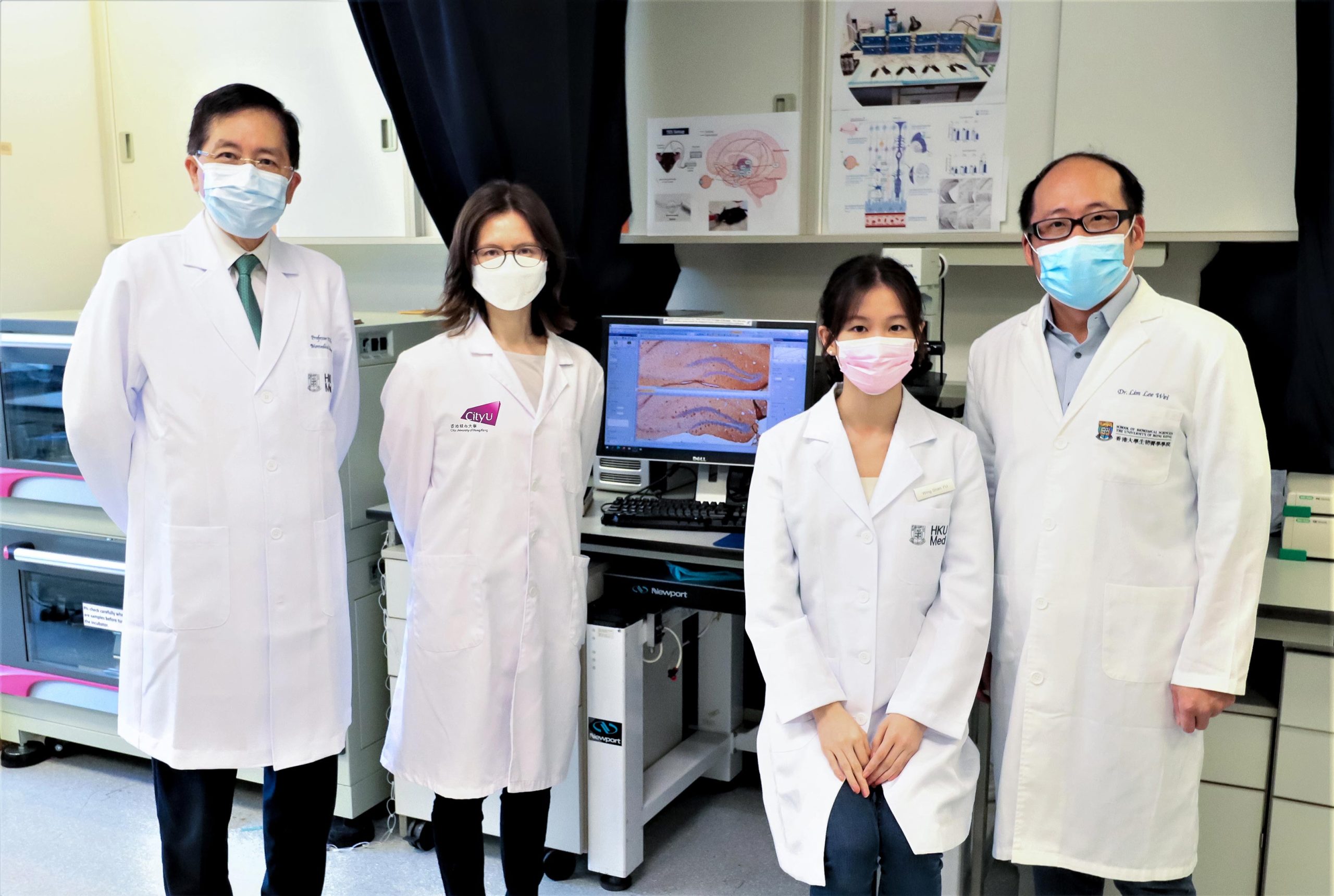
A team of Hong Kong researchers has been looking for alternative ways to treat neuropsychiatric diseases. They discovered that the non-invasive stimulation of the corneal surface of the eye (known as transcorneal electrical stimulation, or TES) that activates brain pathways, resulted in remarkable antidepressant-like effects and reduced stress hormones in an animal model for depression. Furthermore, this technique also induced the expression of genes involved in the development and growth of brain cells in the hippocampus. This team of researchers is headed by Dr. Lim Lee Wei; Dr. Leanne Chan Lai-hang, Associate Professor in the Department of Electrical Engineering, CityU; Professor Chan Ying-shing, Dexter H C Man Family Professor in Medical Science, Professor of the School of Biomedical Sciences, Associate Dean (Development and Infrastructure), HKUMed, and Director of the Neuroscience Research Centre, HKU.
In related experiments, Yu Wing-shan, PhD student, and other research members from the School of Biomedical Sciences, HKUMed, investigated whether this approach could be used to treat Alzheimer’s disease, a common type of dementia with no definitive cure. They found that this non-invasive stimulation in mice drastically improved memory performance and reduced beta-amyloid deposits in the hippocampus, which is one of the hallmarks of Alzheimer’s disease.
Dr. Leanne Chan Lai-hang, an expert on the electrical stimulation of visual and non-visual brain targets, described this research, “Transcorneal electrical stimulation is a non-invasive method initially developed to treat eye diseases, and it would be a major scientific breakthrough if it could be applied to treat neuropsychiatric diseases.”
“These research findings pave the way for new therapeutic opportunities to develop novel treatment for patients suffering from treatment-resistant depression and dementia. Nevertheless, clinical trials must be conducted to validate the efficacy and safety,” remarked Professor Chan Ying-shing.
About the Research Team
The research was led by Dr. Lim Lee Wei, Assistant Professor of the School of Biomedical Sciences, HKUMed and a former Lee Kuan Yew Research Fellow in Singapore; Dr. Leanne Chan Lai-hang, Associate Professor in the Department of Electrical Engineering, CityU; Professor Chan Ying-shing, Dexter H C Man Family Professor in Medical Science, Professor of the School of Biomedical Sciences, Associate Dean (Development and Infrastructure), HKUMed, and Director of the Neuroscience Research Center, HKU; and conducted at the Neuromodulation Laboratory at HKU in collaboration with CityU at the Neural Interface Research Laboratory. Yu Wing-shan was the main researcher. She is a recipient of a prestigious Hong Kong PhD Fellowship, awarded by the Hong Kong Research Grants Council.
Acknowledgments
These scientific works were supported by the General Research Fund of the Hong Kong Research Grants Council (No. 17119420, and No. 11208218), the Fund for Basic Research (No. 201811159133 and No. 201910159163), and for Translational and Applied Research, No. 201910160010); and the Strategic Research Fund at CityU (No. 7005632).
References:
“Antidepressant-like effects of transcorneal electrical stimulation in rat models” by Wing Shan Yu, Anna Chung-Kwan Tse, Li Guan, Jennifer Lok Yu Chiu, Shawn Zheng Kai Tan, Sharafuddin Khairuddin, Stephen Kugbere Agadagba, Amy Cheuk Yin Lo, Man-Lung Fung, Ying-Shing Chan, Leanne Lai Hang Chan and Lee Wei Lim, 27 May 2022, Brain Stimulation.
DOI: 10.1016/j.brs.2022.05.018
“Transcorneal electrical stimulation enhances cognitive functions in aged and 5XFAD mouse models” by Wing Shan Yu, Luca Aquili, Kah Hui Wong, Amy Cheuk Yin Lo, Leanne Lai Hang Chan, Ying-Shing Chan and Lee Wei Lim, 25 June 2022, New York Academy of Sciences.
DOI: 10.1111/nyas.14850
Never miss a breakthrough: Join the SciTechDaily newsletter.
Follow us on Google and Google News.
3 Comments
Yeah. Yeah. And the rats can tell you what they think of you, and even sue. Right?
Carve on my ear, and I could get bored waiting for you to finish up already. Get anywhere near my eye, you got a fight on your hands. And I’m not playing.
Considering the eye is one of many senses that absorbs information i could see how this does have potential.
However there are other factors to take into consideration when treating a mental illness such as depression simply stimulating one part of the brain probably will not fully correct a chemical in balance but it could possibly help to raise dopamine and serotonin levels to an equal level.
As for a treatment for dementia could work but there is a lot to consider once again. Really would like to see this come to fruition and become a successful way to treat or at least help reduce certain mental illnesses.
Through out medical history a lot of other treatments have been accidently discovered simply because the original treatment targeted a certain aliment and wound up working on something else.
So who knows. Maybe this will work for what it is designed to do or maybe it will work on something else or maybe both.
Like.these.do.contunulyi.llease.do.always.study.rearch.etc.akram.