
Close Menu
    Facebook X (Twitter) Instagram
    SciTechDaily
    • Biology
    • Chemistry
    • Earth
    • Health
    • Physics
    • Science
    • Space
    • Technology
    Facebook X (Twitter) Pinterest YouTube RSS
    SciTechDaily
    Home»Space»Massive Filaments Connect Galaxies and Fuel the Growth of Supermassive Black Holes
    Space

    Massive Filaments Connect Galaxies and Fuel the Growth of Supermassive Black Holes

    By RIKENOctober 3, 2019No Comments4 Mins Read
    Facebook Twitter Pinterest Telegram LinkedIn WhatsApp Email Reddit
    Share
    Facebook Twitter LinkedIn Pinterest Telegram Email Reddit
    Computer Simulation of Filaments
    Frame from a movie of a massive galaxy cluster from the C-EAGLE simulation, providing a view of a region comparable to the one where the filaments have been detected. The color map represents the same emission from the gas filaments as the one detected in observations. At the convergence of these filaments, a massive cluster of galaxy is assembling. Credit: Joshua Borrow using C-EAGLE

    An international group of scientists led by the RIKEN Cluster for Piolneering Research have used observations from the Multi Unit Spectroscopic Explorer (MUSE) at the ESO Very Large Telescope (VLT) in Chile and the Suprime-Cam at the Subaru telescope to make detailed observations of the filaments of gas connecting galaxies in a large, distant proto-cluster in the early Universe. Based on direct observations they found that, in accordance with the predictions of the cold dark matter model of galaxy formation, the filaments are extensive, extending over more than 1 million parsecs—a parsec being just over three light-years—and are providing the fuel for the intense formation of stars and the growth of supermassive black holes within the proto-cluster.

    The observations, which constitute a very detailed map of the filaments, were made on SSA22, a massive proto-cluster of galaxies located about 12 billion light-years away in the constellation of Aquarius, making it a structure of the very early universe.
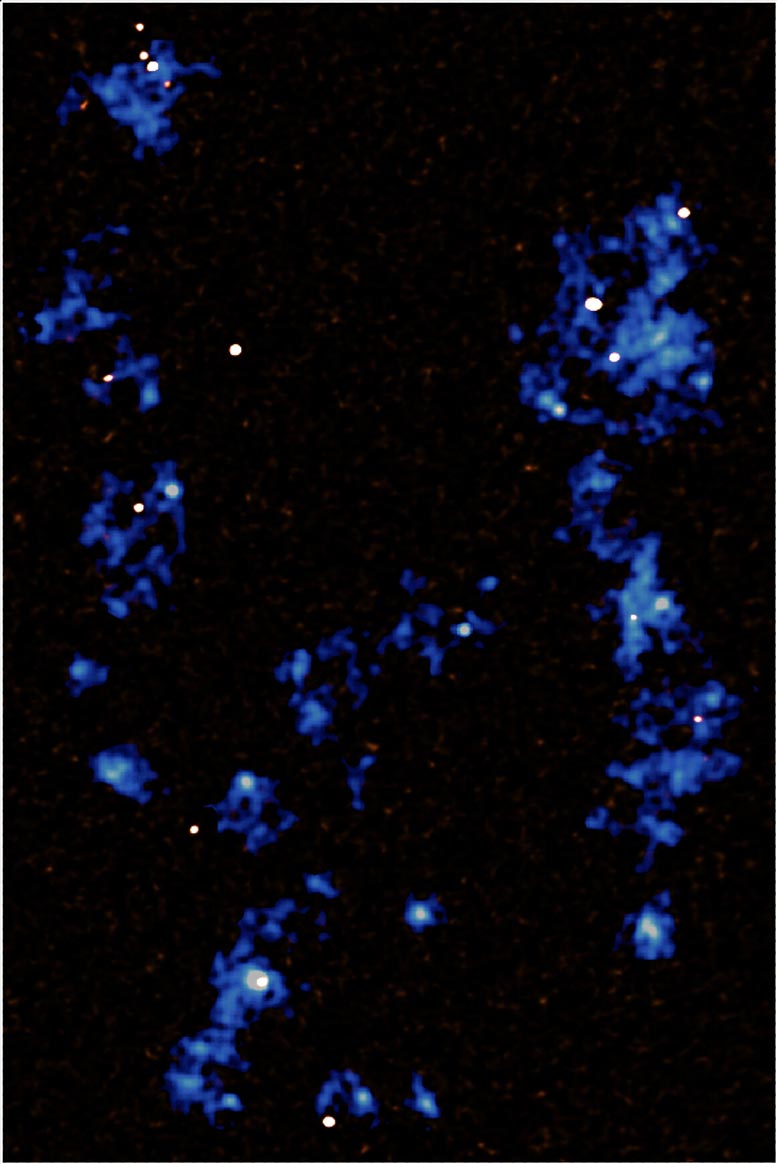
    Map Showing the Gas Filaments
    Map showing the gas filaments (blue) running from the top to the bottom of the image, detected using the MUSE instrument at the Very Large Telescope. The white dots embedded within these filaments are very active star forming galaxies which are being fed by the filaments, and which are detected using the Atacama Large Millimeter/submillimeter array. Credit: Hideki Umehata

    The findings, published in Science, give new insights into galaxy formation. The dominant belief at one time was that galaxies formed and then organized into clusters, in a bottom-up way, but now it is generally believed that filaments in the universe fueled the formation of clusters of galaxies and galaxies at places where the filaments crossed, creating dense regions of matter. In accordance with this, the group found that the intersection between the enormous filaments they identified is home to active galactic nuclei—supermassive black holes—and “starbursting” galaxies that have very active star formation. They determine their location from observations made with the Atacama Large Millimeter/submillimeter Array (ALMA) and the W. M. Keck Observatory.

    Their observations are based on the detection of what is known as Lyman alpha radiation—ultraviolet light that is produced when neutral hydrogen gas is ionized and then returns to its ground state—using the MUSE instrument. The radiation was found to be intense—too high to be from the ultraviolet background radiation of the universe. Their calculations indicated that the high radiation was likely triggered by star-forming galaxies and forming black holes.

    According to Hideki Umehata of the RIKEN Cluster for Pioneering Research and the University of Tokyo, the first author of the paper, “This suggests very strongly that gas falling along the filaments under the force of gravity triggers the formation of starbursting galaxies and supermassive black holes, giving the universe the structure that we see today.”

    “Previous observations,” he continues, “had shown that there were emissions from blobs of gas extending beyond the galaxies, but now we have been able to clearly show that these filaments are extremely long, going even beyond the edge of the field that we viewed. This adds credence to the idea that these filaments are actually powering the intense activity that we see within the galaxies inside the filaments.”

    Co-author Michele Fumagalli from Durham University, UK, said: “It is very exciting to clearly see for the first time multiple and extended filaments in the early universe. We finally have a way to map these structures directly, and to understand in detail their role in regulating the formation of supermassive black holes and galaxies.”

    For more on this study, read Faint Filaments of the Cosmic Web Revealed by Glowing Gas.

    Reference: “Gas filaments of the cosmic web located around active galaxies in a protocluster” by H. Umehata, M. Fumagalli, I. Smail, Y. Matsuda, A. M. Swinbank, S. Cantalupo, C. Sykes, R. J. Ivison, C. C. Steidel, A. E. Shapley, J. Vernet, T. Yamada, Y. Tamura, M. Kubo, K. Nakanishi, M. Kajisawa, B. Hatsukade and K. Kohno, 4 October 2019, Science.
    DOI: 10.1126/science.aaw5949

    The work was done by the RIKEN Cluster for Pioneering Research along with collaborators from the University of Tokyo, Durham University in the UK, National Astronomical Observatory of Japan, Nagoya University, and other institutes.

    Never miss a breakthrough: Join the SciTechDaily newsletter.
    Follow us on Google and Google News.

    ALMA Astrophysics Black Hole Dark Matter MUSE Popular RIKEN Subaru Telescope
    Share. Facebook Twitter Pinterest LinkedIn Email Reddit

    Related Articles

    Earliest Gigantic Black Hole Storm Ever Discovered – Supermassive Black Hole a Telltale Sign About Very Early History of the Universe

    All Dark Matter in the Universe Could Be Primordial Black Holes – Formed From the Collapse of Baby Universes Soon After the Big Bang

    Astronomers Unexpected Discovery Could Explain Supermassive Black Hole Growth in Early Universe

    Black Holes Only Contain Small Percentage of the Universe’s Dark Matter

    ALMA Observes a Black Hole Producing Star-Making Fuel

    NASA Astronomer Reveals Possible Link Between Primordial Black Holes and Dark Matter

    New Discovery Challenges Dark Matter, Stellar Acceleration Models

    Dark Matter Influences Supermassive Black Hole Growth

    Subaru Telescope Reveals Active Supermassive Black Holes in Merging Galaxies

    Leave A Reply Cancel Reply

    • Facebook
    • Twitter
    • Pinterest
    • YouTube

    Don't Miss a Discovery

    Subscribe for the Latest in Science & Tech!

    Trending News

    Breakthrough Bowel Cancer Trial Leaves Patients Cancer-Free for Nearly 3 Years

    Natural Compound Shows Powerful Potential Against Rheumatoid Arthritis

    100,000-Year-Old Neanderthal Fossils in Poland Reveal Unexpected Genetic Connections

    Simple “Gut Reset” May Prevent Weight Gain After Ozempic or Wegovy

    2.8 Days to Disaster: Scientists Warn Low Earth Orbit Could Suddenly Collapse

    Common Food Compound Shows Surprising Power Against Superbugs

    5 Simple Ways To Remember More and Forget Less

    The Atomic Gap That Could Cost the Semiconductor Industry Billions

    Follow SciTechDaily
    • Facebook
    • Twitter
    • YouTube
    • Pinterest
    • Newsletter
    • RSS
    SciTech News
    • Biology News
    • Chemistry News
    • Earth News
    • Health News
    • Physics News
    • Science News
    • Space News
    • Technology News
    Recent Posts
    • Scientists Discover Stem Cells That Could Regrow Teeth and Bone
    • Scientists Discover Natural Molecule That Stops Alzheimer’s Protein Clumps From Forming
    • Early Cannabis Use May Stall Key Brain Skills in Teens
    • Popular Vitamin D Supplement Has “Previously Unknown” Negative Effect, Study Finds
    • Powerful Antioxidant Found To Play a Key Role in Proper Protein Folding
    Copyright © 1998 - 2026 SciTechDaily. All Rights Reserved.
    • Science News
    • About
    • Contact
    • Editorial Board
    • Privacy Policy
    • Terms of Use

    Type above and press Enter to search. Press Esc to cancel.