
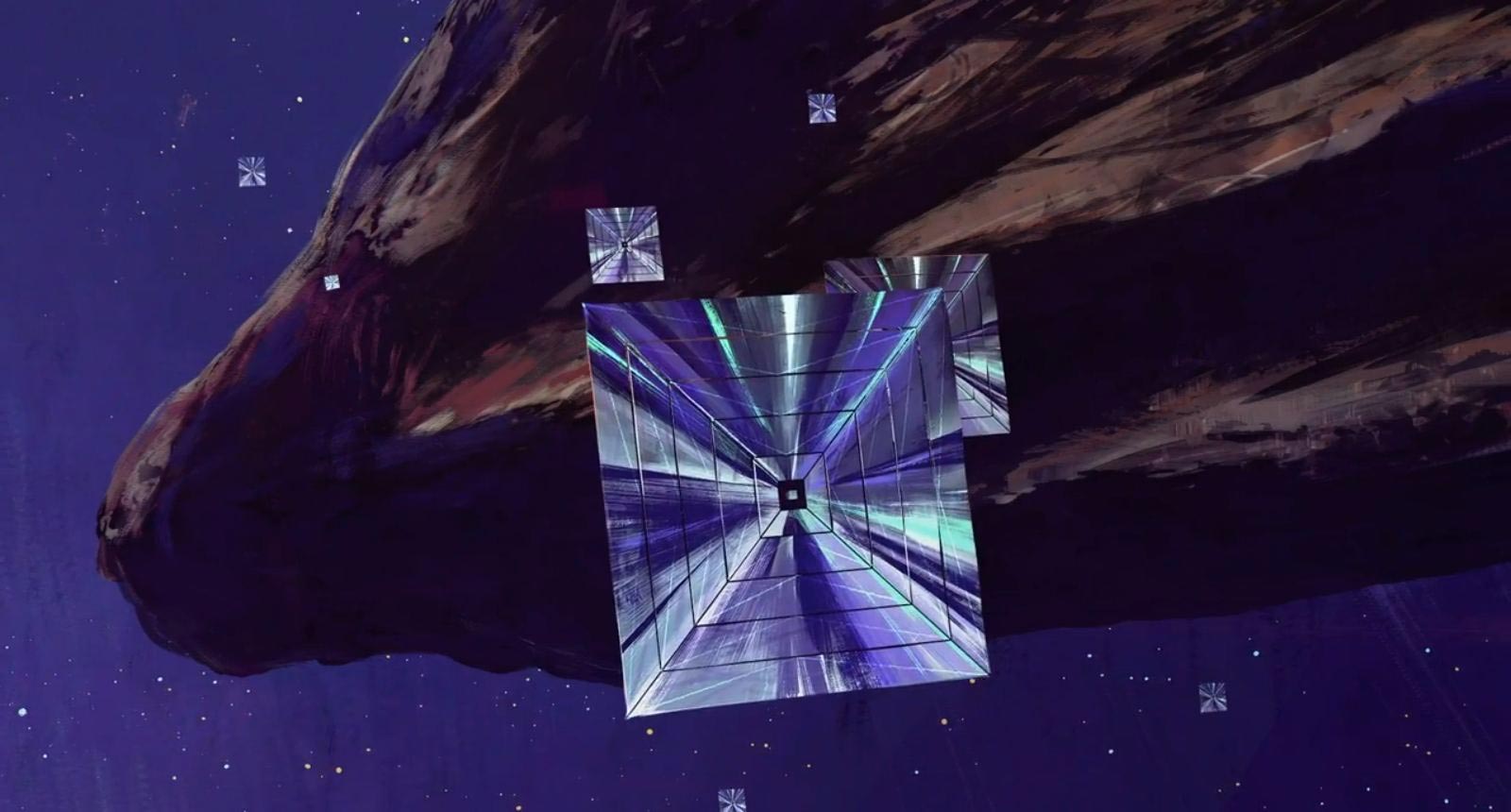
Project Lyra proposes a mission to catch up with the interstellar object ‘Oumuamua by 2054, using advanced propulsion techniques.
In October 2017, the interstellar object ‘Oumuamua passed through our Solar System, leaving a lot of questions in its wake. Not only was it the first object of its kind ever to be observed, but the limited data astronomers obtained as it shot out of our Solar System left them all scratching their heads. Even today, almost five years after this interstellar visitor made its flyby, scientists are still uncertain about its true nature and origins. In the end, the only way to get some real answers from ‘Oumuamua is to catch up with it.
Interestingly enough, there are many proposals on the table for missions that could do just that. Consider Project Lyra, a proposal by the Institute for Interstellar Studies (i4is) that would rely on advanced propulsions technology to rendezvous with interstellar objects (ISOs) and study them. According to their latest study, if their mission concept launched in 2028 and performed a complex Jupiter Oberth Manoeuvre (JOM), it would be able to catch up to ‘Oumuamua in 26 years.
Project Lyra: A Mission to Reach ‘Oumuamua
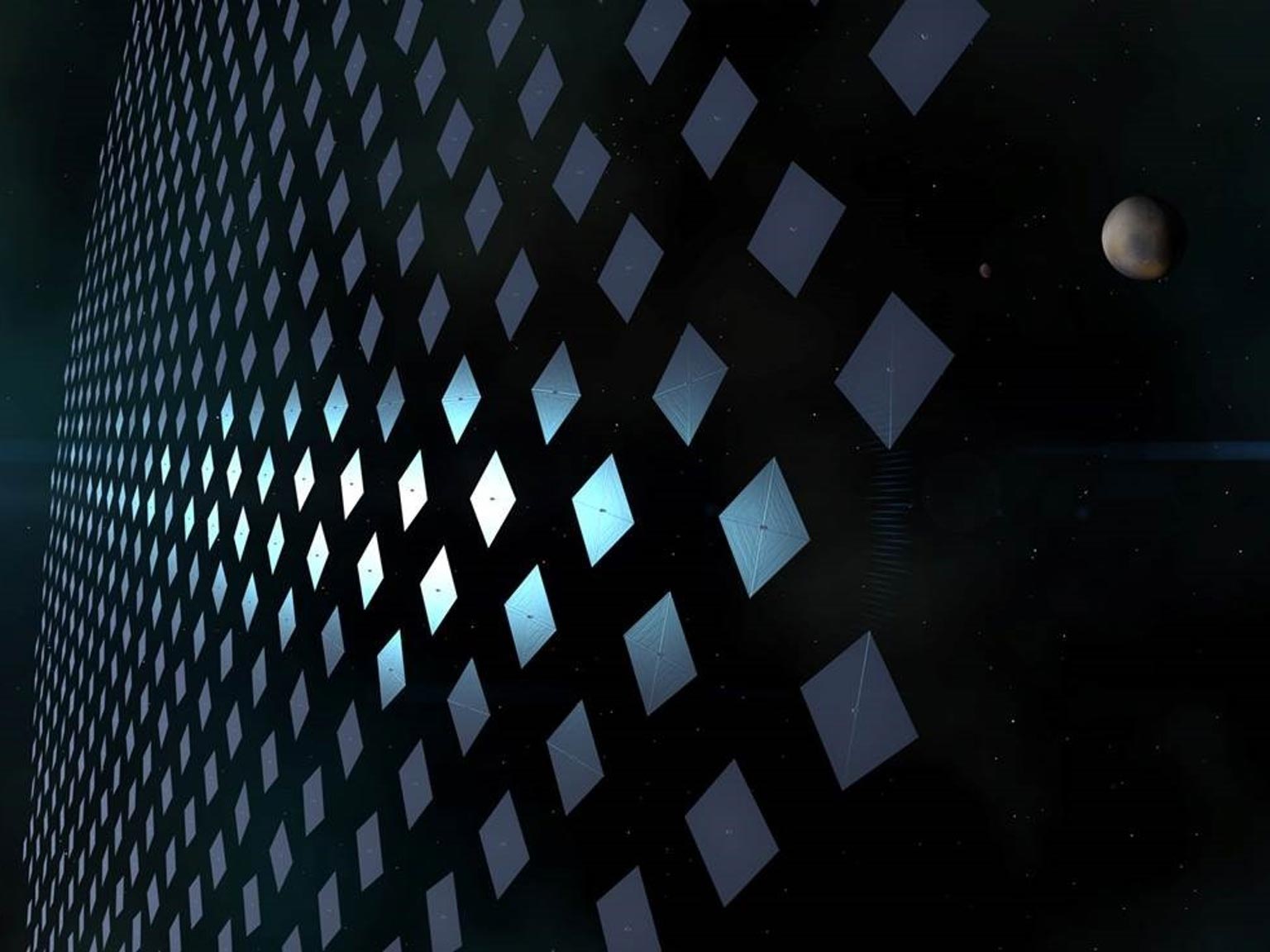
On October 30th, 2017, less than two weeks after ‘Oumuamua was detected, the Initiative for Interstellar Studies (i4is) inaugurated Project Lyra. The purpose of this concept study was to determine if a mission to rendezvous with ‘Oumuamua was feasible using current or near-term technologies. Since then, the i4is team has conducted studies that considered catching up with the ISO using nuclear-thermal propulsion (NTP) and a laser sailcraft, similar to Breakthrough Starshot – an interstellar mission concept for reaching Alpha Centauri in 20 years.
As they describe in their study, most of the previously proposed methods for reaching 1I/’Oumuamua using near-term technologies call for a Solar Oberth Maneuver (SOM). A perfect example is the “Sundiver,” a proposal made by researcher Coryn Bailer-Jones of the Max Planck Institute for Astronomy (MPIA). As he described to Universe Today in a previous article, this concept relies on the Sun’s radiation pressure to obtain a very high velocity with a light sail.
The Solar Oberth Manoeuvre and Its Challenges
“The principle of the Oberth effect is to apply your boost when you are moving fastest relative to the body you are orbiting, which is the Sun in the case of the Sundiver,” he said. “The closer you are to the Sun in your orbit, the faster you will be. So to take advantage of the Oberth effect, you need to get as close to the Sun as possible.”
At the heart of the SOM and other Oberth maneuvers is a technique known as a Gravity Assist, which has been used to explore the Solar System since the early 1970s. This technique involves using the gravitational force of three bodies, including the spacecraft, a second body that provides the “assist” (typically a large planet), and the central body about which the spacecraft’s path is being controlled.
Adam Hibberd, a researcher with the i4is, was the lead author of this latest Lyra study (titled “Project Lyra: A Mission to 1I/’Oumuamua without Solar Oberth Manoeuvre.”) Before joining i4is, Hibberd was an aerospace engineer who developed the Optimum Interplanetary Trajectory Software (OITS). When ‘Oumuamua was detected, he decided to use OITS with this ISO as the intended destination. After finding out about Project Lyra, he joined them and their research efforts shortly afterward.

As he explained to Universe Today via email, the Solar Oberth Maneuver (SOM) relies on three discrete changes in velocity (aka. impulses) to exit the Solar System. These include:
- At Earth, to increase the spacecraft’s farthest distance from the Sun (aphelion),
- At aphelion, to slow down and fall in close to the Sun,
- At the closest point to the Sun (perihelion) when the spacecraft is traveling at its fastest to get an extra boost
“This 3-impulse scenario was discovered by Theodore Edelbaum in 1959, although the term SOM seems to have stuck. It is fuel-optimal for generating high speeds out of the solar system. This is precisely what is needed to catch an ISO when the ISO has passed perihelion and is receding quickly from the sun.”
“However, this theoretical setup disregards Jupiter. Thus as a slight modification to this, if we slow down in step 2 with the help of a reverse Jupiter gravitational assist, then we can achieve escape with even less fuel. It is because the SOM is so efficient at generating high speeds that it has been used to research missions to ISOs.”
Looking for alternatives to a SOM, Hibbert and his colleagues considered using a time-tested route that would incorporate Jupiter’s powerful gravitational pull. Part of their motivation for this was the inherent challenges a solar gravity assist maneuver presents. While this maneuver looks great on paper, it has never been executed before and therefore has a low Technology Readiness Level (TRL) rating.
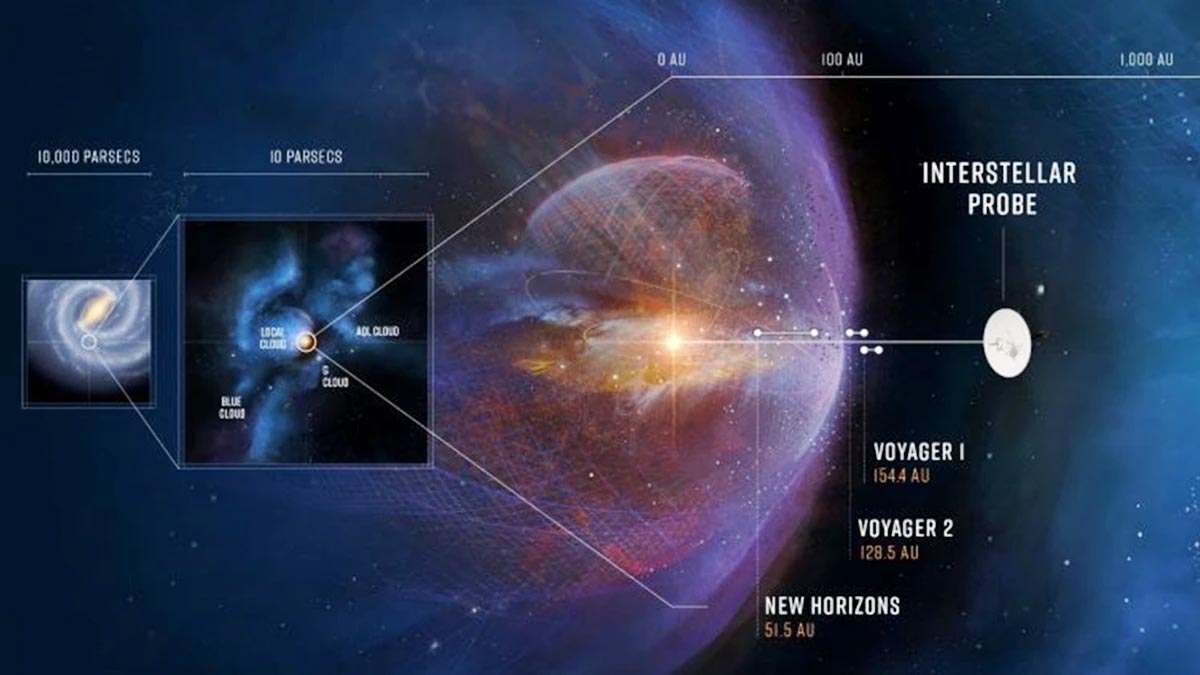
What’s more, there’s the issue of how much heating will take place as the spacecraft achieves perihelion during step 3 (between 3 and 10 solar radii). These issues were addressed in a recent NASA Solar and Space Physics concept study titled “Interstellar Probe: Humanity’s Journey to Interstellar Space.” This study was conducted for the Solar and Space Physics 2023–2032 Decadal Survey, which included (among others) concepts for an interstellar probe. In Appendix D2.2., the study addresses thermal protection in the context of a Solar Oberth Maneuver:
“Unlike earlier missions, where a shield design was needed for a given Sun distance, the Interstellar Probe challenge is to see how close to the Sun a spacecraft can realistically get. As the solar distance decreases, the umbra angle increases and the size of the shield, relative to the spacecraft, grows significantly.
“Because a conceptual design effort cannot include all the material design, fabrication, and testing limitations of the full design, the final recommendation of allowable Sun distance is made based on where the design seems to be moving from very difficult to impossible.”
As the Parker Solar Probe amply demonstrates, getting close to the Sun requires a heat shield that can handle the extreme heat and radiation. In the case of Parker, that shield measures about 2.44 meters (8 ft) in diameter and weighs almost 72.5 kg (160 lbs). While the size and mass of a heat shield for Lyra would not be identical, it’s a fair bet that a solar heat shield would result in a lot of additional mass for the lightsail.
Jupiter Oberth Manoeuvre: A Viable Alternative
As an alternative, Hibberd and his team recommended a Jupiter Oberth Manoeuvre (JOM), which would launch from Earth, swing around Venus and Earth, conduct a Deep Space Maneuver (DSM), swing by Earth again, then receive a Gravity Assist using Jupiter’s gravitational pull. This is summarized by the acronym V-E-DSM-E-J, or the more commonly used V-E-E-GA – Venus, Earth, Earth, Gravity Assist. As Hibberd indicated, this maneuver would have several advantages over a SOM, among them:
“[It] would not require a heavy heat shield and also would not need: a) An extra travel distance from Jupiter to the Solar Oberth of around 5.2 astronomical units (au), [and] b) A further travel back to around Jupiter’s orbit of an additional 5.2 au. Both (a) & (b) would take time for a SOM which would not be required for a Jupiter Oberth Manoeuvre.”
“JOM is a discovery which is key to the remit of ‘Project Lyra’ to find options using ‘current or near-term technology’ as essentially it does not require any hardware or manoeuvres which have not been tried before, unlike the SOM. Nevertheless, despite the saving in time from not requiring (a) & (b) above – the lower escape speeds generated by the JOM mean the mission duration must be longer.”
Another advantage Hibberd and his team identified was the arrival speed of the spacecraft, which would be much slower than one relying on a SOM – 18 km/s (64,800 km/h; 40,265 mph) vs. 30 km/s (108,000 km/h; 67,108 mph). This would give the spacecraft more time to analyze ‘Oumuamua during approach and departure. Based on a launch window of 2028, they determined that a Project Lyra spacecraft would be able to catch up to ‘Oumuamua by 2054.
Given that ‘Oumuamua is the closest piece of interstellar material accessible to us, the scientific returns for a rendezvous mission would be immeasurable. For the relatively low cost of a rendezvous mission, humanity could get its first glimpse of what goes on in other star systems by mid-century. More to the point, it would be a chance to finally resolve the many questions’ Oumuamua raised when it made its historic flyby of Earth years ago!
Was it a nitrogen iceberg? Was it aliens? Was it something else entirely? If we play our cards right, we will know the answers to all of these questions by mid-century!
Adapted from an article originally published on Universe Today.
Never miss a breakthrough: Join the SciTechDaily newsletter.
Follow us on Google and Google News.