
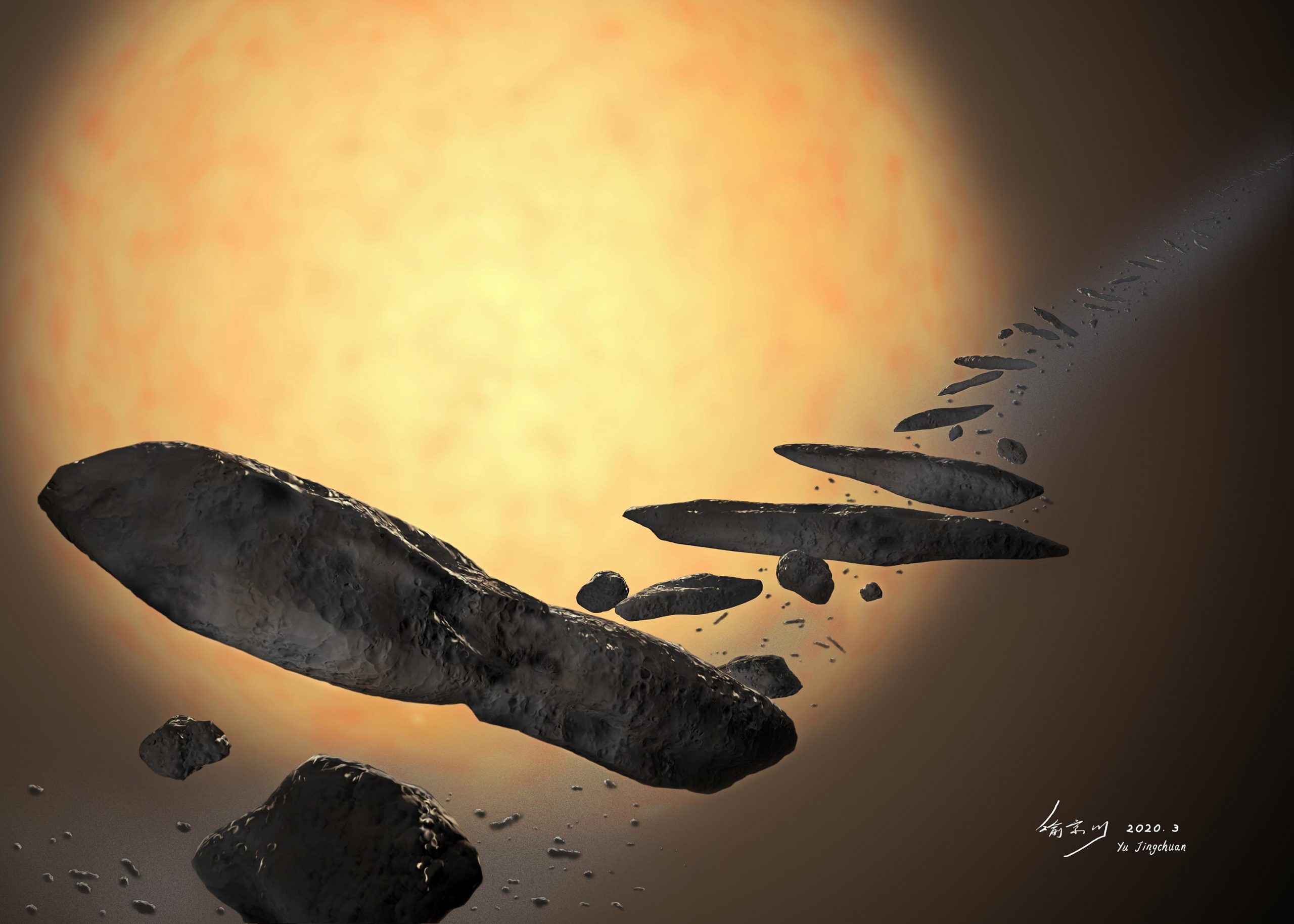
What is the origin of the famous interstellar object ‘Oumuamua? How was it formed and where did it come from? An article published on April 13, 2020, in Nature Astronomy by ZHANG Yun from National Astronomical Observatories of Chinese Academy of Sciences (NAOC) and Douglas N. C. Lin from University of California, Santa Cruz, offers the first comprehensive answer to this mystery, which involves tidal forces like those felt by Earth’s oceans and explains all of the unusual characteristics of this interstellar object.
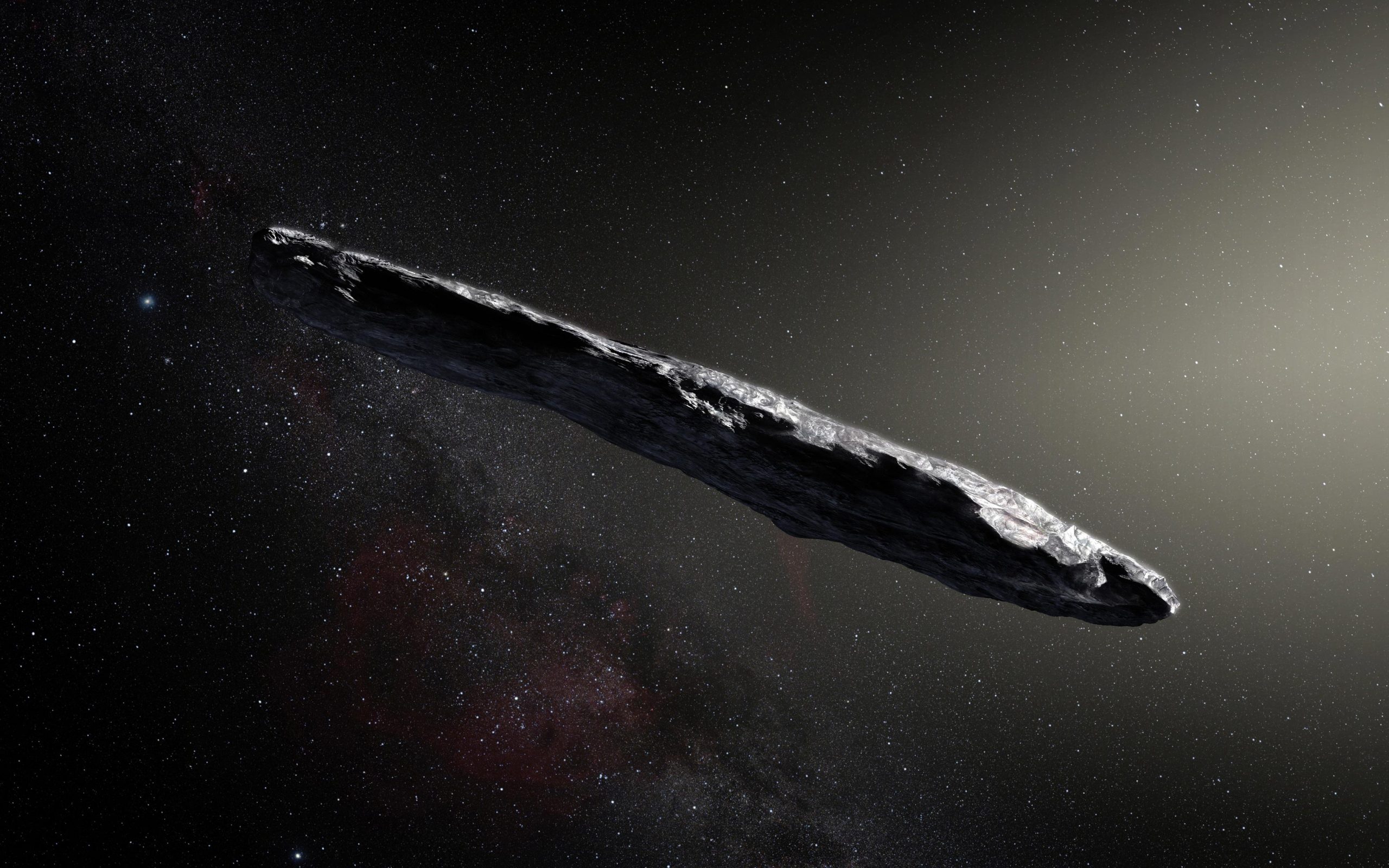
‘Oumuamua was discovered on October 19, 2017, by the Panoramic Survey Telescope and Rapid Response System 1 (Pan-STARRS1) located in Hawaii. As the first known interstellar object to visit our Solar System, ‘Oumuamua is absolutely nothing like anything else in the Solar System. Its dry surface, unusually elongated shape, and puzzling motion even drove some scientists to wonder if it was an alien probe.
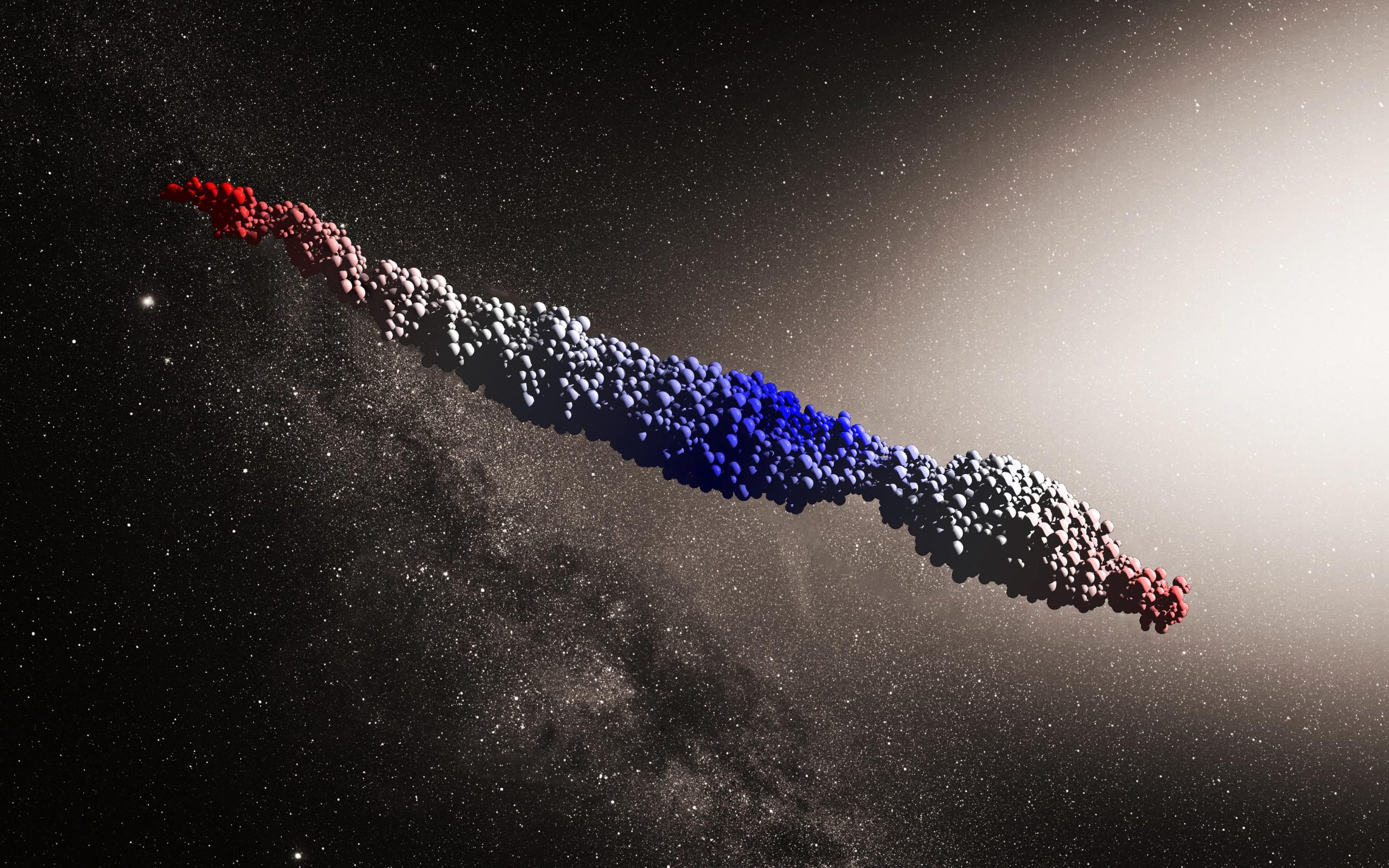
“It is really a mystery,” said ZHANG Yun, first author of the study, “but some signs, like its colors and the absence of radio emission, point to ‘Oumuamua being a natural object.”
“Our objective is to come up with a comprehensive scenario, based on well-understood physical principles to piece together all the tantalizing clues,” said Douglas Lin, coauthor of the study.
It was generally assumed that the first discovered interstellar object would be an icy body, like a comet. In effect, icy objects are constantly tossed out of their host systems. They are also much more visible due to their apparent coma. However, ‘Oumuamua’s dry appearance, similar to rocky bodies, like asteroids in the Solar System, indicates a different ejection scenario.
“The discovery of ‘Oumuamua implies that the population of rocky interstellar objects is much larger than we previously thought. On average, each planetary system should eject in total about a hundred trillion objects like ‘Oumuamua. We need to construct a very efficient scenario,” said ZHANG. “In space, some objects occasionally come very close to a bigger one. Tidal forces of the bigger one can disrupt these small ones, like the things happened to comet Shoemaker-Levy 9 when it closely passed by Jupiter.”
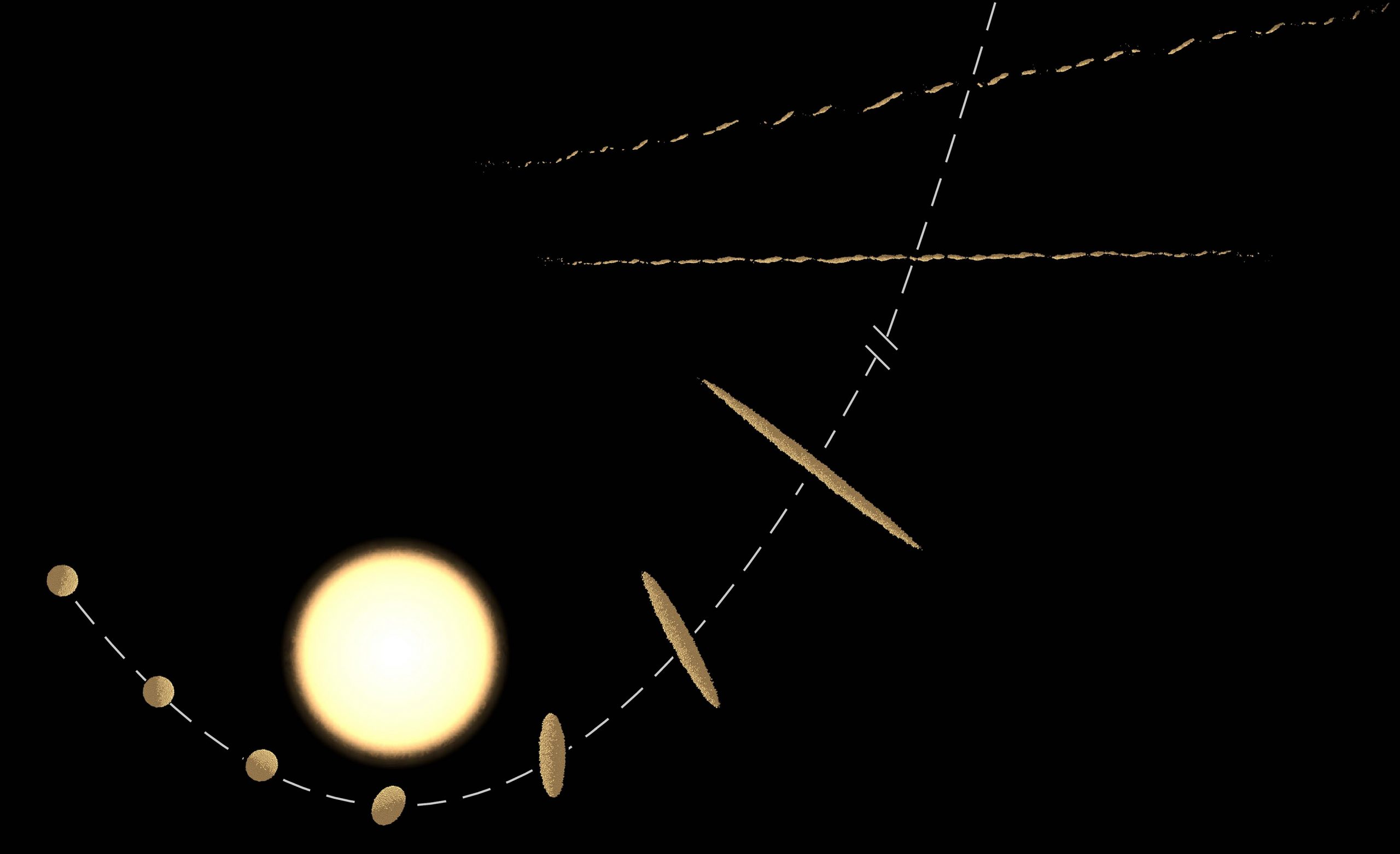
ZHANG and Lin ran high-resolution computer simulations to model the dynamics of an object closely flying by a star. They found that the star can dramatically split the object, if it comes enough close to the star, into extremely elongated fragments, and then eject them into the interstellar space.
“The elongated shape is more compelling when we considered the phase transition of material during the stellar encounter. The long-to-short axis ratio can be even larger than ten.” ZHANG said. Due to the intense stellar radiation, the surfaces of fragments melt at a very short distance to the star and re-condense at further distances. Like melting chocolate beans, the surface materials stick together to maintain the elongated shape.
“Heat diffusion also consumes large amounts of volatiles. These fragments become dry and have ‘Oumuamua-like surface.” ZHANG added. “However, some water ice buried under the surface can be preserved. These residual water ice could be activated during its Solar System passage to cause its non-gravitational motion.”
“The tidal fragmentation scenario not only provides a way to form one single ‘Oumuamua, but also accounts for the vast population of rocky interstellar objects.” ZHANG said. Their calculations demonstrate the efficiency of stellar tides in producing this kind of objects. Possible progenitors, including long-period comets, debris disks, and even planets, can be transformed into ‘Oumuamua-size pieces during stellar encounters. The inferred number density of interstellar objects is consistent with ‘Oumuamua’s occurrence rate.
This work highlights the prolificacy of ‘Oumuamua-like interstellar object population between stars. Since these objects pass through the domains of habitable zones, the prospect of transport of matter capable of generating life by these objects cannot be ruled out.
“This work provides a plausible narrative that links its strange properties to the process of planet formation that is ubiquitous in the Milky Way Galaxy,” said Gregory Laughlin, a professor of astronomy at Yale University.
” ‘Oumuamua is just the tip of the iceberg. We anticipate many more interstellar visitors with similar traits will be discovered by future observation with the forthcoming Vera C. Rubin Observatory,” Lin said.
“This is a very new field. These interstellar objects could provide critical clues about how planetary systems form and evolve, and how life started on the Earth.” ZHANG said.
“This work does a remarkable job of explaining a variety of unusual properties of ‘Oumuamua with a single, coherent model,” said US Naval Academy astronomer Matthew Knight, co-leader of the ‘Oumuamua International Space Science Institute team, “As future interstellar objects are discovered in coming years, it will be very interesting to see if any exhibit ‘Oumuamua-like properties. If so, it may indicate that the processes described in this study are widespread.”
Read Mysterious Interstellar Object ’Oumuamua Explained by New Formation Theory for more on this study.
Reference: “Tidal fragmentation as the origin of 1I/2017 U1 (‘Oumuamua)” by Yun Zhang and Douglas N. C. Lin, 13 April 2020, Nature Astronomy.
DOI: 10.1038/s41550-020-1065-8
Never miss a breakthrough: Join the SciTechDaily newsletter.
Follow us on Google and Google News.
1 Comment
Makes me wonder if there is some physical explanation for a resemblance between the taffy-stretched out piece of matter in this simulation and the proposition that there are dark matter hairs surrounding planetary objects and connecting larger cosmic objects: https://www.space.com/31200-dark-matter-hairs-earth.html
Thoughts?