
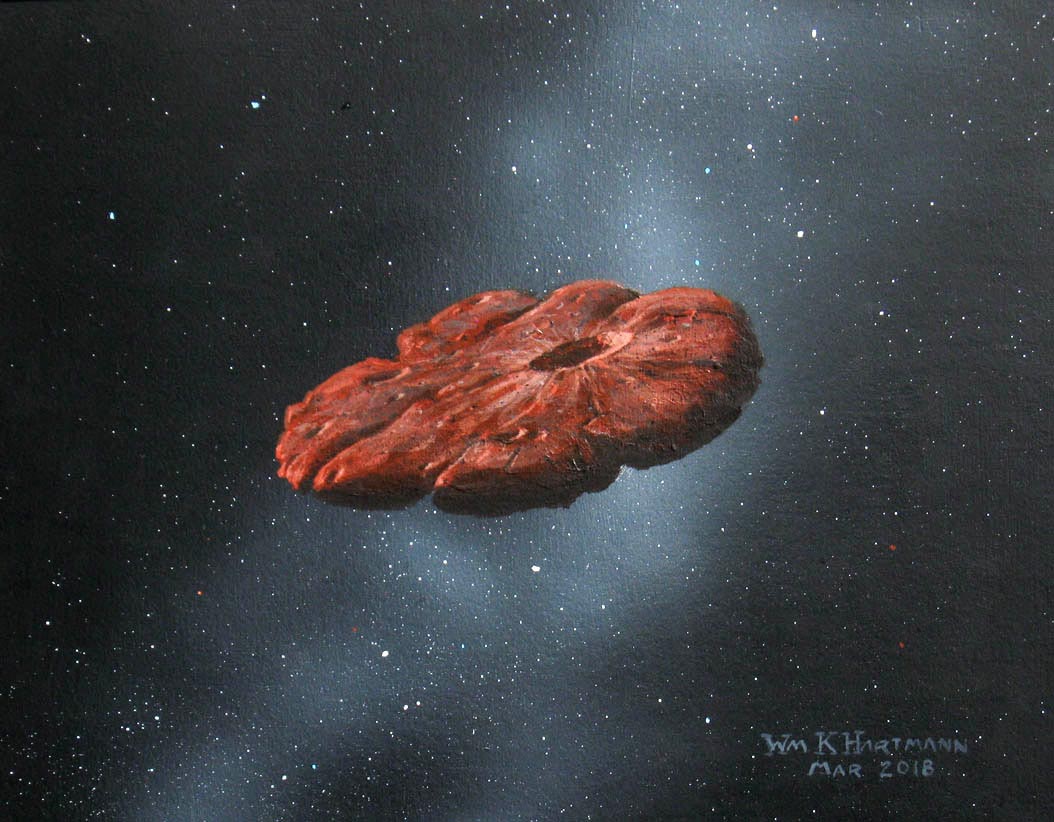
‘Oumuamua, the first interstellar object observed in our solar system, is now thought to be a fragment of nitrogen ice from a Pluto-like planet in another system.
In 2017, the first interstellar object from beyond our solar system was discovered via the Pan-STARRS astronomical observatory in Hawaii. It was named ‘Oumuamua, meaning “scout” or “messenger” in Hawaiian. The object was like a comet, but with features that were just odd enough to defy classification.
Two Arizona State University astrophysicists, Steven Desch and Alan Jackson of the School of Earth and Space Exploration, set out to explain the odd features of ‘Oumuamua and have determined that it is likely a piece of a Pluto-like planet from another solar system. Their findings have been recently published in a pair of papers in the AGU Journal of Geophysical Research: Planets.
“In many ways ‘Oumuamua resembled a comet, but it was peculiar enough in several ways that mystery surrounded its nature, and speculation ran rampant about what it was,” said Desch, who is a professor in the School of Earth and Space Exploration.
From observations of the object, Desch and Jackson determined several characteristics of the object that differed from what would be expected from a comet.
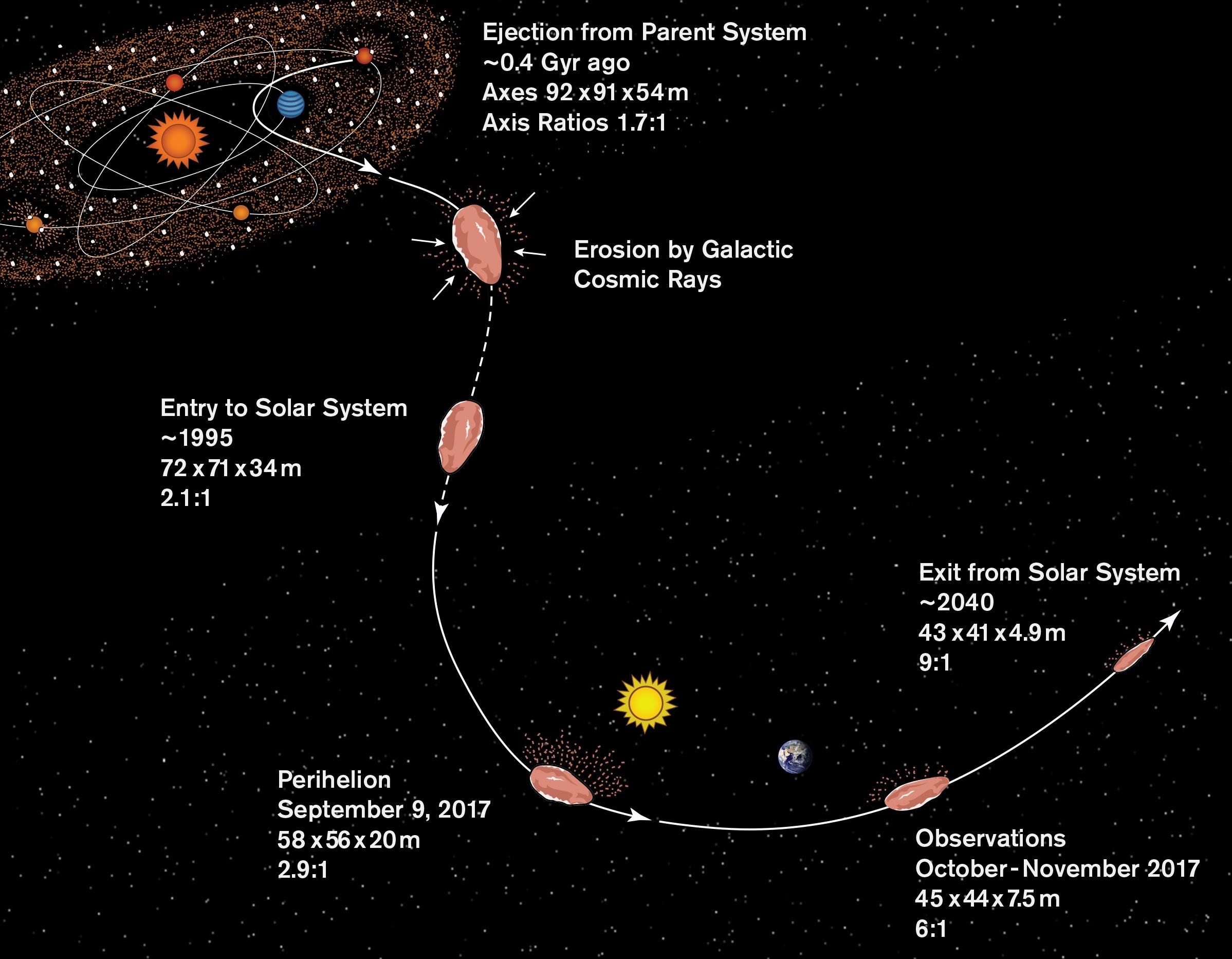
In terms of speed, the object entered the solar system at a velocity a bit lower than would be expected, indicating that it had not been traveling in interstellar space for more than a billion years or so. In terms of size, its pancake shape was also more flattened than any other known solar system object.
They also observed that while the object acquired a slight push away from the sun (a “rocket effect” common in comets as sunlight vaporizes the ices they are made of), the push was stronger than could be accounted for. Finally, the object lacked a detectable escaping gas, which is usually depicted visibly by a comet’s tail. In all, the object was very much like a comet, but unlike any comet that had ever been observed in the solar system.
The Solid Nitrogen Hypothesis
Desch and Jackson then hypothesized that the object was made of different ices and they calculated how quickly these ices would sublimate (passing from a solid to a gas) as ‘Oumuamua passed by the sun. From there, they calculated the rocket effect, the object’s mass and shape, and the reflectivity of the ices.
“That was an exciting moment for us,” Desch said. “We realized that a chunk of ice would be much more reflective than people were assuming, which meant it could be smaller. The same rocket effect would then give ‘Oumuamua a bigger push, bigger than comets usually experience.”
Desch and Jackson found one ice in particular — solid nitrogen — that provided an exact match to all the object’s features simultaneously. And since solid nitrogen ice can be seen on the surface of Pluto, it is possible that a cometlike object could be made of the same material.
“We knew we had hit on the right idea when we completed the calculation for what albedo (how reflective the body is) would make the motion of ‘Oumuamua match the observations,” said Jackson, who is a research scientist and an Exploration Fellow at ASU. “That value came out as being the same as we observe on the surface of Pluto or Triton, bodies covered in nitrogen ice.”
A Chunk of an ‘Exo-Pluto’
They then calculated the rate at which chunks of solid nitrogen ice would have been knocked off the surfaces of Pluto and similar bodies early in our solar system’s history. And they calculated the probability that chunks of solid nitrogen ice from other solar systems would reach ours.
“It was likely knocked off the surface by an impact about half a billion years ago and thrown out of its parent system,” Jackson said. “Being made of frozen nitrogen also explains the unusual shape of ‘Oumuamua. As the outer layers of nitrogen ice evaporated, the shape of the body would have become progressively more flattened, just like a bar of soap does as the outer layers get rubbed off through use.”
Could ’Oumuamua Have Been Alien Technology?
Although ‘Oumuamua’s cometlike nature was quickly recognized, the inability to immediately explain it in detail led to speculation that it is a piece of alien technology, as in the recently published book “Extraterrestrial: The First Signs of Intelligent Life Beyond Earth” by Avi Loeb of Harvard University.
This has sparked a public debate about the scientific method and the responsibility of scientists not to jump to unwarranted conclusions.
“Everybody is interested in aliens, and it was inevitable that this first object outside the solar system would make people think of aliens,” Desch said. “But it’s important in science not to jump to conclusions. It took two or three years to figure out a natural explanation — a chunk of nitrogen ice — that matches everything we know about ‘Oumuamua. That’s not that long in science, and far too soon to say we had exhausted all natural explanations.”
A Glimpse Into Extrasolar Systems
Although there is no evidence that it is alien technology, as a fragment of a Pluto-like planet, ‘Oumuamua has provided scientists with a special opportunity to look at extrasolar systems in a way that they have not been able to before. As more objects like ‘Oumuamua are found and studied, scientists can continue to expand our understanding of what other planetary systems are like and the ways in which they are similar to, or different from, our own solar system.
“This research is exciting in that we’ve probably resolved the mystery of what ‘Oumuamua is and we can reasonably identify it as a chunk of an ‘exo-Pluto,’ a Pluto-like planet in another solar system,” Desch said. “Until now, we’ve had no way to know if other solar systems have Pluto-like planets, but now we have seen a chunk of one pass by Earth.”
Desch and Jackson hope that future telescopes, like those at the Vera Rubin Observatory/Large Synoptic Survey Telescope in Chile, which will be able to survey the entire southern sky on a regular basis, will be able to start finding even more interstellar objects that they and other scientists can use to further test their ideas.
“It’s hoped that in a decade or so we can acquire statistics on what sorts of objects pass through the solar system, and if nitrogen ice chunks are rare or as common as we’ve calculated,” Jackson said. “Either way, we should be able to learn a lot about other solar systems, and whether they underwent the same sorts of collisional histories that ours did.”
References:
“1I/‘Oumuamua as an N2 ice fragment of an exo‐Pluto surface: I. Size and Compositional Constraints” by Alan P. Jackson and Steven J. Desch, 16 March 2021, Journal of Geophysical Research: Planets.
DOI: 10.1029/2020JE006706
“1I/‘Oumuamua as an N2 ice fragment of an exo‐pluto surface II: Generation of N2 ice fragments and the origin of ‘Oumuamua” by S. J Desch and A. P Jackson, 16 March 2021, Journal of Geophysical Research: Planets.
DOI: 10.1029/2020JE006807
Never miss a breakthrough: Join the SciTechDaily newsletter.
Follow us on Google and Google News.
2 Comments
“But it’s important in science not to jump to conclusions. …”
Yes! However, it seems that many scientists are unfamiliar with T. C. Chamberlain’s important work, “The Method of Multiple Working Hypotheses.”
Pareidolia is pareidolia, … regardless of whether or not one has the credentials to back up one’s presumptions. So, someone Scienced the Hell out of it; presenting a constellation of SPECULATION, ASSUMPTIONS and “logical” PROJECTIONS BUT no tangible PROOF. As my professor in LOGIC 101 offered: the bigger the BUT, the bigger the BUTT. To wit: Arguments which begin by defining what a “THING” IS-NOT, are couched in denial from the get-go. THEN (for the proponents of the theory) it’s just a matter of fitting “observable” characteristics into a predetermined paradigm. CREDENTIALS do not a TRUTH make. I test such theories by counting the number of presumptions, and the subsequent number of presumptions based on presumptions… and so on. Beyond the second magnitude (presumptions based on presumptions), one can safely conclude: “Their GUESS is as good as mine.” An errant “chunk” of nitrogen ice from a “Pluto-like planetoid” launched from a distant solar system… yadda-yadda-yadda. Orthodoxy rears its ugly head. In the vernacular: All this hooptie and we don’t even have a clear picture of the damn “thingee”.
OUMUAMUAA is what it is: cause for speculation. It behaves oddly, has some “features” which are not easily explained or more importantly, not easily explained away. The vedic anecdote of the 12 blind viziers (wizards) defining an elephant by feel, comes to mind: 12 different definitions of what they are “NOT-seeing” is the result. This theory seems plausible on the surface, but it is a clear illustration of “NOT-seeing” the ELEPHANT in the room. And yes, right you are, this is only one person’s opinion. The “truth” is open to speculation, regardless of ones credentials. This principle is at the root of true Science. Deal with it. 👽🙄