
Close Menu
    Facebook X (Twitter) Instagram
    SciTechDaily
    • Biology
    • Chemistry
    • Earth
    • Health
    • Physics
    • Science
    • Space
    • Technology
    Facebook X (Twitter) Pinterest YouTube RSS
    SciTechDaily
    Home»Space»Chandra Reveals Cluster of X-Ray Binary Stars Near the Galaxy’s Center
    Space

    Chandra Reveals Cluster of X-Ray Binary Stars Near the Galaxy’s Center

    By Megan Watzke, Harvard-Smithsonian Center For AstrophysicsJune 29, 20181 Comment3 Mins Read
    Facebook Twitter Pinterest Telegram LinkedIn WhatsApp Email Reddit
    Share
    Facebook Twitter LinkedIn Pinterest Telegram Email Reddit
    X Ray Binary Stars Near the Galaxy's Center
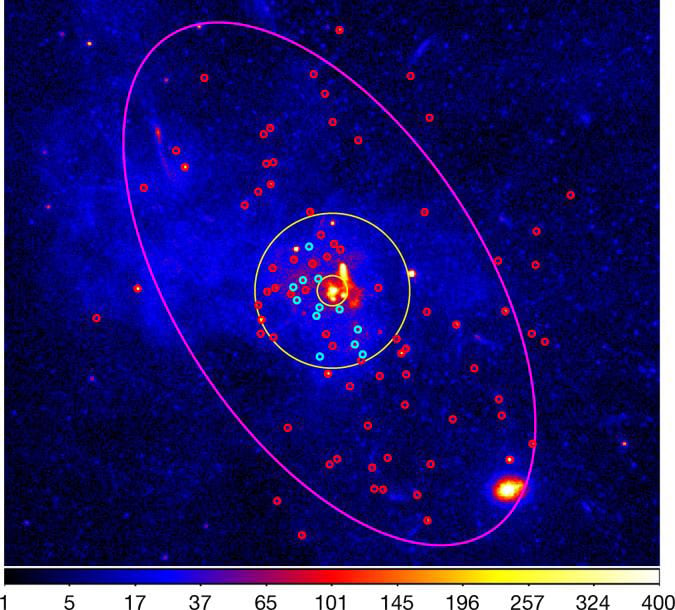
    A Chandra image of the central tens of light-years of the Milky Way. Red and cyan circles are X-ray emitting sources with the latter being black hole binaries. Astronomers have concluded that these results are consistent with galaxy evolution models that predict tens of thousands of black holes have accumulated in the central region of the galaxy (the observations only see the brightest black holes in binary systems). NASA/Chandra

    A binary star system is one that contains a pair of stars orbiting each other. A black hole X-ray binary is a binary system in which one of the stars is a black hole and the other is a normal star. When matter from the normal star accretes onto the black hole, charged particles are ejected that emit X-ray radiation, making identification of these objects possible. At the other extreme, the most massive known black holes, with millions or even billions of solar-mass, exist at the centers of most galaxies including our own, and one of the basic predictions of galaxy evolution is that the gravitational potency of a nuclear supermassive black hole should lead to a dense accumulation of black holes in its vicinity. The models predict that as many as twenty thousand black holes should have settled into the central few light-years of our Milky Way. (For a sense of how extreme this scenario is, consider that the closest star to our Sun, Proxima Centauri, is 4.2 light-years away.) Until now, however, no such density cusp of black holes has been detected.

    The most straightforward way to detect a black hole is to find it in an X-ray binary system. Writing in last week’s issue of the journal, Nature, CfA astronomer Jaesub Hong and five colleagues used the Chandra X-ray Observatory archive to identify a dozen X-ray binaries in a density cusp within three light-years of the Galactic Center. Over the past twelve years, Chandra has observed the region for over 380 hours. The scientists analyzed X-ray images of the region between 0.65 and 12.4 light-years from the supermassive black hole (the innermost region had too many complicating sources). They found 415 X-ray point sources, and after carefully considering other possible origins for each one (novae, unusual stars, extragalactic background sources, among other possibilities) they conclude that these dozen are black hole X-ray binaries. The authors then consider the sensitivity limits, the expected abundance of single black holes relative to binaries, and other uncertainties to conclude that the observed number is in good agreement with general model expectations for black holes. They add, however, that alternative models of galaxy evolution cannot be entirely excluded. Some of the observed binaries could be the result of unique events, for example if a globular cluster and its black holes fell into the region.

    Reference:  “A Density Cusp of Quiescent X-Ray Binaries in the Central Parsec of the Galaxy” by Charles J. Hailey, Kaya Mori, Franz E. Bauer, Michael E. Berkowitz, Jaesub Hong and Benjamin J. Hord, 5 April 2018, Nature.
    DOI: 10.1038/nature25029

    Never miss a breakthrough: Join the SciTechDaily newsletter.
    Follow us on Google and Google News.

    Astronomy Chandra X-ray Observatory Cosmology Harvard-Smithsonian Center for Astrophysics
    Share. Facebook Twitter Pinterest LinkedIn Email Reddit

    Related Articles

    Invisible Storm Lights Up Galaxy Cluster With Record-Breaking Radio Glow

    Chandra Identifies X-Ray Emission from the Nuclear Region of Arp 220

    Deep VLA Observations Of The Toothbrush Cluster

    Astronomers Discover a Cosmic Particle Accelerator in Abell 3411 and 3412

    NASA’s Chandra Views a Stellar Circle of Life, Cygnus X-3

    Astronomers Study the Pulsar Wind Nebula Created by PSR B0355+54

    Chandra Detects X-Rays from Pluto

    Astronomers Search for Trigger of Nearby Supernova

    Supernova Shock Wave Breaks Through a Cocoon of Gas

    1 Comment

    1. VALERIY POLULYAKH on June 29, 2018 7:34 am

      In search of black holes and dark matter astrophysicists are relying on indirect observations. It would seem that the measurement of the event horizon of a black hole directly would be a direct evidence. However, by the nature of a horizon, any real measurement of the event horizon will be indirect. The Event Horizon Telescope will get picture of the silhouette of the Sgr A* which is due to optical effects of spacetime outside of the event horizon. The result will be determined by the simple quality of the resulting image that does not depend on the properties of the spacetime within the image. So, it will be also indirect and an existence of BH is a hypothesis.
      https://www.academia.edu/12468184/Are_there_Black_Holes_and_Dark_Matter_in_the_Milky_Way

      Reply
    Leave A Reply Cancel Reply

    • Facebook
    • Twitter
    • Pinterest
    • YouTube

    Don't Miss a Discovery

    Subscribe for the Latest in Science & Tech!

    Trending News

    Breakthrough Bowel Cancer Trial Leaves Patients Cancer-Free for Nearly 3 Years

    Natural Compound Shows Powerful Potential Against Rheumatoid Arthritis

    100,000-Year-Old Neanderthal Fossils in Poland Reveal Unexpected Genetic Connections

    Simple “Gut Reset” May Prevent Weight Gain After Ozempic or Wegovy

    2.8 Days to Disaster: Scientists Warn Low Earth Orbit Could Suddenly Collapse

    Common Food Compound Shows Surprising Power Against Superbugs

    5 Simple Ways To Remember More and Forget Less

    The Atomic Gap That Could Cost the Semiconductor Industry Billions

    Follow SciTechDaily
    • Facebook
    • Twitter
    • YouTube
    • Pinterest
    • Newsletter
    • RSS
    SciTech News
    • Biology News
    • Chemistry News
    • Earth News
    • Health News
    • Physics News
    • Science News
    • Space News
    • Technology News
    Recent Posts
    • Early Cannabis Use May Stall Key Brain Skills in Teens
    • Popular Vitamin D Supplement Has “Previously Unknown” Negative Effect, Study Finds
    • Powerful Antioxidant Found To Play a Key Role in Proper Protein Folding
    • MIT Laser Breakthrough Lets Scientists Watch Drugs Enter the Brain in Real Time
    • Study Reveals Malaria’s Hidden Role in Human Evolution
    Copyright © 1998 - 2026 SciTechDaily. All Rights Reserved.
    • Science News
    • About
    • Contact
    • Editorial Board
    • Privacy Policy
    • Terms of Use

    Type above and press Enter to search. Press Esc to cancel.