
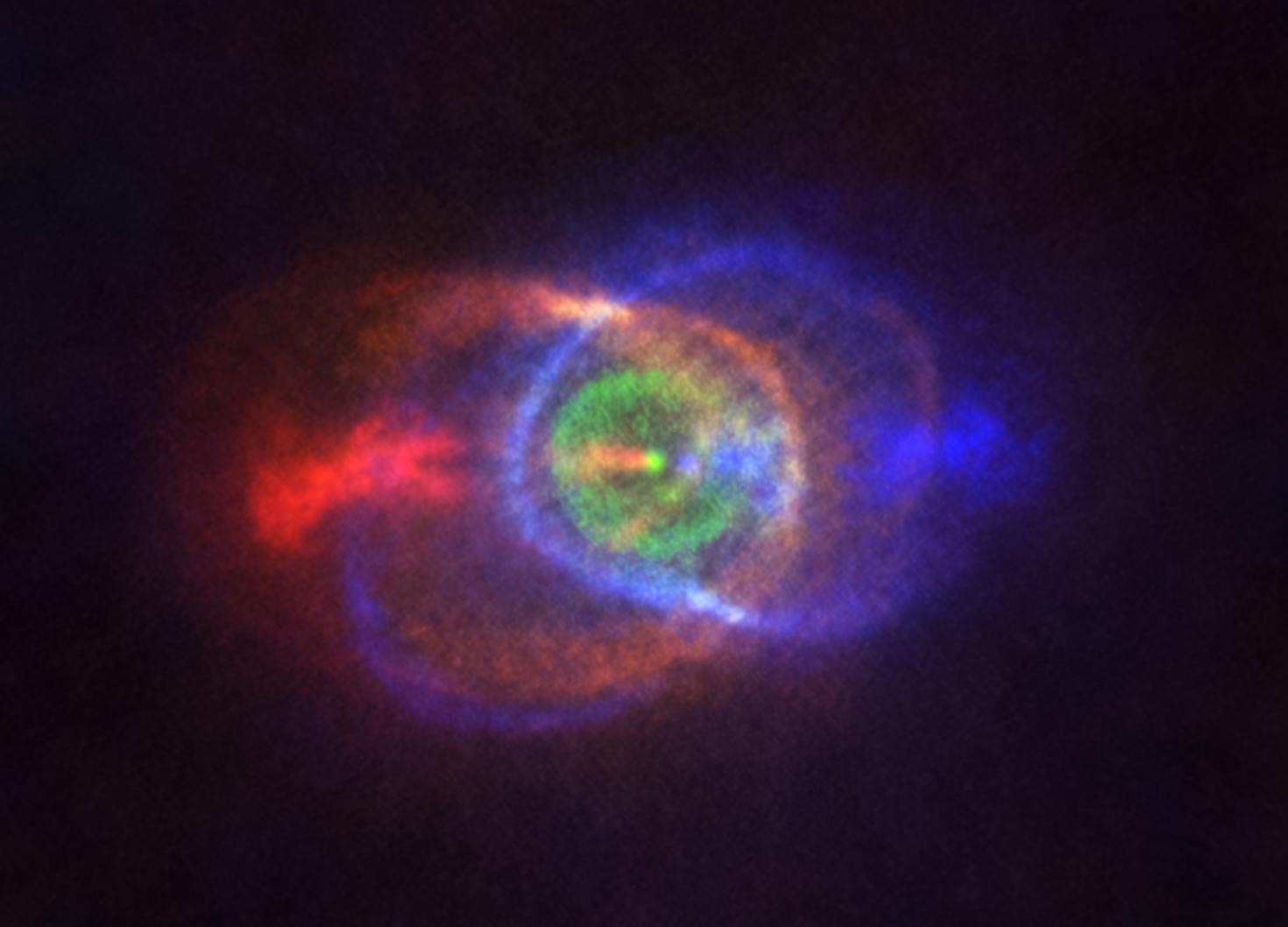
Astronomers using the Atacama Large Millimeter/submillimeter Array (ALMA), in which ESO is a partner, have spotted a peculiar gas cloud that resulted from a confrontation between two stars. One star grew so large it engulfed the other which, in turn, spiraled towards its partner provoking it into shedding its outer layers.
Like humans, stars change with age and ultimately die. For the Sun and stars like it, this change will take it through a phase where, having burned all the hydrogen in its core, it swells up into a large and bright red-giant star. Eventually, the dying Sun will lose its outer layers, leaving behind its core: a hot and dense star called a white dwarf.
Astronomers using the Atacama Large Millimeter/submillimeter Array (ALMA), in which ESO is a partner, have spotted a peculiar gas cloud that resulted from a confrontation between two stars. Find out more about this stellar fight in this ESOcast Light. Credit: ESO
“The star system HD101584 is special in the sense that this ‘death process’ was terminated prematurely and dramatically as a nearby low-mass companion star was engulfed by the giant,” said Hans Olofsson of the Chalmers University of Technology, Sweden, who led a recent study, published in Astronomy & Astrophysics, of this intriguing object.
Thanks to new observations with ALMA, complemented by data from the ESO-operated Atacama Pathfinder EXperiment (APEX), Olofsson and his team now know that what happened in the double-star system HD101584 was akin to a stellar fight. As the main star puffed up into a red giant, it grew large enough to swallow its lower-mass partner. In response, the smaller star spiraled in towards the giant’s core but didn’t collide with it. Rather, this maneuver triggered the larger star into an outburst, leaving its gas layers dramatically scattered and its core exposed.

The team says the complex structure of the gas in the HD101584 nebula is due to the smaller star’s spiraling towards the red giant, as well as to the jets of gas that formed in this process. As a deadly blow to the already defeated gas layers, these jets blasted through the previously ejected material, forming the rings of gas and the bright bluish and reddish blobs seen in the nebula.
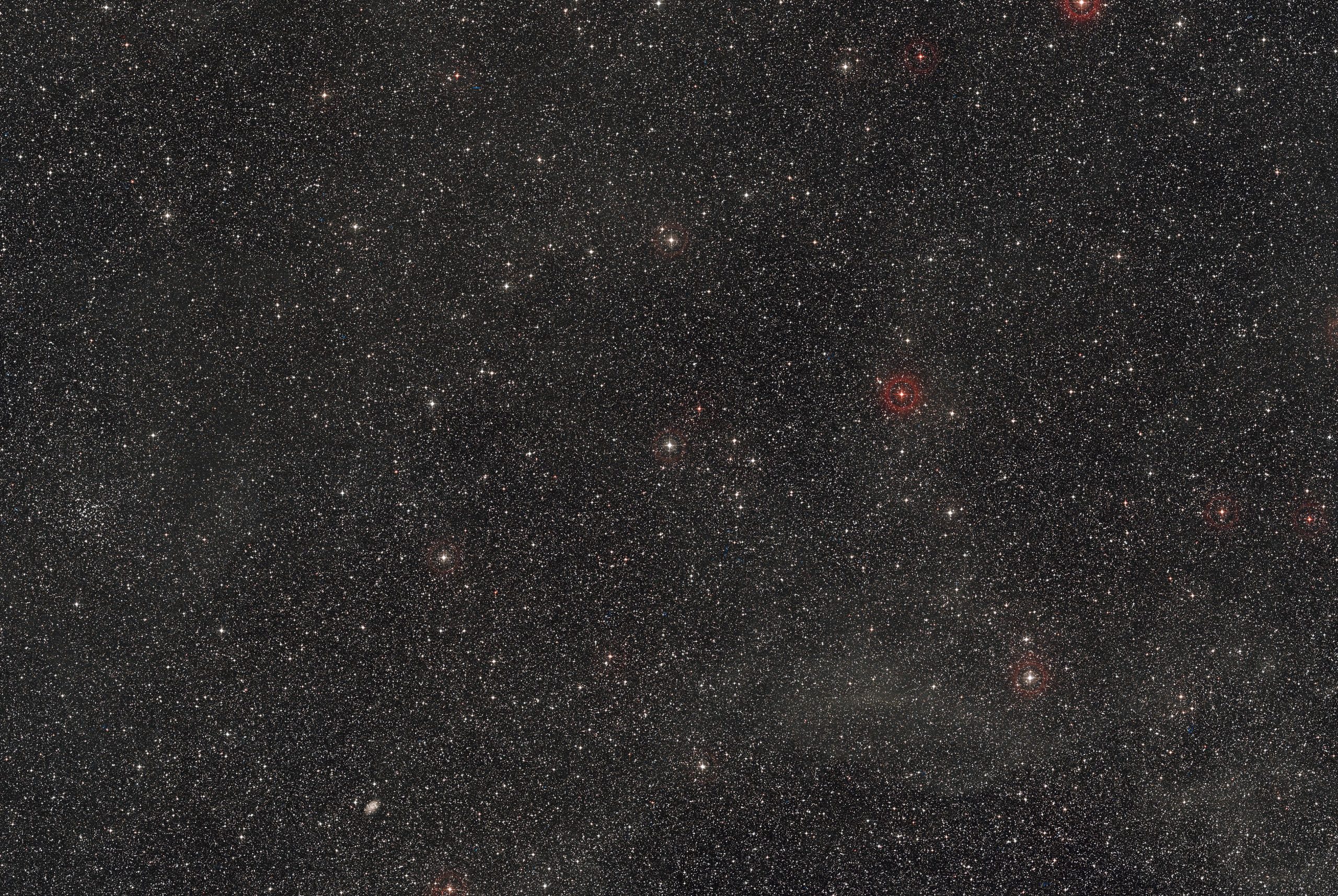
This video starts by showing a wide-field view of a region of the sky in the constellation of Centaurus. It then zooms in to show HD 101584, a gas cloud surrounding a binary star recently studied with ALMA and APEX. Credit: ALMA (ESO/NAOJ/NRAO), Olofsson et al. Acknowledgement: Robert Cumming; N. Risinger (skysurvey.org), Digitized Sky Survey 2. Music: Astral Electronic
A silver lining of a stellar fight is that it helps astronomers to better understand the final evolution of stars like the Sun. “Currently, we can describe the death processes common to many Sun-like stars, but we cannot explain why or exactly how they happen. HD101584 gives us important clues to solve this puzzle since it is currently in a short transitional phase between better-studied evolutionary stages. With detailed images of the environment of HD101584 we can make the connection between the giant star it was before, and the stellar remnant it will soon become,” says co-author Sofia Ramstedt from Uppsala University, Sweden.
Co-author Elizabeth Humphreys from ESO in Chile highlighted that ALMA and APEX, located in the country’s Atacama region, were crucial to enabling the team to probe “both the physics and chemistry in action” in the gas cloud. She added: “This stunning image of the circumstellar environment of HD101584 would not have been possible without the exquisite sensitivity and angular resolution provided by ALMA.”
While current telescopes allow astronomers to study the gas around the binary, the two stars at the center of the complex nebula are too close together and too far away to be resolved. ESO’s Extremely Large Telescope, under construction in Chile’s Atacama Desert, “will provide information on the ‘heart’ of the object,” says Olofsson, allowing astronomers a closer look at the fighting pair.
This research was presented in a paper published in Astronomy & Astrophysics.
Reference: “HD 101584: circumstellar characteristics and evolutionary status” by H. Olofsson, T. Khouri1, M. Maercker, P. Bergman1, L. Doan, D. Tafoya, W. H. T. Vlemmings, E. M. L. Humphreys, M. Lindqvist1, L. Nyman and S. Ramstedt, Accepted 30 January 2020, Astronomy & Astrophysics.
DOI: 10.1051/0004-6361/201834897
PDF
The team is composed of H. Olofsson (Department of Space, Earth and Environment, Chalmers University of Technology, Onsala Space Observatory, Sweden [Chalmers]), T. Khouri (Chalmers), M. Maercker (Chalmers), P. Bergman (Chalmers), L. Doan (Department of Physics and Astronomy, Uppsala University, Sweden [Uppsala]), D. Tafoya (National Astronomical Observatory of Japan), W. H. T. Vlemmings (Chalmers), E. M. L. Humphreys (European Southern Observatory [ESO], Garching, Germany), M. Lindqvist (Chalmers), L. Nyman (ESO, Santiago, Chile), and S. Ramstedt (Uppsala).
Never miss a breakthrough: Join the SciTechDaily newsletter.
Follow us on Google and Google News.
1 Comment
By the time our Sun leaves the Main Sequence, one would expect not to find those familiar continents in their accustomed places–for starters…