
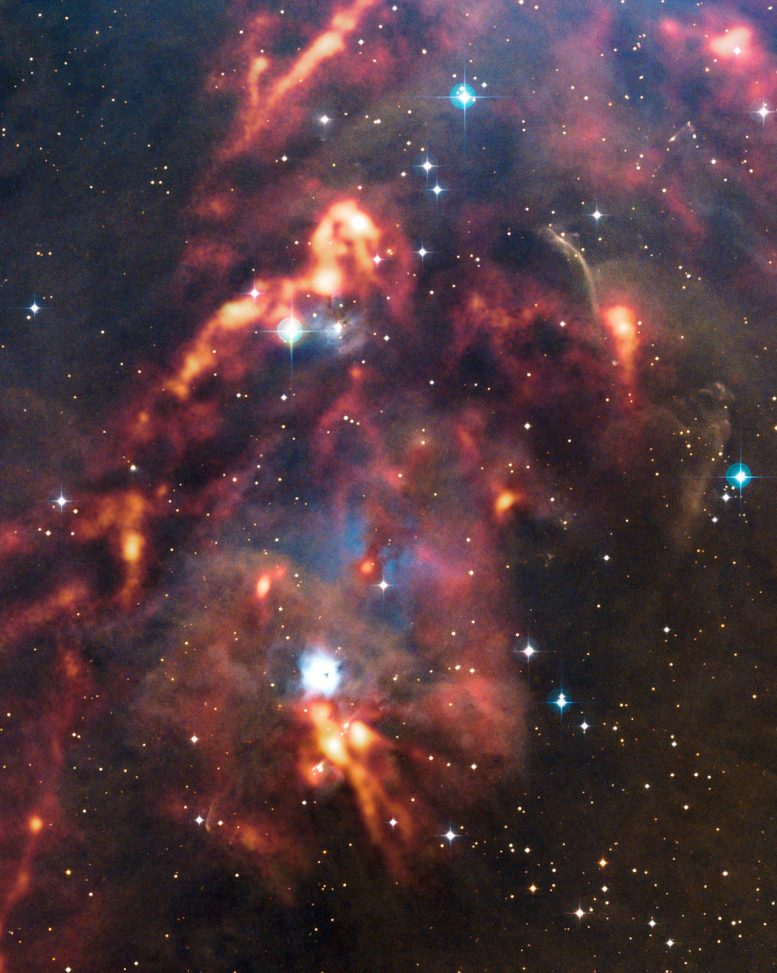
This new image from the APEX telescope in Chile shows the region around the reflection nebula NGC 1999 in visible light, with the APEX observations overlaid in brilliant orange tones that seem to set the dark clouds on fire.
A new image from the Atacama Pathfinder Experiment (APEX) telescope in Chile shows a beautiful view of clouds of cosmic dust in the region of Orion. While these dense interstellar clouds seem dark and obscured in visible-light observations, APEX’s LABOCA camera can detect the heat glow of the dust and reveal the hiding places where new stars are being formed. But one of these dark clouds is not what it seems.
In space, dense clouds of cosmic gas and dust are the birthplaces of new stars. In visible light, this dust is dark and obscuring, hiding the stars behind it. So much so that, when astronomer William Herschel observed one such cloud in the constellation of Scorpius in 1774, he thought it was a region empty of stars and is said to have exclaimed, “Truly there is a hole in the sky here!”[1]
In order to better understand star formation, astronomers need telescopes that can observe at longer wavelengths, such as the submillimeter range, in which the dark dust grains shine rather than absorb light. APEX, on the Chajnantor Plateau in the Chilean Andes, is the largest single-dish submillimeter-wavelength telescope operating in the southern hemisphere, and is ideal for astronomers studying the birth of stars in this way.
Located in the constellation of Orion (The Hunter), 1500 light-years away from Earth, the Orion Molecular Cloud Complex is the closest region of massive star formation to Earth, and contains a treasury of bright nebulae, dark clouds, and young stars. The new image shows just part of this vast complex in visible light, with the APEX observations overlaid in brilliant orange tones that seem to set the dark clouds on fire. Often, the glowing knots from APEX correspond to darker patches in visible light — the tell-tale sign of a dense cloud of dust that absorbs visible light, but glows at submillimeter wavelengths, and possibly a site of star formation.
The bright patch below the center of the image is the nebula NGC 1999. This region — when seen in visible light — is what astronomers call a reflection nebula, where the pale blue glow of background starlight is reflected from clouds of dust. The nebula is mainly illuminated by the energetic radiation from the young star V380 Orionis[2] lurking at its heart. In the center of the nebula is a dark patch, which can be seen even more clearly in a well-known image from the NASA/ESA Hubble Space Telescope.
A new image from the Atacama Pathfinder Experiment (APEX) telescope in Chile shows a beautiful view of clouds of cosmic dust in the region of Orion. While these dense interstellar clouds seem dark and obscured in visible-light observations, APEX’s LABOCA camera can detect the heat glow of the dust and reveal the hiding places where new stars are being formed. The video pans over the region around the reflection nebula NGC 1999 in visible light, with the APEX observations overlaid in brilliant orange tones that seem to set the dark clouds on fire. Credit: ESO/APEX (MPIfR/ESO/OSO)/T. Stanke et al./Digitized Sky Survey 2. Music: movetwo
Normally, a dark patch such as this would indicate a dense cloud of cosmic dust, obscuring the stars and nebula behind it. However, in this image we can see that the patch remains strikingly dark, even when the APEX observations are included. Thanks to these APEX observations, combined with infrared observations from other telescopes, astronomers believe that the patch is in fact a hole or cavity in the nebula, excavated by material flowing out of the star V380 Orionis. For once, it truly is a hole in the sky!
The region in this image is located about two degrees south of the large and well-known Orion Nebula (Messier 42), which can be seen at the top edge of the wider view in visible light from the Digitized Sky Survey.
Reference: “Hier ist wahrhaftig ein Loch im Himmel – The NGC 1999 dark globule is not a globule” by T. Stanke, A. M. Stutz, J. J. Tobin, B. Ali, S. T. Megeath, O. Krause, H. Linz, L. Allen, E. Bergin, N. Calvet, J. Di Francesco, W. J. Fischer, E. Furlan, L. Hartmann, T. Henning, P. Manoj, S. Maret, J. Muzerolle, P. C. Myers, D. Neufeld, M. Osorio, K. Pontoppidan, C. A. Poteet, D. M. Watson and T. Wilson, 16 July 2010, Astronomy & Astrophysics.
DOI: 10.1051/0004-6361/201014612
The research into the dark patch in NGC 1999 discussed above is described in a paper by T. Stanke et al., A&A 518, L94 (2010).
The APEX observations used in this image were led by Thomas Stanke (ESO), Tom Megeath (University of Toledo, USA), and Amy Stutz (Max Planck Institute for Astronomy, Heidelberg, Germany). APEX is a collaboration between the Max Planck Institute for Radio Astronomy (MPIfR), the Onsala Space Observatory (OSO) and ESO. Operation of APEX at Chajnantor is entrusted to ESO.
Notes
- In German, “Hier ist wahrhaftig ein Loch im Himmel!”
- V380 Orionis has a high surface temperature of about 10 000 Kelvin (about the same in degrees Celsius), nearly twice that of our own Sun. Its mass is estimated to be 3.5 times that of the Sun.
Never miss a breakthrough: Join the SciTechDaily newsletter.
Follow us on Google and Google News.
1 Comment
Not only informative but exquisitely written. It is rare to see the stunning beauty of the cosmos reflected in the phrasing of a science article. Thank you!