
Close Menu
    Facebook X (Twitter) Instagram
    SciTechDaily
    • Biology
    • Chemistry
    • Earth
    • Health
    • Physics
    • Science
    • Space
    • Technology
    Facebook X (Twitter) Pinterest YouTube RSS
    SciTechDaily
    Home»Space»AB Aur: A Rosetta Stone for Planet Formation
    Space

    AB Aur: A Rosetta Stone for Planet Formation

    By Harvard-Smithsonian Center for AstrophysicsDecember 26, 20203 Comments3 Mins Read
    Facebook Twitter Pinterest Telegram LinkedIn WhatsApp Email Reddit
    Share
    Facebook Twitter LinkedIn Pinterest Telegram Email Reddit
    SPHERE AB Aurigae
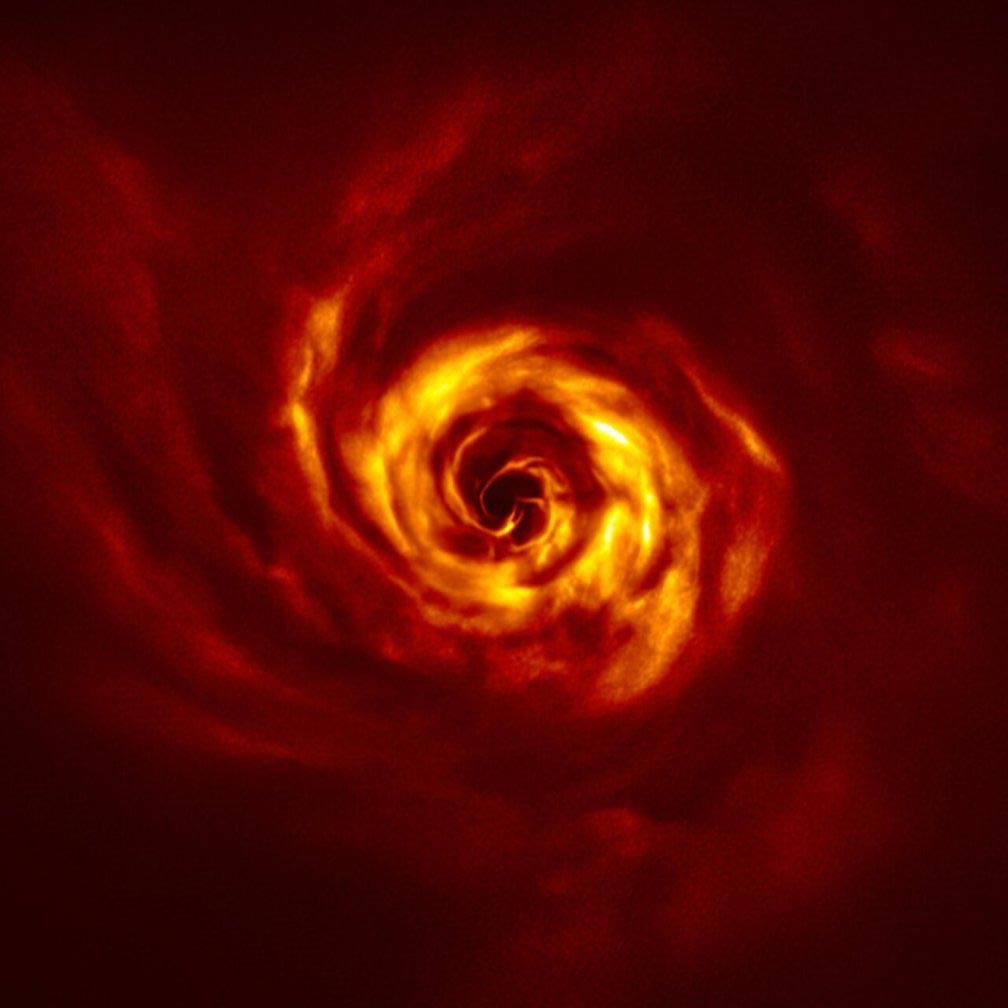
    This image shows the disc around the young star AB Aurigae in polarized near-infrared light as seen with the European Very Large Telescope’s SPHERE instrument. Measurements of the molecular components of the disk at millimeter wavelengths reveal several unexpected properties including a warmer temperature, more dust, and a deficiency of sulfur. Credit: ESO/Boccaletti et al.

    Planets are formed from the disk of gas and dust around a star, but the mechanisms for doing so are imperfectly understood. Gas is the key driver in the dynamical evolution of planets, for example, because it is the dominant component of the disk (by mass). The timescale over which the gas dissipates sets the timescale for planet formation, yet its distribution in disks is just starting to be carefully measured. Similarly, the chemical composition of the gas determines the composition of the future planets and their atmospheres, but even after decades of studying protoplanetary disks, their chemical compositions are poorly constrained; even the gas-to-dust ratios are largely unknown.

    The detailed characterizations of individual sources provide insights into the physical and chemical nature of protoplanetary disks. The star AB Aurigae is a widely studied system hosting a young transitional disk, a disk with gaps suggestive of clearing by newly forming planets. Located 536 light-years (plus-or-minus 1%) from the Sun, it is close enough to be an excellent candidate in which to study the spatial distribution of gas and dust in detail.

    CfA astronomer Romane Le Gal was a member of a team that used the NOrthern Extended Millimeter Array (NOEMA) to observe the AB Aur gas disk at high spatial resolution in the emission lines of CO, H2CO, HCN, and SO; combined with archival results, their dataset includes a total of seventeen different spectral features.

    The scientists, for the first time in a transition disk, mapped the gas density and the gas-to-dust ratio, finding that it was less than expected — half of the interstellar medium value or even in some places as much as four times smaller. Different molecules were seen tracing different regions of the disk, for instance the envelope or the surface. The team measured the average disk temperature to be about 39K, warmer than estimated in other disks. Not least, their chemical analysis determined the relative abundances of the chemicals and found (depending on some assumptions) that sulfur is strongly depleted compared to the solar system value.

    The new paper’s primary conclusion, that the planet-forming disk around this massive young star is significantly different from expectations, highlights the importance of making such detailed observations of disks around massive stars.

    Reference: “AB Aur, a Rosetta stone for studies of planet formation I. Chemical study of a planet-forming disk” by P. Rivière-Marichalar, A. Fuente, R. Le Gal, C. Baruteau, R. Neri, D. Navarro-Almaida, S. P. Treviño-Morales, E. Macías, R. Bachiller and M. Osorio, 1 October 2020, Astronomy & Astrophysics.
    DOI: 10.1051/0004-6361/202038549

    Never miss a breakthrough: Join the SciTechDaily newsletter.
    Follow us on Google and Google News.

    Astronomy Astrophysics Harvard-Smithsonian Center for Astrophysics Planets
    Share. Facebook Twitter Pinterest LinkedIn Email Reddit

    Related Articles

    Astronomers Uncover New Evidence of Baby Planet in the Making

    TRAPPIST-1: How Flat Can a Planetary System Get?

    Astrophysicists Spot an Exoplanet With the Potential To Form Moons

    Growing up Stardust: Astronomers Discover That Stars and Planets May Be Siblings

    Striped or Spotted? Planetary Scientists Solve a Brown Dwarf Mystery

    Chandra Studies Extraordinary Magnetar: Fastest Spinning and Possibly the Youngest Magnetar Known

    Artificial Intelligence Classifies Real Supernova Explosions With Unprecedented Accuracy

    Astronomers Discover Pair of Lonely Exotic Planet-Like Objects Born Like Stars

    Astronomers Detect Possible Radio Emission From Exoplanet for the First Time

    3 Comments

    1. Torbjörn Larsson on December 26, 2020 7:54 am

      “The scientists, for the first time in a transition disk, mapped the gas density and the gas-to-dust ratio, finding that it was less than expected — half of the interstellar medium value or even in some places as much as four times smaller.”

      May refer to:

      “5.- The derived gas-to-dust ratios along the central parts of the dust ring range from ∼ 10 to ∼ 40, and reach 200 only in the inner and outer edges. As expected, the minimum gas-to-dust ratio is measured towards the dust trap. This value of the gas-to-dust ratio is in agreement with values typically found in T Tauri and Herbig Ae/Be disks.”

      On the dust ring the paper says:

      “Dust trapping in local pressure maxima has been proposed to overcome the radial drift of solid particles, and hence favor planet formation in transitions disks.”

      Reply
      • Torbjörn Larsson on December 26, 2020 7:56 am

        I.e. it could confirm that a planet and its formation process sops up gas (early on).

        Reply
    2. The 10th Man on December 27, 2020 6:06 am

      Here we go making things up from one little bit of fact. Omg, give it a rest and do your jobs and quit gossiping. You ruin any reputation you have.

      Reply
    Leave A Reply Cancel Reply

    • Facebook
    • Twitter
    • Pinterest
    • YouTube

    Don't Miss a Discovery

    Subscribe for the Latest in Science & Tech!

    Trending News

    What Causes Chronic Pain? Scientists Identify Key Culprit in the Brain

    Semaglutide Shows Surprising Mental Health Benefits in Massive 100,000-Person Study

    This Liquid Snapped Instead of Flowing and Scientists Were Shocked

    Breakthrough Alzheimer’s Drug Rewires the Brain Instead of Just Clearing Plaques

    Scientists Discover Hidden “Footprint of Death” That Could Transform How We Fight Disease

    A Simple Nose Swab Could Detect Alzheimer’s Years Before Symptoms Appear

    Scientists Just Rewrote the Timeline of Complex Life on Earth

    Teenager’s Fossil Find Leads to Discovery of Shark Teeth in 5 Million-Year-Old Whale Skull

    Follow SciTechDaily
    • Facebook
    • Twitter
    • YouTube
    • Pinterest
    • Newsletter
    • RSS
    SciTech News
    • Biology News
    • Chemistry News
    • Earth News
    • Health News
    • Physics News
    • Science News
    • Space News
    • Technology News
    Recent Posts
    • Even “Failed” Diets May Deliver Long-Term Health Gains, Study Finds
    • Childhood Junk Food May Rewire the Brain for Life
    • NIH Scientists Discover Powerful New Opioid That Relieves Pain Without Dangerous Side Effects
    • Breakthrough Study Reveals Why Damaged Nerves Struggle To Heal
    • 20-Year Study Reveals Cholera’s Surprising Weakness
    Copyright © 1998 - 2026 SciTechDaily. All Rights Reserved.
    • Science News
    • About
    • Contact
    • Editorial Board
    • Privacy Policy
    • Terms of Use

    Type above and press Enter to search. Press Esc to cancel.