
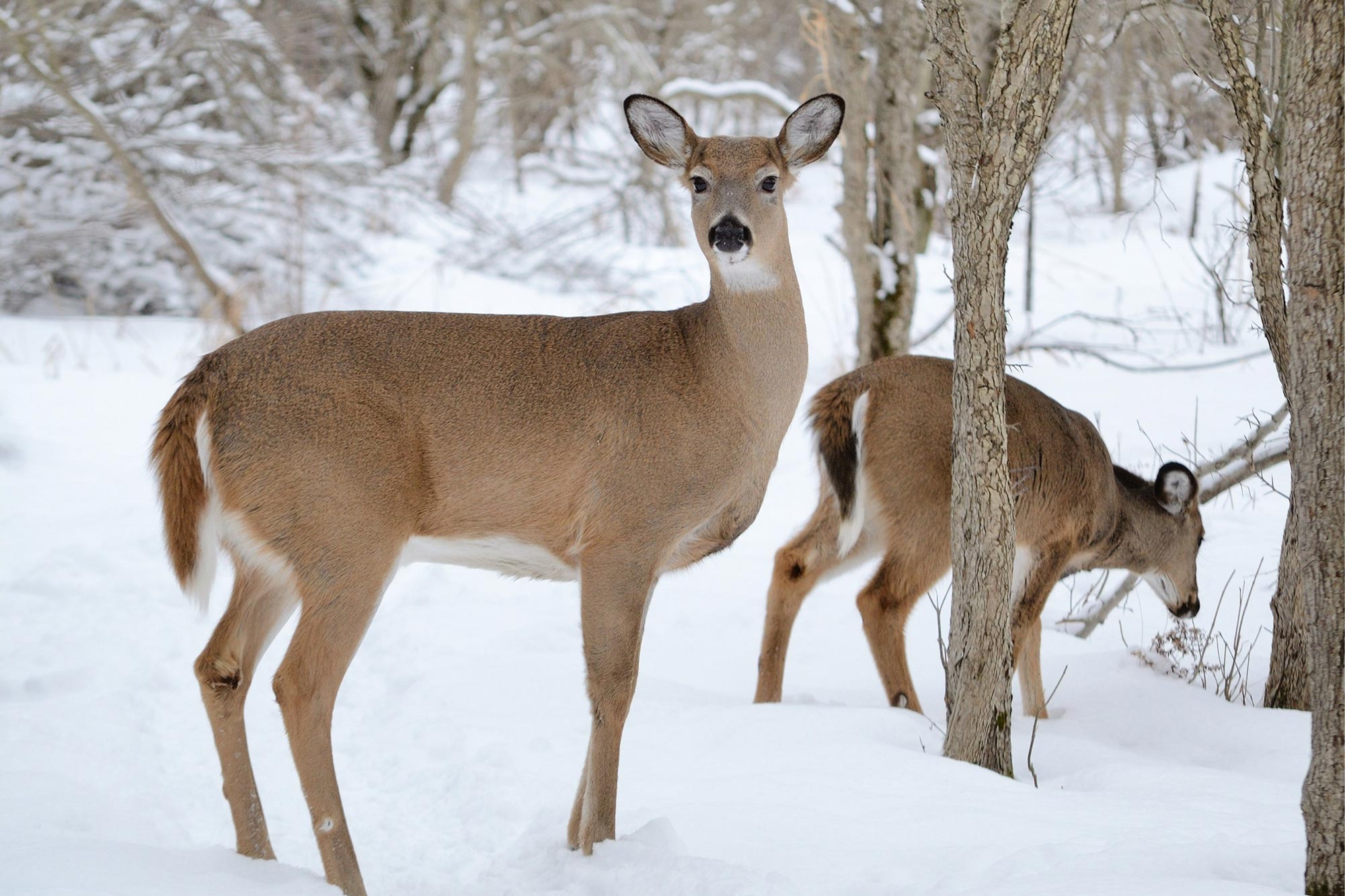
Scientists Unsure if Wild Deer Could Be SARS-CoV-2 Virus Reservoir
Scientists have detected infection by at least three variants of the virus that causes COVID-19 in free-ranging white-tailed deer in six northeast Ohio locations, the research team has reported.
Previous research led by the U.S. Department of Agriculture had shown evidence of antibodies in wild deer. This study, published today (December. 23, 2021) in Nature, details the first report of active COVID-19 infection in white-tailed deer supported by the growth of viral isolates in the lab, indicating researchers had recovered viable samples of the SARS-CoV-2 virus and not only its genetic traces.
Deer Infections Mirror Human Strains Found in Ohio
Based on genomic sequencing of the samples collected between January and March 2021, researchers determined that variants infecting wild deer matched strains of the SARS-CoV-2 virus that had been prevalent in Ohio COVID-19 patients at the time. Sample collection occurred before the Delta variant was widespread, and that variant was not detected in these deer. The team is testing more samples to check for new variants as well as older variants, whose continued presence would suggest the virus can set up shop and survive in this species.
The fact that wild deer can become infected “leads toward the idea that we might actually have established a new maintenance host outside humans,” said Andrew Bowman, associate professor of veterinary preventive medicine at The Ohio State University and senior author of the paper.
“Based on evidence from other studies, we knew they were being exposed in the wild and that in the lab we could infect them and the virus could transmit from deer to deer. Here, we’re saying that in the wild, they are infected,” Bowman said. “And if they can maintain it, we have a new potential source of SARS-CoV-2 coming into humans. That would mean that beyond tracking what’s in people, we’ll need to know what’s in the deer, too.
“It could complicate future mitigation and control plans for COVID-19.”
A lot of unknowns remain: how the deer got infected, whether they can infect humans and other species, how the virus behaves in the animals’ body, and whether it’s a transient or long-term infection.
The research team took nasal swabs from 360 white-tailed deer in nine northeast Ohio locations. Using PCR testing methods, the scientists detected genetic material from at least three different strains of the virus in 129 (35.8%) of the deer sampled.
Multiple Human-to-Deer Spillover Events Detected
The analysis showed that B.1.2 viruses dominant in Ohio in the early months of 2021 spilled over multiple times into deer populations in different locations.
“The working theory based on our sequences is that humans are giving it to deer, and apparently we gave it to them several times,” Bowman said. “We have evidence of six different viral introductions into those deer populations. It’s not that a single population got it once and it spread.”
Each site was sampled between one and three times, adding up to a total of 18 sample collection dates. Based on the findings, researchers estimated the prevalence of infection varied from 13.5% to 70% across the nine sites, with the highest prevalence observed in four sites that were surrounded by more densely populated neighborhoods.
Possible Outcomes: Mutation or Spillback to Humans
White-tailed deer functioning as a viral reservoir of SARS-CoV-2 would likely result in one of two outcomes, Bowman said. The virus could mutate in deer, potentially facilitating transmission of new strains to other species, including humans, or the virus could survive in deer unmutated while it simultaneously continues to evolve in humans, and at some point when humans don’t have immunity to the strains infecting deer, those variants could come spilling back to humans.
How transmission happened initially in these deer, and how it could happen across species, are among the pending questions related to these findings. The research team speculated that white-tailed deer were infected through an environmental pathway – possibly by drinking contaminated water. Research has shown that the virus is shed in human stool and detectable in wastewater.
The white-tailed deer tested for this study were part of a population control initiative, so they are not a transmission threat.
Though there are an estimated 600,000 white-tailed deer in Ohio and 30 million in the United States, Bowman said this sampling focused on locations close to dense human populations and is not representative of all free-ranging deer.
Reference: “SARS-CoV-2 infection in free-ranging white-tailed deer” by Vanessa L. Hale, Patricia M. Dennis, Dillon S. McBride, Jaqueline M. Nolting, Christopher Madden, Devra Huey, Margot Ehrlich, Jennifer Grieser, Jenessa Winston, Dusty Lombardi, Stormy Gibson, Linda Saif, Mary L. Killian, Kristina Lantz, Rachel Tell, Mia Torchetti, Suelee Robbe-Austerman, Martha I. Nelson, Seth A. Faith and Andrew S. Bowman, 23 December 2021, Nature.
DOI: 10.1038/s41586-021-04353-x
This work was supported by the Ohio State Infectious Diseases Institute and the National Institute of Allergy and Infectious Diseases. In addition to USDA, NIAID, Ohio Wildlife Center and Cleveland Metroparks contributors, Ohio State co-authors include Vanessa Hale, Patricia Dennis, Dillon McBride, Jacqueline Nolting, Christopher Madden, Devra Huey, Margot Ehrlich, Jenessa Winston, Dubraska Diaz-Campos, Page Yaxley, Alexis McLaine, Risa Pesapane, Mark Flint, Jaylene Flint, Anastasia Vlasova, Scott Kenney, Qiuhong Wang, Linda Saif and Seth Faith.
Never miss a breakthrough: Join the SciTechDaily newsletter.
Follow us on Google and Google News.
2 Comments
Are Deer determined to be Dying from covid or does their resistance keep them alive with a strong antibody response
A. Zigon, COVID-19 is especially good at infecting human cells, thats why humans get sick. It infects other animal’s cells at a much lower rate so it is able to get into their bodies, reproduce and spread to other living things without causing ill effects in their bodies – because not enough cells get hijacked by the virus and die/get killed by the immune system to interfere with normal bodily functions