
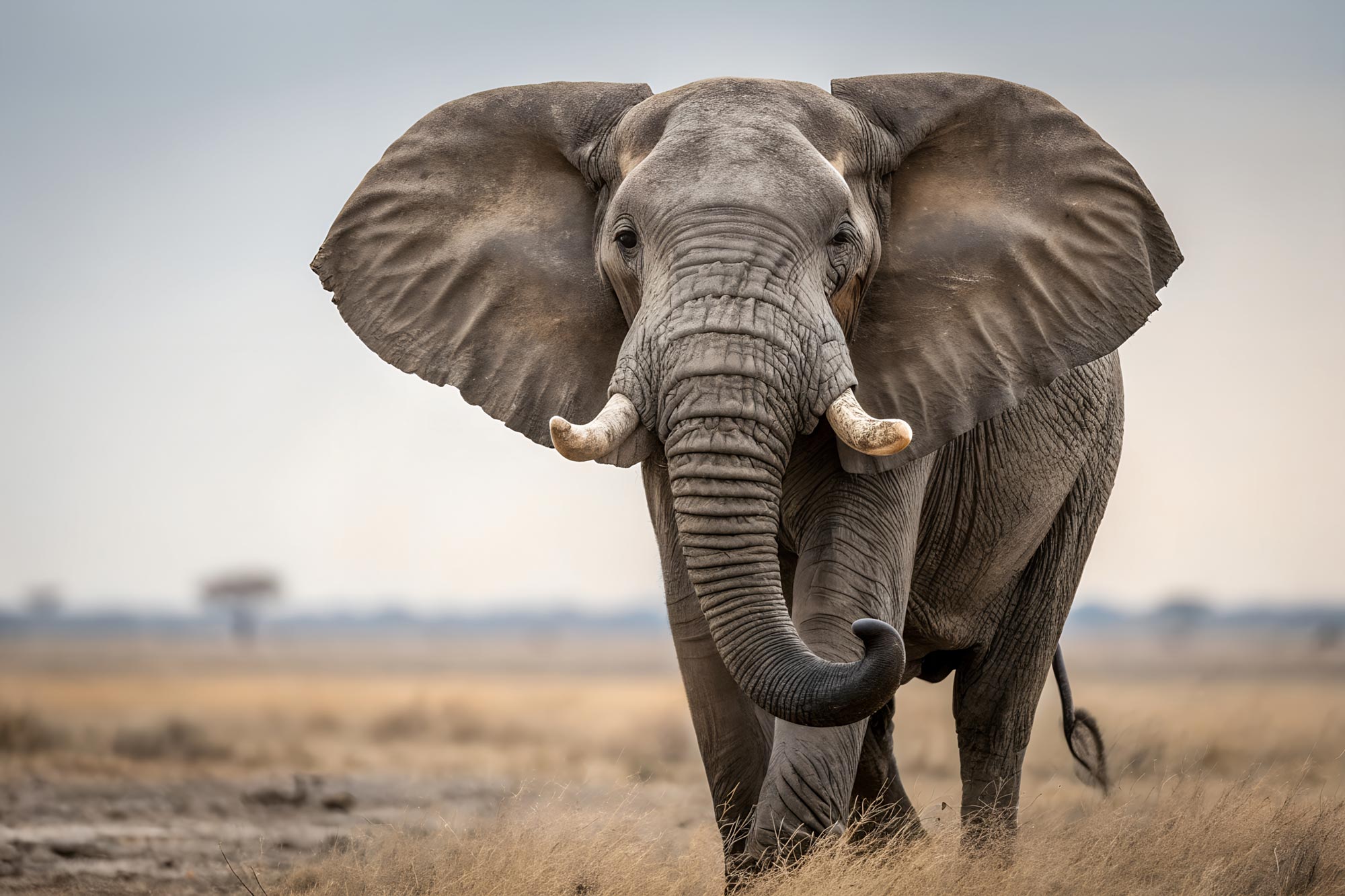
Africa’s giant herbivores did not simply vanish in a wave of extinctions. Their evolutionary family tree was slowly running out of new branches.
A new study suggests that the long decline of animals such as elephants, hippopotamuses, and their extinct relatives was driven primarily by low rates of speciation. Once a giant species disappeared, another rarely evolved quickly enough to take its place.
The finding challenges the idea that extreme size made these animals unusually vulnerable to extinction. It also places the beginning of their decline millions of years before humans acquired the technology needed to hunt such formidable prey.
A Lost World of Giant Herbivores
Megaherbivores weigh at least 1,000 kilograms (2,205 pounds) and can transform entire landscapes through feeding, trampling, digging, and seed dispersal. Modern elephants and hippopotamuses continue to perform some of these roles, but they represent only a fraction of the giant herbivore diversity that once existed.
Researchers from the National Museum of Natural Sciences (MNCN-CSIC), the National Research Center on Human Evolution (CENIEH), and the University of Alcalá reconstructed that lost history in a study published in Nature Communications.
The team examined 3,327 fossil records representing 396 species of herbivorous mammals (hippopotamuses, antelopes, and giraffes, among others) that lived in Africa during the past 23 million years. Neural network models were used to estimate how rates of extinction and speciation changed through time.
Fossils Reveal an Evolutionary Imbalance
The analysis incorporated body mass, tooth crown height, environmental change, and evolutionary relationships among different mammal families. Tooth structure was especially informative because high-crowned teeth last longer when animals consume tough grasses and other abrasive foods. The study linked this adaptation to lower extinction rates.
The broader pattern, however, was controlled by the balance between species disappearing and new ones evolving. A lineage can withstand frequent extinctions if speciation replaces its losses. Even a comparatively low extinction rate can cause a prolonged collapse when few new species emerge.
That second scenario appears to have shaped the history of Africa’s largest herbivores. Their lineages were not losing species exceptionally quickly, but they were poorly equipped to replenish their diversity over evolutionary time.
Africa Became Drier and More Open
The shift began around 7.2 million years ago as Africa grew increasingly dry. Forests and other densely vegetated environments gave way in many regions to more open habitats, changing food supplies and reorganizing communities of ungulates, or hoofed mammals. Both speciation and extinction initially accelerated during this transition.
Around 3.6 million years ago, the formation of new species stopped increasing at the same pace. Extinctions continued to climb and then rose sharply at the beginning of the Pleistocene, 2.58 million years ago. Large-bodied herbivores were therefore losing diversity long before humans could routinely kill animals of comparable size.
Among the casualties were Deinotherium, a massive elephant relative with tusks that curved downward from its lower jaw, and the Anthracotheriidae, piglike relatives of modern hippopotamuses.
Large Size Was Not the Main Weakness
“We found that, contrary to what was previously thought, larger species did not go extinct faster than smaller ones. In fact, their extinction rates were somewhat lower. The key is that megaherbivore species gave rise to new species much more slowly,” explains MNCN researcher Juan López Cantalapiedra.
During the driest intervals, animals weighing less than 45 kilograms (99 pounds) disappeared only 15% faster than species weighing more than a ton. Yet those smaller animals generated new species at 2.2 times the rate, allowing their lineages to recover losses far more effectively.
“This difference allowed small and medium-sized herbivores to better offset their losses. Large lineages, by contrast, kept losing diversity because not enough new species emerged to replace those that disappeared. This, combined with aridification, compounded the imbalance: it favored the emergence of new species among smaller ungulates while reducing it by nearly 20% among megaherbivores,” notes Óscar Sanisidro, from the University of Alcalá de Henares.
A Decline Millions of Years in the Making
The results show that people entered a story that had already been unfolding for millions of years. Climate change, expanding open habitats, and falling ecosystem productivity had steadily reduced the evolutionary resilience of Africa’s giant herbivores.
“The expansion of open habitats, increasing aridity, and declining ecosystem productivity transformed African communities over millions of years. Our results suggest that, although human activity may have contributed to some recent disappearances, it was not the main cause of the widespread loss of these large herbivores,” concludes Ignacio A. Lazagabaster from CENIEH.
Reference: “Lower speciation, not higher extinction, drove African megaherbivore diversity collapse” by Juan L. Cantalapiedra, Ignacio A. Lazagabaster, Fernando Blanco, Torsten Hauffe, Faysal Bibi, María Ríos, Bastien Mennecart, Juha Saarinen, Daniele Silvestro, Manuel Hernández Fernández and Oscar Sanisidro, 31 July 2026, Nature Communications.
DOI: 10.1038/s41467-026-76105-2
Never miss a breakthrough: Join the SciTechDaily newsletter.
Follow us on Google and Google News.