
Over the past forty years, three glaciers in Alaska—Yakutat, Alsek, and Grand Plateau—have significantly retreated, leading to the formation and expansion of lakes in their wake.
This transformation has doubled the size of the lakes, creating a new lake district that rivals the size of New York’s Seneca Lake and represents the fastest lake growth in the United States this century.
Transforming Landscapes: Glacier Retreat and Lake Formation in Alaska
In parts of Alaska, melting glaciers are giving way to water. As these massive ice formations thin and retreat, meltwater pools at their edges, creating what are known as proglacial lakes. Mauri Pelto, a glaciologist from Nichols College, has observed rapid growth in three of these lakes in southeastern Alaska over the past few decades.
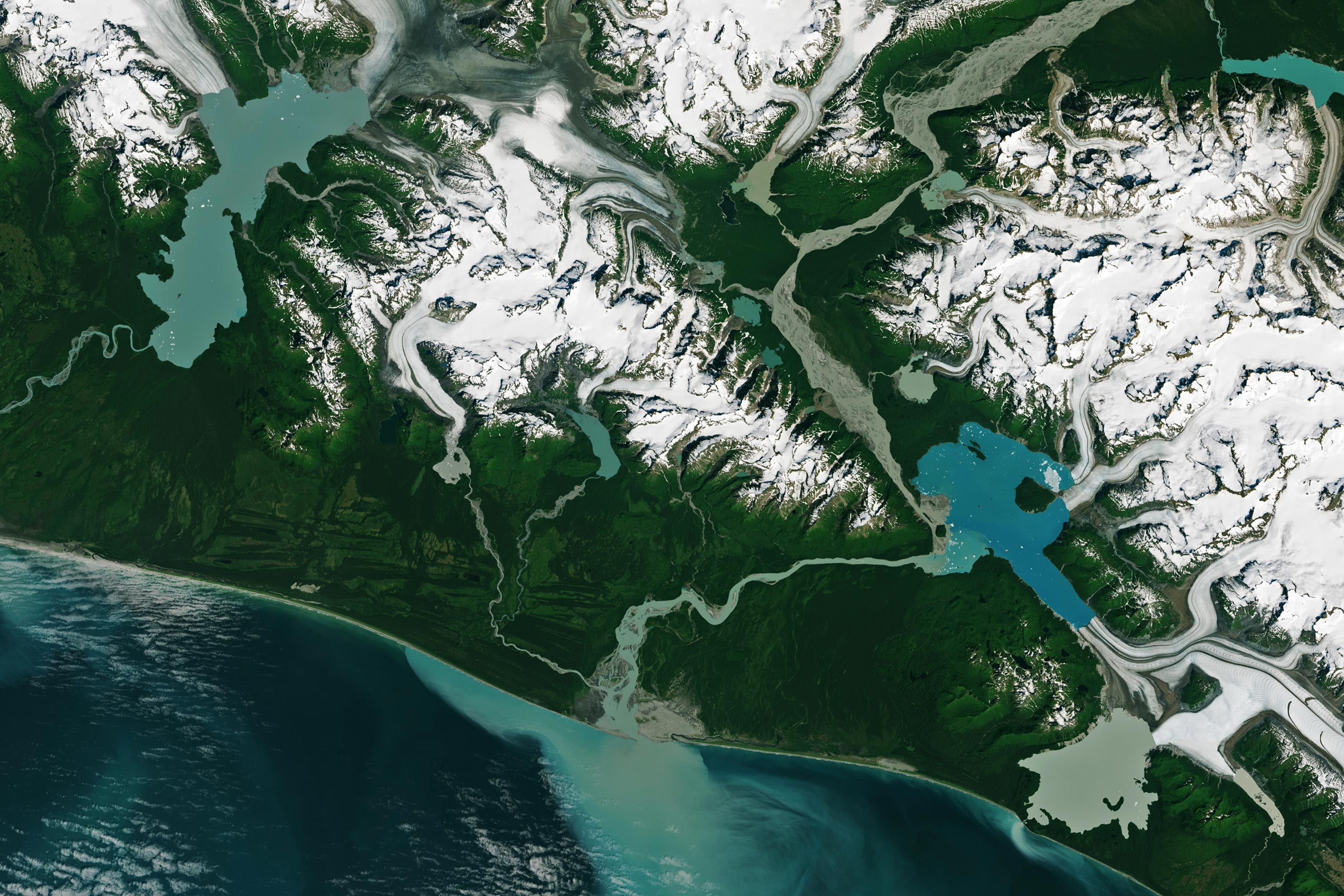
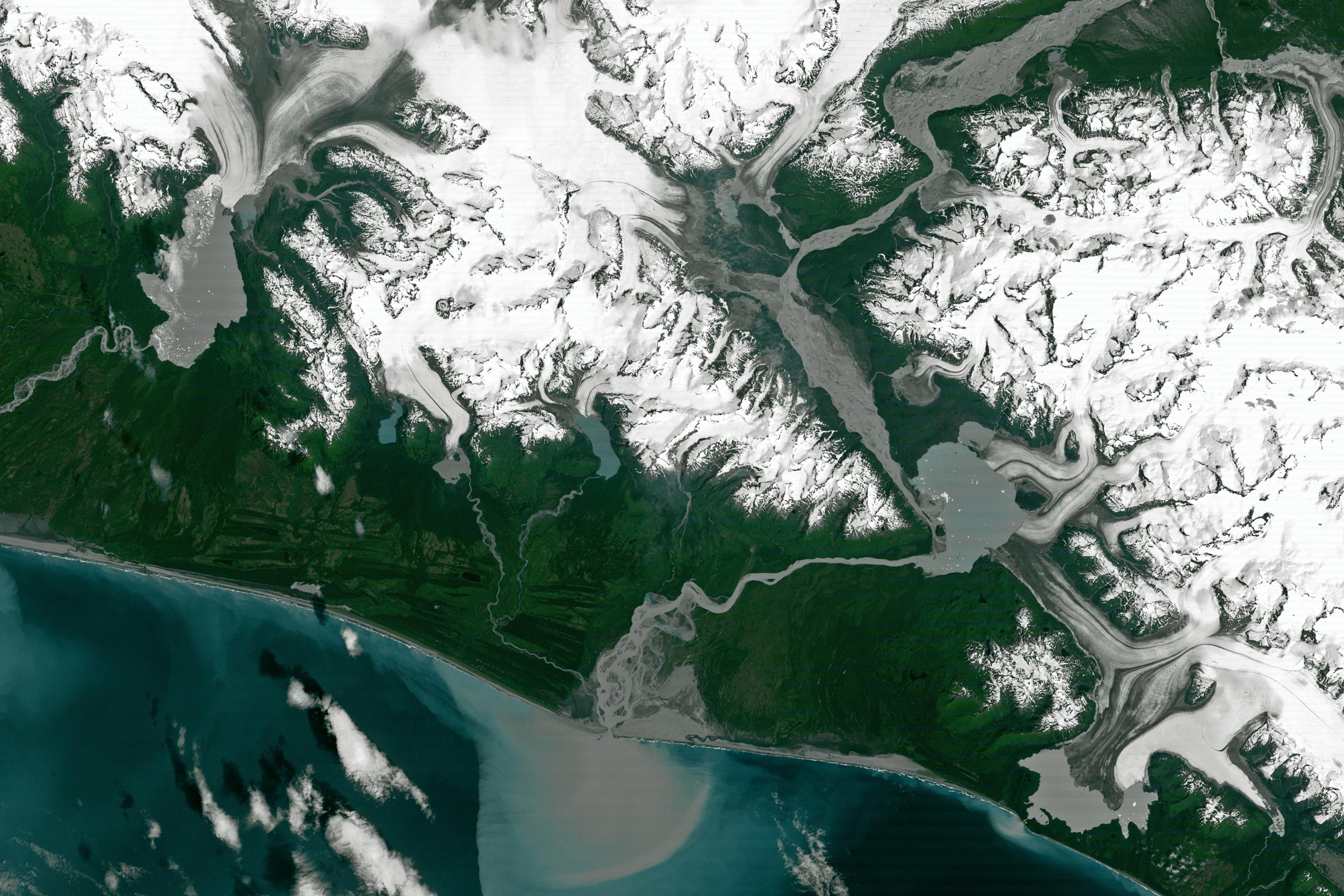
The Yakutat, Alsek, and Grand Plateau glaciers flow from inland mountains to the coastal plains southeast of Yakutat Borough, terminating in Harlequin Lake, Alsek Lake, and Grand Plateau Lake. The dramatic retreat of these glaciers and the corresponding expansion of their lakes are clearly visible in summer satellite images captured by Landsat 5 in 1984 (lower) and Landsat 8 in 2024 (upper).
Glacial Retreat: Dramatic Shifts Over Four Decades
During this period, Yakutat Glacier’s main arm retreated 7.0 kilometers (4.3 miles), while Alsek Glacier’s northern and southern arms retreated 5.3 kilometers (3.3 miles) and 5.5 kilometers (3.4 miles), respectively. Grand Plateau Glacier’s northern arm lost the most, retreating 7.8 kilometers (4.8 miles).
Lakes now fill the void left by the retreating glaciers. Collectively, the three lakes more than doubled in size over 40 years. In 1984, they covered about 50 square miles (130 square kilometers). By 2024, they spanned 90 square miles (240 square kilometers). That’s an area larger than Seneca Lake (67 square miles)—one of the Finger Lakes in New York, which also have a glacial origin.
The Emergence of a New Lake District
“The lakes that are forming in this region are immense, starting at the mountains and spreading toward the coast, making this a new lake district that is unique in our nation,” Pelto said.
Millions of other lakes, named and unnamed, dot the state. But this system has grown fast, so much so that Pelto thinks it might represent the fastest lake growth in the United States this century.
Sediment and Ecological Changes in Alaskan Lakes
The lakes are also changing in other ways. Alsek Lake appears much bluer in the 2024 image, indicating that the lake is receiving less fine-grained sediment, or “glacial flour,” from meltwater streams. As the lake receives less sediment, it will turn darker blue, Pelto said, allowing more light to penetrate the water and aid aquatic life and fishery development.
NASA Earth Observatory image by Wanmei Liang, using Landsat data from the U.S. Geological Survey.
Never miss a breakthrough: Join the SciTechDaily newsletter.
Follow us on Google and Google News.