
The Arctic is rapidly losing older, thicker sea ice due to warming and delayed freeze-ups, raising the risk of a dramatic further drop in summer ice coverage.
Throughout 2020, the Arctic Ocean and surrounding seas endured several notable weather and climate events. In spring, a persistent heatwave over Siberia provoked the rapid melting of sea ice in the East Siberian and Laptev Seas. By the end of summer, Arctic Ocean ice cover melted back to the second-lowest minimum extent on record. In autumn, the annual freeze-up of sea ice got off to a late and sluggish start.
But any single month, season, or even year, is just a snapshot in time. The long view is more telling, and it is troubling.
Forty years of satellite data show that 2020 was just the latest in a decades-long decline of Arctic sea ice. In a review of scientific literature, polar scientists Julienne Stroeve and Dirk Notz outlined some of these changes: In addition to shrinking ice cover, melting seasons are getting longer and sea ice is losing its longevity.
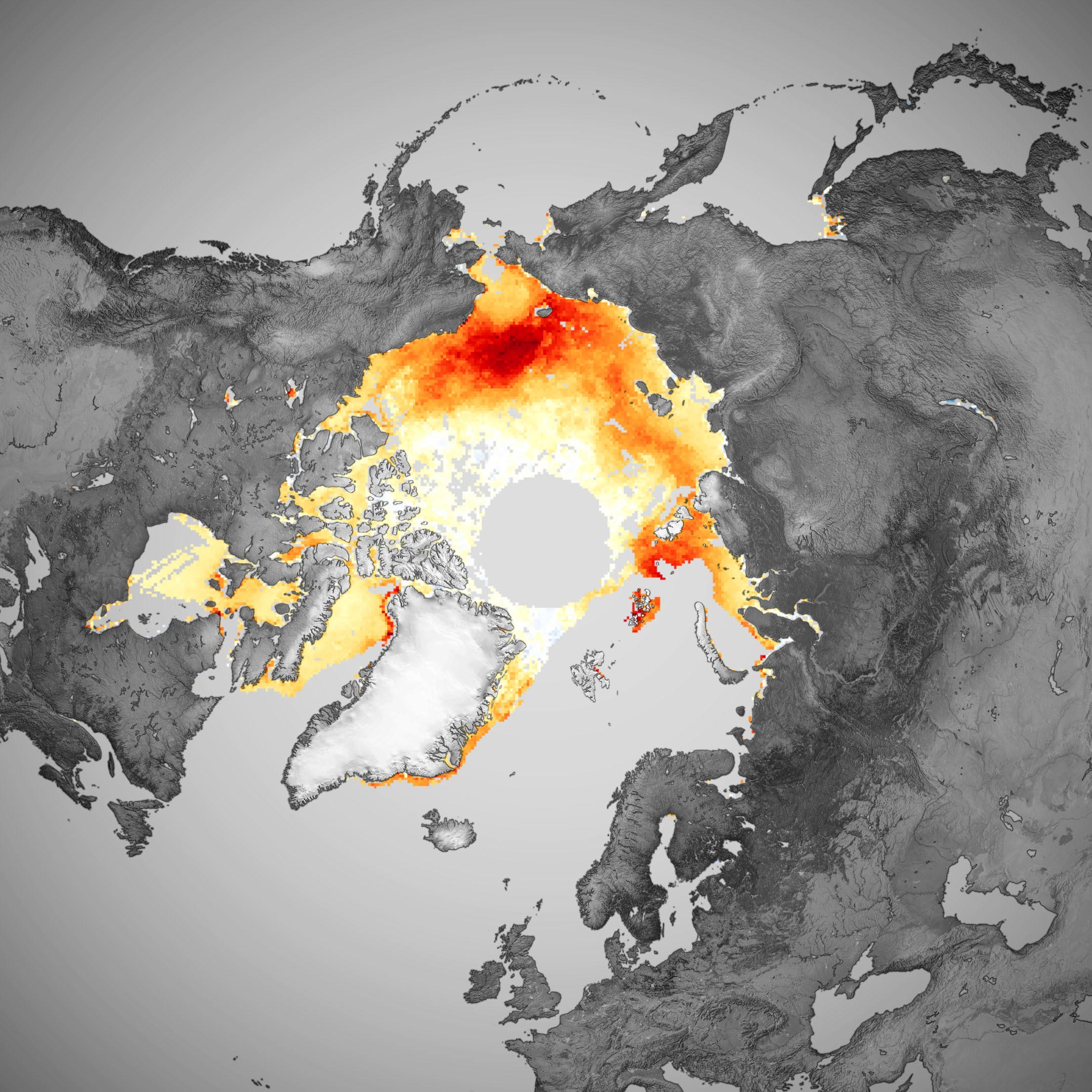
The longer melting seasons are the result of increasingly earlier starts to spring melting and ever-later starts to freeze up in autumn. The map above shows trends in the onset of freeze-up from 1979 through 2019. Averaged across the entire Arctic Ocean, freeze-up is happening about a week later per decade. That equates to nearly one month later since the start of the satellite record in 1979.
How Ice-Albedo Feedback Fuels Warming
The change is part of a cycle called “ice-albedo feedback.” Open ocean water absorbs 90 percent of the Sun’s energy that falls on it; bright sea ice reflects 80 percent of it. With greater areas of the Arctic Ocean exposed to solar energy early in the season, more heat can be absorbed—a pattern that reinforces melting. Until that heat escapes to the atmosphere, sea ice cannot regrow.
Sea Ice Is Getting Younger and Thinner
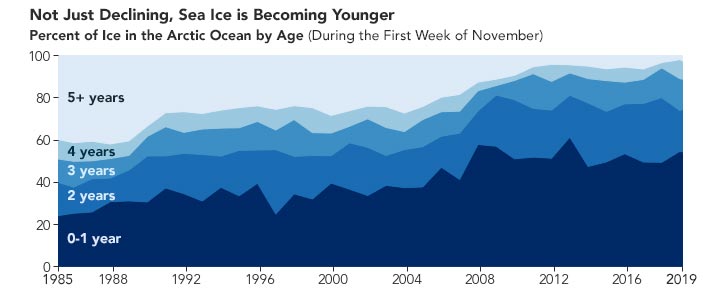
The chart above demonstrates another way the Arctic is changing: the average age of sea ice is becoming younger. At the start of the satellite record, much of the ice covering the Arctic Ocean was greater than four years old. Today, most of the ice covering the Arctic Ocean is “first-year ice” —ice that forms in winter and does not survive a single summer melt season. (After sea ice reaches its minimum extent each September, the remaining ice graduates to second-year status.)
Dominated by thin first-year ice, along with some older ice thinned by warm ocean water, the Arctic sea ice pack is becoming more fragile. In summer 2020, ships easily navigated the Northern Sea Route in ice-free waters, and even made it to the North Pole without much resistance.
Fortunately, summers are still not entirely ice-free. “We’ve been hovering for some time around 4 million square kilometers of Arctic sea ice each summer,” said Stroeve, a researcher at University of Manitoba. She added that she intends to examine which conditions and processes could push sea ice to the next “precipitous drop”—when the extent of summer ice cover drops to a new benchmark of 3 million square kilometers.
NASA Earth Observatory images by Joshua Stevens, using data from the National Snow and Ice Data Center courtesy of Julienne Stroeve/Centre for Polar Observation and Modelling (CPOM).
Reference: “Changing state of Arctic sea ice across all seasons” by Julienne Stroeve and Dirk Notz, 24 September 2018, Environmental Research Letters.
DOI: 10.1088/1748-9326/aade56
Never miss a breakthrough: Join the SciTechDaily newsletter.
Follow us on Google and Google News.
1 Comment
“Open ocean water absorbs 90 percent of the Sun’s energy that falls on it; bright sea ice reflects 80 percent of it.”
The above quote is approximately true for tropical waters where the sun is nearly overhead at noon. The specular reflection for sea water at noon is about 2% from the Equator to about 40 deg N/S latitude; at higher latitudes the specular reflection rises rapidly, reaching 100% at 90 deg latitude (geographic pole at the Equinox, or at the terminator at low latitudes). Thus, the 12-hour average is much higher than 2%. There is also a diffuse component of reflectance from sea water, resulting from suspended sediment and plankton. Therefore, the low and mid-latitudes have a combined reflectance of about 10% at NOON. However, there is generally less sediment and plankton in the cold Arctic waters and the reflectance is dominated by the specular component, which varies from about 10% to 100%.
Snow reflects about 80% of the sunlight falling on it and is relatively insensitive to the angle of the sunlight, being a diffuse reflector. However, smooth ice is a specular reflector, like liquid water, and can similarly reflect 100% of glancing light.
Is the Arctic warming? Yes. However, the reason given by NASA leaves a lot to be desired. And, if you will pardon the pun, it reflects poorly on NASA to put out such misinformation.
https://wattsupwiththat.com/2016/09/12/why-albedo-is-the-wrong-measure-of-reflectivity-for-modeling-climate/