
Eastern Siberia is famous for some of the coldest wintertime temperatures in the Northern Hemisphere. But in 2020, it has been the region’s wildly high temperatures and wildfires that have wowed meteorologists.
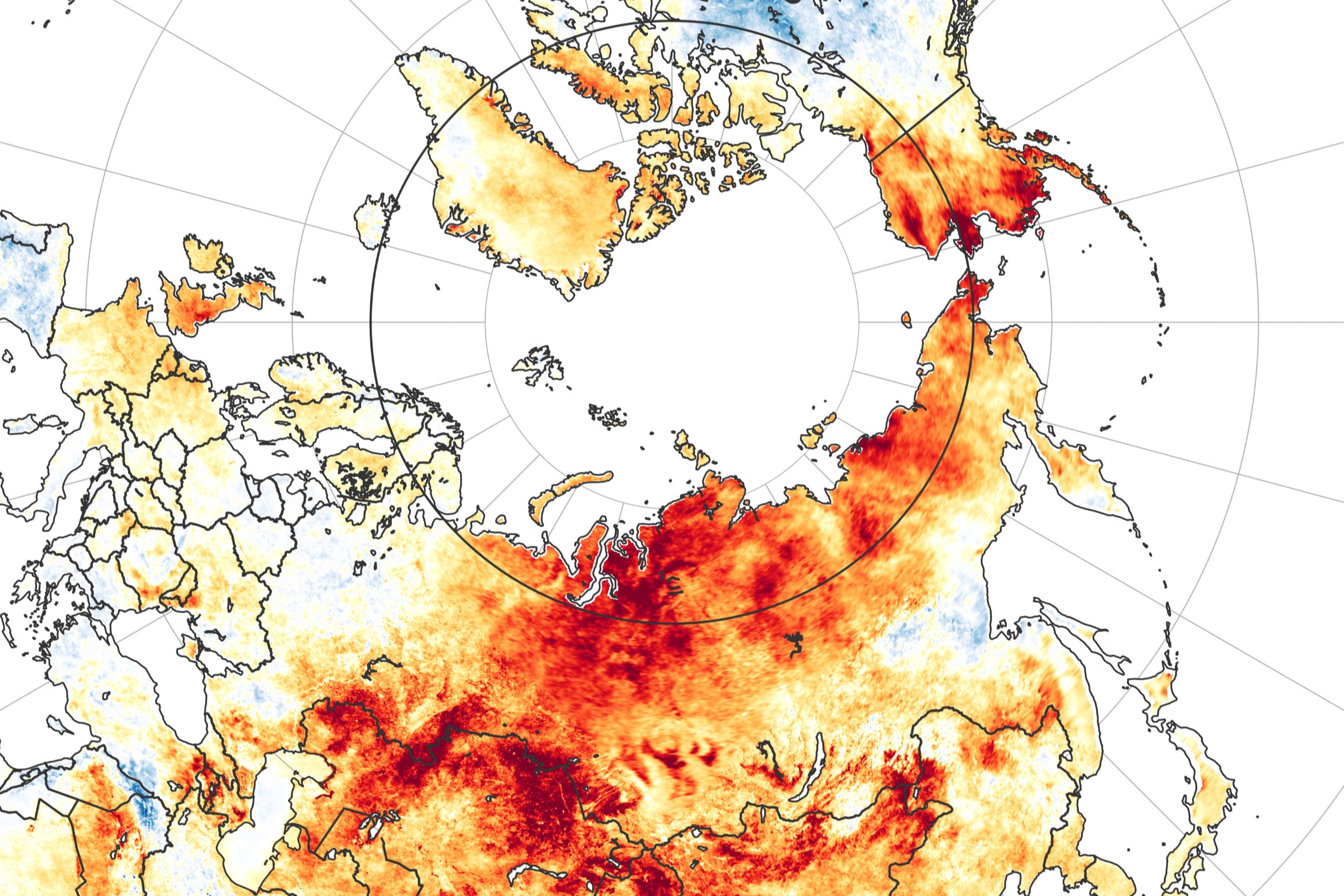
After several months of warm weather, the Russian town of Verkhoyansk reported a daytime temperature of 38°C (100.4°F) on June 20—likely a record high for the town. (The previous high was 37.3°C or 99.1°F, recorded on July 25, 1988.) If verified, this will be the northernmost temperature reading above 100°F ever observed and the highest temperature on record in the Arctic, according to the Capital Weather Gang.
“This event seems very anomalous in the last hundred years or so,” said NASA Goddard Institute for Space Studies Director Gavin Schmidt. “The background trends in temperature in this region are about 3 degrees Celsius or 5.4 degrees Fahrenheit since the 19th century, so the probabilities of breaking records there are increasing fast.”
The map at the top of the page shows land surface temperature anomalies from March 19 to June 20, 2020. Red colors depict areas that were hotter than average for the same period from 2003-2018; blues were colder than average. The map is based on data from the Moderate Resolution Imaging Spectroradiometer (MODIS) on NASA’s Aqua satellite.
Note that the map depicts land surface temperatures (LSTs), not air temperatures. LSTs reflect how hot the surface of the Earth would feel to the touch and can sometimes be significantly hotter or cooler than air temperatures.
In a report about the remarkably warm temperatures in Siberia, European scientists examined historical temperature data in their global ERA5 reanalysis, finding that temperatures have been unusually warm in the region since January 2020. Since the ERA5 data begins in 1979, the European team also looked to GISTEMP, a NASA temperature record with data through 1880. They could not find any other examples in either dataset of such an intense heat wave in this part of Siberia persisting for such an extended period.
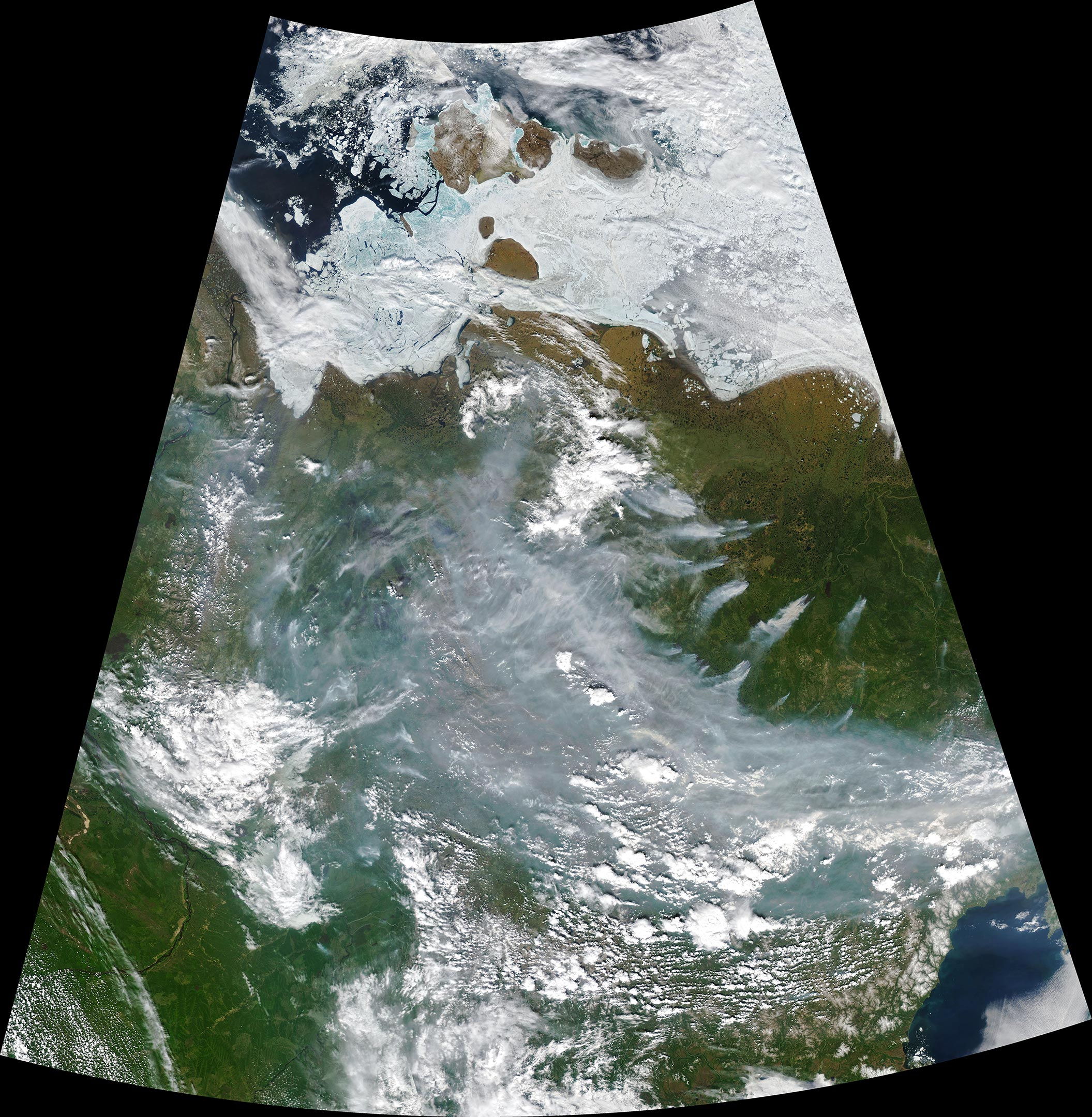
The persistent high-pressure atmospheric pattern that brought the extreme heat has exacerbated wildfires, prompting dozens to burn in the region’s forest and shrub ecosystems. Some of those ecosystems grow on top of carbon-rich layers of peat and permafrost. The natural-color image below shows smoke streaming from several active wildfires in Russia’s Sakha region.
“Most of Earth’s terrestrial carbon is stored in the upper latitudes of the northern hemisphere,” explained Amber Soja, a NASA scientist who has conducted field research in the region. Soja noted that many forests in the region are dominated by a coniferous tree—Dahurian larch—that drops its needles each winter. “But because the winters are so cold, there are few decomposers around to break the needles down. Over time, you end up with lots of buried fuel that has built up over centuries, even millennia, and stores huge quantities of carbon in peat and soils.”
Intense heat waves can thaw the permafrost layer and make long-frozen deposits susceptible to fires, which move carbon from the ground to the atmosphere and contribute to global concentrations of greenhouse gases. “In this part of Siberia, the signs of climate change are already here. It’s not some distant future. It’s now,” she said. “The heat and fires this year are just adding more evidence to the climate change signal that we have seen in these forests for years.”
Though it is still early in the fire season, satellite observations of active fires by NASA and NOAA’s MODIS and VIIRS sensors show the number of fire detections to be among the highest observed in any year since 2003. “Over the Russian Far East, there has been about the same amount of fire as last year, another very active year,” said NASA and Columbia University scientist Robert Field. “Both 2020 and 2019 were about twice the 2003–2020 average, and about half as much as 2011, the most active year.”
NASA Earth Observatory images by Joshua Stevens, using data from the Level 1 and Atmospheres Active Distribution System (LAADS) and Land Atmosphere Near real-time Capability for EOS (LANCE), and data from NASA EOSDIS/LANCE and GIBS/Worldview and the Suomi National Polar-orbiting Partnership.
Never miss a breakthrough: Join the SciTechDaily newsletter.
Follow us on Google and Google News.