
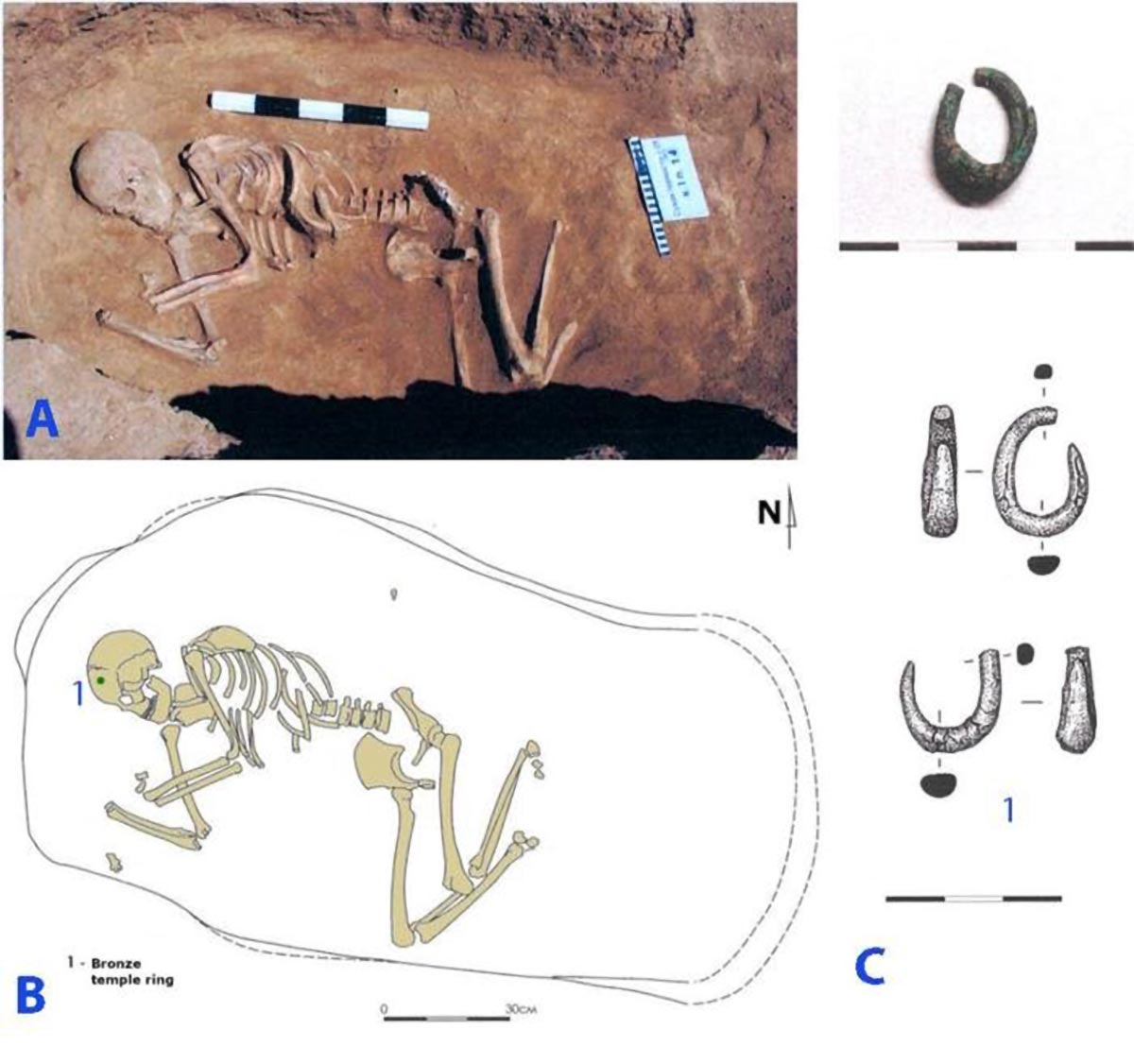
Ancient DNA analysis provides new insights into our linguistic roots.
Where did the Indo-European language family originate? A recent study by Ron Pinhasi and his team at the Department of Evolutionary Anthropology at the University of Vienna, in collaboration with David Reich’s ancient DNA laboratory at Harvard University, sheds new light on this enduring question. The researchers analyzed ancient DNA from 435 individuals excavated from archaeological sites across Eurasia, dating between 6,400 and 2,000 BCE. Their findings identify a previously unrecognized population from the Caucasus-Lower Volga region as a key ancestral group linked to all Indo-European-speaking populations. The study is published in Nature.
The Indo-European language family, comprising more than 400 languages—including major branches such as Germanic, Romance, Slavic, Indo-Iranian, and Celtic—is spoken by nearly half the global population today. These languages trace their roots to Proto-Indo-European (PIE), whose origins and dispersal have been a subject of scholarly investigation since the 19th century. Despite extensive research, significant gaps remain in our understanding of how and when PIE spread. This new genetic study provides crucial insights into the linguistic and demographic history of Indo-European-speaking populations.
The new study published in Nature, also involving Tom Higham and Olivia Cheronet from the University of Vienna, analyzes ancient DNA from 435 individuals from archaeological sites across Eurasia between 6400–2000 BCE. Earlier genetic studies had shown that the Yamnaya culture (3.300-2.600 BCE) of the Pontic-Caspian steppes north of the Black and Caspian Seas expanded into both Europe and Central Asia beginning about 3.100 BCE, accounting for the appearance of “steppe ancestry” in human populations across Eurasia 3.100-1.500 BCE. These migrations out of the steppes had the largest effect on European human genomes of any demographic event in the last 5.000 years and are widely regarded as the probable vector for the spread of Indo-European languages.

The only branch of Indo-European language (IE) that had not exhibited any steppe ancestry previously was Anatolian, including Hittite, probably the oldest branch to split away, uniquely preserving linguistic archaisms that were lost in all other IE branches. Previous studies had not found steppe ancestry among the Hittites because, the new paper argues, the Anatolian languages were descended from a language spoken by a group that had not been adequately described before, an Eneolithic population dated 4.500-3.500 BCE in the steppes between the North Caucasus Mountains and the lower Volga. When the genetics of this newly recognized Caucasus-Lower Volga (CLV) population are used as a source, at least five individuals in Anatolia dated before or during the Hittite era show CLV ancestry.
Newly recognized population with broad influence
The new study shows the Yamnaya population to have derived about 80% of its ancestry from the CLV group, which also provided at least one-tenth of the ancestry of Bronze Age central Anatolians, speakers of Hittite. “The CLV group therefore can be connected to all IE-speaking populations and is the best candidate for the population that spoke Indo-Anatolian, the ancestor of both Hittite and all later IE languages,” explains Ron Pinhasi. The results further suggest that the integration of the proto-Indo-Anatolian language, shared by both Anatolian and Indo-European peoples, reached its zenith among the CLV communities between 4.400 BC and 4.000 BC.
“The discovery of the CLV population as the missing link in the Indo-European story marks a turning point in the 200-years-old quest to reconstruct the origins of the Indo-Europeans and the routes by which these people spread across Europe and parts of Asia”, concludes Ron Pinhasi.
Reference: “The genetic origin of the Indo-Europeans” by Iosif Lazaridis, Nick Patterson, David Anthony, Leonid Vyazov, Romain Fournier, Harald Ringbauer, Iñigo Olalde, Alexander A. Khokhlov, Egor P. Kitov, Natalia I. Shishlina, Sorin C. Ailincăi, Danila S. Agapov, Sergey A. Agapov, Elena Batieva, Baitanayev Bauyrzhan, Zsolt Bereczki, Alexandra Buzhilova, Piya Changmai, Andrey A. Chizhevsky, Ion Ciobanu, Mihai Constantinescu, Marietta Csányi, János Dani, Peter K. Dashkovskiy, Sándor Évinger, Anatoly Faifert, Pavel Flegontov, Alin Frînculeasa, Mădălina N. Frînculeasa, Tamás Hajdu, Tom Higham, Paweł Jarosz, Pavol Jelínek, Valeri I. Khartanovich, Eduard N. Kirginekov, Viktória Kiss, Alexandera Kitova, Alexeiy V. Kiyashko, Jovan Koledin, Arkady Korolev, Pavel Kosintsev, Gabriella Kulcsár, Pavel Kuznetsov, Rabadan Magomedov, Aslan M. Mamedov, Eszter Melis, Vyacheslav Moiseyev, Erika Molnár, Janet Monge, Octav Negrea, Nadezhda A. Nikolaeva, Mario Novak, Maria Ochir-Goryaeva, György Pálfi, Sergiu Popovici, Marina P. Rykun, Tatyana M. Savenkova, Vladimir P. Semibratov, Nikolai N. Seregin, Alena Šefčáková, Raikhan S. Mussayeva, Irina Shingiray, Vladimir N. Shirokov, Angela Simalcsik, Kendra Sirak, Konstantin N. Solodovnikov, Judit Tárnoki, Alexey A. Tishkin, Viktor Trifonov, Sergey Vasilyev, Ali Akbari, Esther S. Brielle, Kim Callan, Francesca Candilio, Olivia Cheronet, Elizabeth Curtis, Olga Flegontova, Lora Iliev, Aisling Kearns, Denise Keating, Ann Marie Lawson, Matthew Mah, Adam Micco, Megan Michel, Jonas Oppenheimer, Lijun Qiu, J. Noah Workman, Fatma Zalzala, Anna Szécsényi-Nagy, Pier Francesco Palamara, Swapan Mallick, Nadin Rohland, Ron Pinhasi and David Reich, 5 February 2025, Nature.
DOI: 10.1038/s41586-024-08531-5
Never miss a breakthrough: Join the SciTechDaily newsletter.
Follow us on Google and Google News.
1 Comment
When the black sea rose about 6500 bc, all the people living in that flat plain had to escape the flood. By moving up the river valleys they could still plant crops. But the groups moving from the Crimea regions became steppe herders. May cop culture and yamniha. The language spoken by these people’s who populated the region are the proto- indo speakers.