

A giant burrowing salamander fossil challenges assumptions about amphibian evolution in prehistoric Appalachia.
A giant salamander with powerful jaws once burrowed through the ancient soil of what is now Tennessee.
Thanks to a fossil found near East Tennessee State University, scientists have gained new insight into how this creature influenced the diversity of amphibians in the Appalachian region.
This large plethodontid salamander is now part of the impressive collection of prehistoric life preserved at the Gray Fossil Site and Museum.
The discovery was published in the journal Historical Biology by a team of researchers from the Gray Fossil Site and Museum and ETSU: Assistant Collections Manager Davis Gunnin, Director and Professor of Geosciences Dr. Blaine Schubert, Head Curator and Associate Professor of Geosciences Dr. Joshua Samuels, Museum Specialist Keila Bredehoeft, and Assistant Collections Manager Shay Maden.
“Our researchers are not only uncovering ancient life, they are modeling the kind of collaboration and curiosity that define ETSU,” said Dr. Joe Bidwell, dean of the College of Arts and Sciences. “This exciting find underscores the vital role our university plays in preserving and exploring Appalachia’s deep natural history.”
Southern Appalachia: a salamander hotspot
Today, the forests of Southern Appalachia are known for their rich variety of salamander species, especially the lungless salamanders belonging to the family Plethodontidae. Tennessee alone is home to over 50 different species, accounting for about one in every eight salamander species alive today.
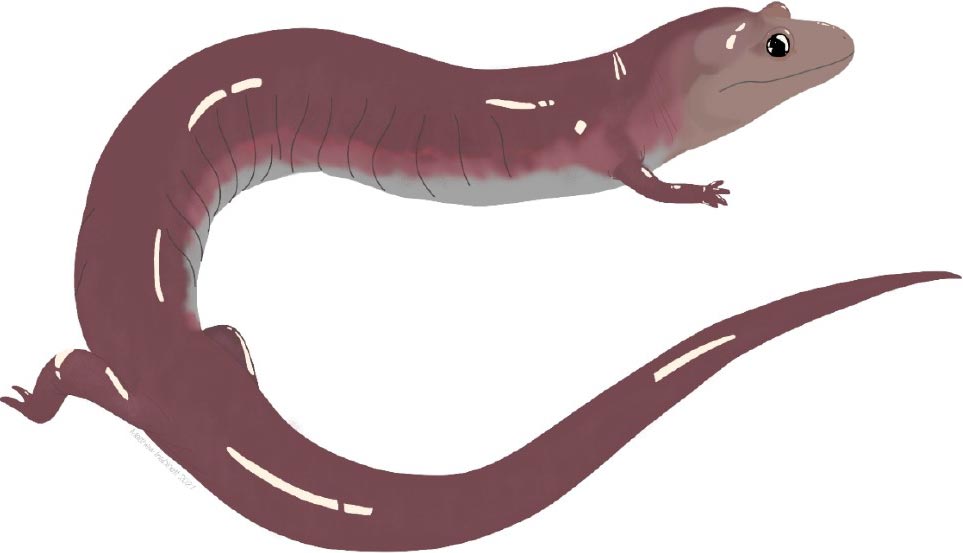
Dusky salamanders, which are commonly found in Appalachian mountain streams, likely descended from burrowing ancestors. One close relative is Alabama’s Red Hills salamander, a large, underground-dwelling species with a worm-like body and small limbs. This group began to diversify rapidly around 12 million years ago, contributing to much of the salamander diversity seen in the region today.
Among these ancient creatures was Dynamognathus robertsoni, a powerful salamander recently identified at the site. Measuring about 16 inches long, it was one of the largest salamanders ever known to inhabit the forests of prehistoric Appalachia.
Rethinking salamander evolution
“Finding something that looks like a Red Hills salamander here in East Tennessee was a bit of a surprise,” Gunnin said. “Today, they’re only found in a few counties in southern Alabama, and researchers thought of them as a highly specialized dead-end lineage not particularly relevant to the evolution of the dusky salamanders. Discovery of Dynamognathus robertsoni here in Southern Appalachia shows that these types of relatively large, burrowing salamanders were once more widespread in eastern North America and may have had a profound impact on the evolution of Appalachian salamander communities.”
Dynamognathus robertsoni is “the largest plethodontid salamander and one of the largest terrestrial salamanders in the world,” Gunnin said. Dusky salamanders in the Appalachians today reach only seven inches long at their largest.
Researchers believe predators like this one may have driven the rapid evolution of Appalachian stream-dwelling salamanders, highlighting the region’s key role in salamander diversification.
“The warmer climate in Tennessee 5 million years ago, followed by cooling during the Pleistocene Ice Ages, may have restricted large, burrowing salamanders to lower latitudes, like southern Alabama, where the Red Hills salamander lives today,” said Samuels.
Maden explained the naming of this new salamander.
Naming the powerful-jawed salamander
“This group of salamanders has unusual cranial anatomy that gives them a strong bite force, so the genus name – Dynamognathus – Greek for ‘powerful jaw,’ is given to highlight the great size and power of the salamander compared to its living relatives,” said Maden.
The species name robertsoni honors longtime Gray Fossil Site volunteer Wayne Robertson, who discovered the first specimen of the new salamander and has personally sifted through more than 50 tons of fossil-bearing sediment since 2000.
From volunteers and students to staff to faculty, the ETSU Gray Fossil Site & Museum is represented by a dynamic team of lifelong learners and is one of the many reasons ETSU is the flagship institution of Appalachia.
“The latest salamander publication is a testament to this teamwork and search for answers,” said Schubert. “When Davis Gunnin, the lead author, began volunteering at the museum as a teenager with an interest in fossil salamanders, I was thrilled, because this region is known for its salamander diversity today, and we know so little about their fossil record. Thus, the possibility of finding something exciting seemed imminent.”
Reference: “A new plethodontid salamander from the Early Pliocene of northeastern Tennessee, U.S.A., and its bearing on desmognathan evolution” by Davis Gunnin, Blaine W. Schubert, Joshua X. Samuels, Keila E. Bredehoeft and Shay Maden, 16 May 2025, Historical Biology.
DOI: 10.1080/08912963.2025.2501332
Never miss a breakthrough: Join the SciTechDaily newsletter.
Follow us on Google and Google News.
4 Comments
Extremely interesting.
Show the fossil, not child drawings of it
I’ve seen these all over Stewart County Tennessee while growing up.
Recently, I found this type of Salamader in my yard when I was digging up dead lavender. I had my gardener remove it because it looked exactly like the picture on here ! I was big and the exact color !