
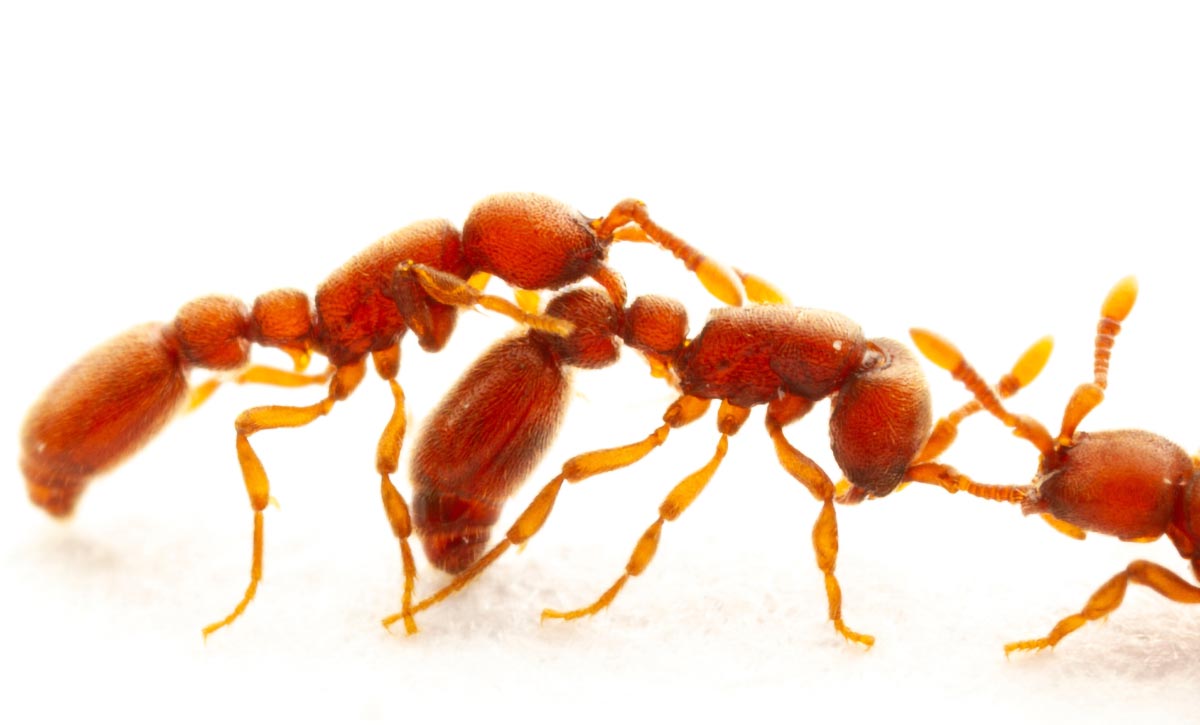
Ant societies rely on precise recognition systems to maintain cooperation, but new research reveals that these systems are more adaptable than once believed.
For ants, quickly telling friend from foe can mean the difference between survival and collapse. A new study reveals that the system ants use to recognize colony members is not fixed, but surprisingly adaptable.
Published in Current Biology, the research shows that clonal raider ants adjust their sense of colony identity throughout their lives based on repeated encounters. Even so, they still retain a built-in ability to recognize their genetic relatives. The study explains how ants can learn to accept outsiders while outsiders begin to fit in, and it lays the groundwork for future research on how the brain processes social smells.
“We’ve known for a long time that ants are very good at distinguishing between an ant from a different colony and one of their own, but less was known about how flexible this behavior is,” says Daniel Kronauer, head of the Laboratory of Social Evolution and Behavior at Rockefeller University. “This work is a first step toward figuring out, on a behavioral level, how ants make that distinction, and it will help inform future experiments into the neurobiological underpinnings of ant society.”
Life as a superorganism
Ant colonies mark a major evolutionary transition, shifting from solitary insects to tightly coordinated societies where thousands of individuals function as a single unit. Similar systems appear throughout biology. Cells in the body, immune defenses, and insect societies all rely on the same basic principle: distinguishing self from outsider.
In the immune system, cells must destroy harmful invaders without damaging healthy tissue. Ants face a comparable challenge. They must recognize nestmates while identifying and rejecting intruders that attempt to exploit the colony.
To do this, ants rely on waxy chemicals that coat their bodies. While all colonies use the same types of compounds, each colony has a unique chemical signature based on the proportions of those compounds. Ants learn this scent early in life and use it to identify one another.
These chemical cues are not permanent. “Perhaps the genetic composition of the colony changes; perhaps environmental influences change the colony odor; perhaps the ant colony encounters different neighbors and now needs to discriminate against ants from certain colonies more than others,” Kronauer says. “Ants must have some way of updating this system.”
Tiphaine Bailly, a postdoctoral researcher in Kronauer’s lab, suspected that learning plays a larger role than previously thought. “We knew that ant societies depend on cooperation, and that recognizing who belongs to the colony and who does not is essential,” Bailly says. “Understanding how ants make this distinction would therefore help us uncover the mechanisms that maintain cooperation in complex societies.”
An ant’s sense of self
To test how flexible this recognition system is, Bailly and her colleagues studied the clonal raider ant (Ooceraea biroi). This species reproduces asexually, allowing scientists to create genetically identical ants from different lineages. By mixing these lineages, the researchers built experimental colonies to observe how ants adjust their social recognition.
The team examined several distinct clonal lines. Chemical analysis confirmed that all colonies share the same basic compounds, but each produces a different scent by combining them in unique ratios. When ants from one genotype were introduced into another colony, the resident ants reacted aggressively, often biting the newcomers.
Learning, Memory, and Limits
The researchers then explored whether these responses could change. Young ants with still-developing chemical profiles were placed into foreign colonies. Over time, extended exposure altered both their scent and their behavior.
After about a month, these ants chemically matched their new colony and no longer showed aggression toward it, similar to ants born there. However, this flexibility had clear boundaries. Even ants separated from their relatives since the egg stage still accepted individuals with their own genotype. This suggests that experience can expand recognition, but it does not fully override an innate sense of identity.
This learned tolerance was also temporary. When contact with the new colony stopped, aggression returned within roughly a week. As time passed, the ants’ chemical signatures shifted back toward their original state, eventually leading former nestmates to reject them.
At the same time, even occasional contact was enough to preserve tolerance. This points to a form of longer-lasting smell-based memory rather than a brief sensory adjustment, which would normally fade within hours. Notably, ants maintained tolerance even after five days of complete separation.
Parallels With the Immune System
The pattern resembles how the immune system responds to repeated low-level exposure. For instance, small controlled doses of allergens such as pollen can train the immune system to tolerate them instead of triggering a reaction.
Ants appear to follow a similar principle. Repeated exposure to foreign colony scents reduces hostility, while occasional encounters help maintain that tolerance over time.
“It’s a conceptual comparison, of course. At the molecular level, these things work quite differently,” Kronauer explains. “But the evolution of an ant colony is similar to the transition from a single-celled to a multicellular organism, and it is interesting to think about the parallels between major transitions in evolution. These parallels may run deeper than we thought.”
Overall, the findings show that ants can adjust their definition of who belongs, but only within limits. They continuously refine their internal template of colony membership while preserving a core recognition of their own genetic identity.
This work provides a foundation for future studies aimed at uncovering where and how this learning occurs in the brain.
“Now we can combine the neurobiological tools with this behavioral system and image neural activity while an ant encounters a nestmate or a non-nestmate,” Kronauer says. “With this foundation, we can finally begin to ask where learning and adaptation happens in the brain.”
Reference: “Tolerance toward foreigners in ants requires chronic exposure for establishment but only sporadic exposure for maintenance” by Tiphaine P.M. Bailly, Matteo Rossi, Stephany Valdés-Rodríguez, Thomas Schmitt, Erik T. Frank and Daniel J.C. Kronauer, 20 March 2026, Current Biology.
DOI: 10.1016/j.cub.2026.02.041
Never miss a breakthrough: Join the SciTechDaily newsletter.
Follow us on Google and Google News.
1 Comment
An interesting study. Praise to the team. When comparing the immune system to the ants’ recognition, I feel that it is another feather in the cap of evolutionary theory