
Close Menu
    Facebook X (Twitter) Instagram
    SciTechDaily
    • Biology
    • Chemistry
    • Earth
    • Health
    • Physics
    • Science
    • Space
    • Technology
    Facebook X (Twitter) Pinterest YouTube RSS
    SciTechDaily
    Home»Biology»Area of Monkey Brain Keeps Tally of Altruistic Acts
    Biology

    Area of Monkey Brain Keeps Tally of Altruistic Acts

    By SciTechDailyDecember 24, 20122 Comments2 Mins Read
    Facebook Twitter Pinterest Telegram LinkedIn WhatsApp Email Reddit
    Share
    Facebook Twitter LinkedIn Pinterest Telegram Email Reddit
    altruism-monkey
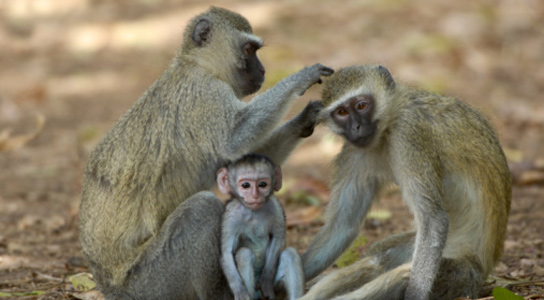
    Researchers have found that monkeys have a distinct brain area for tracking altruistic behavior.

    Steve Chang and his colleagues from Duke University in Durham, North Carolina, have discovered that monkeys have a specific area in their brains to keep track of altruistic acts. This might help researchers understand the mechanisms underlying normal social behavior in primates and humans, and could even provide insight into autism spectrum disorder.

    The scientists published their findings in the journal Nature Neuroscience. They used electrodes to directly record neuronal activity in three areas of the prefrontal cortex, an area that is known to be involved in social decision-making while the monkey performed reward-related tasks.

    When the monkeys had the choice to drink juice from a tube for themselves or give it to another, they would mostly drink it themselves. However, when the choice was between giving juice to a neighbor or neither monkey receiving anything, the monkey would often choose to give the juice to the other.

    The researchers found that in two out of the three brain areas being recorded, neurons fired in the presence or absence of the juice reward only. By contrast, the area known as the anterior cingulate gyrus responded only when the monkey allocated the juice to the neighbor and observed it being received. The scientists suggest that the neurons in the ACG respond to and record the act simultaneously.

    The ACG is known to be a region specialized for social decision-making in primates, and it is located in the same area of the brain as that associated with the generation of feelings of empathy in humans.

    Whether the ACG operates in a similar fashion in humans hasn’t been demonstrated yet, but the authors suggest that the intricate balance between the signaling of neurons in these three brain regions may be crucial for normal social behavior in humans, and that disruption may contribute to various psychiatric conditions, including autistic spectrum disorders.

    Reference: “Neuronal reference frames for social decisions in primate frontal cortex” by Steve W C Chang, Jean-François Gariépy and Michael L Platt, 23 December 2012, Nature Neuroscience.
    DOI: 10.1038/nn.3287

    Never miss a breakthrough: Join the SciTechDaily newsletter.
    Follow us on Google and Google News.

    Brain Activity Neurology Neuroscience Primates Primatology Zoology
    Share. Facebook Twitter Pinterest LinkedIn Email Reddit

    Related Articles

    Stem Cells in Hippocampus React by “Listen in” on Nearby Neurons

    Images of Brain Connectivity Help Predict Intelligence

    Imbalance Between Neuronal Excitation and Inhibition May Account for Seizure Susceptibility in Angelman Syndrome

    Life Long Learning and Experiences Are Good for the Brain

    Von Economo Neuron Discovered in the Insula of Macaque Monkeys

    DRD2 May Protect Brain Regions from Alcohol-Induced Brain Damage

    Researchers Use FDDNP–PET Scanning to Predict Cognitive Decline

    Neuroscientists Create Model to Study Burst Suppression and Brain States

    Researchers Use fMRI to Study How Humor Activates Kids’ Brain Regions

    2 Comments

    1. Madanagopal.V.C. on December 26, 2012 9:36 pm

      Social decision in living beings is a common one. We can see the behaviour in crows also when they find food, they cry to their friends to share the same. ACG response in the brain is a common one. But in humans it is not working because of suppression of neuronal firing by us in order to be greedy of having the reward kept to ourselves. The only greediness in animals is the territorial behaviour to protect their living territory and it will not enlarge to other spheres of social activity. By the by maximum area in our brain is reserved for operation of our fingers and thumb for which task we are adapted to live. Thank You.

      Reply
    2. Beautiful but beaten in CA on July 17, 2025 3:48 am

      I’ve read that narcissists brain specifically their ACG is a dark & lonely place devoid of activity. Is this true?
      If so could this information be utilized in court?

      Reply
    Leave A Reply Cancel Reply

    • Facebook
    • Twitter
    • Pinterest
    • YouTube

    Don't Miss a Discovery

    Subscribe for the Latest in Science & Tech!

    Trending News

    New Study Reveals Why Ozempic Works Better for Some People Than Others

    Climate Change Is Altering a Key Greenhouse Gas in a Way Scientists Didn’t Expect

    New Study Suggests Gravitational Waves May Have Created Dark Matter

    Scientists Discover Why the Brain Gets Stuck in Schizophrenia

    Scientists Engineer “Tumor-Eating” Bacteria That Devour Cancer From Within

    Even “Failed” Diets May Deliver Long-Term Health Gains, Study Finds

    NIH Scientists Discover Powerful New Opioid That Relieves Pain Without Dangerous Side Effects

    Collapsing Plasma May Hold the Key to Cosmic Magnetism

    Follow SciTechDaily
    • Facebook
    • Twitter
    • YouTube
    • Pinterest
    • Newsletter
    • RSS
    SciTech News
    • Biology News
    • Chemistry News
    • Earth News
    • Health News
    • Physics News
    • Science News
    • Space News
    • Technology News
    Recent Posts
    • The Surprising Reason You Might Want To Sleep Without a Pillow
    • Household Cats Could Hold the Secret to Fighting Breast Cancer
    • Scientists Say This Natural Hormone Reverses Obesity by Targeting the Brain
    • This 15,000-Year-Old Discovery Changes What We Know About Early Human Creativity
    • 35-Million-Year-Old Mystery: Strange Arachnid Discovered Preserved in Amber
    Copyright © 1998 - 2026 SciTechDaily. All Rights Reserved.
    • Science News
    • About
    • Contact
    • Editorial Board
    • Privacy Policy
    • Terms of Use

    Type above and press Enter to search. Press Esc to cancel.