
Close Menu
    Facebook X (Twitter) Instagram
    SciTechDaily
    • Biology
    • Chemistry
    • Earth
    • Health
    • Physics
    • Science
    • Space
    • Technology
    Facebook X (Twitter) Pinterest YouTube RSS
    SciTechDaily
    Home»Space»Arecibo Radar Views Near-Earth Asteroid 3200 Phaethon
    Space

    Arecibo Radar Views Near-Earth Asteroid 3200 Phaethon

    By DC Agle, Jet Propulsion LaboratoryDecember 22, 2017No Comments4 Mins Read
    Facebook Twitter Pinterest Telegram LinkedIn WhatsApp Email Reddit
    Share
    Facebook Twitter LinkedIn Pinterest Telegram Email Reddit
    Arecibo Radar Views Asteroid Phaethon
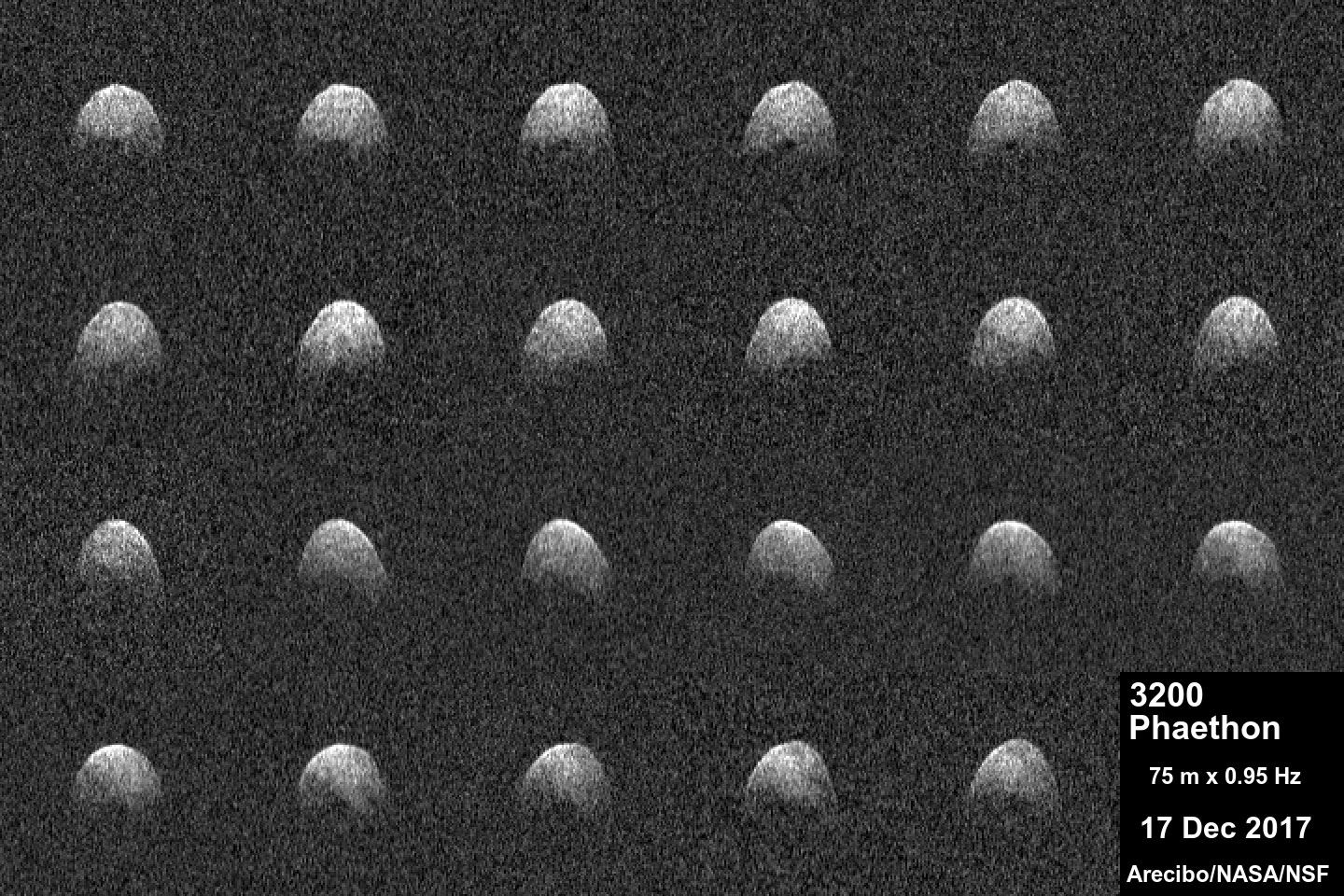
    These radar images of near-Earth asteroid 3200 Phaethon were generated by astronomers at the National Science Foundation’s Arecibo Observatory on December 17, 2017. Observations of Phaethon were conducted at Arecibo from December 15 through 19, 2017. At time of closest approach on December 16 at 3 p.m. PST (3 p.m. EST, 11 p.m. UTC) the asteroid was about 1.1 million miles (1.8 million kilometers) away, or about 4.6 times the distance from Earth to the moon. The encounter is the closest the object will come to Earth until 2093. Credit: Arecibo Observatory/NASA/NSF

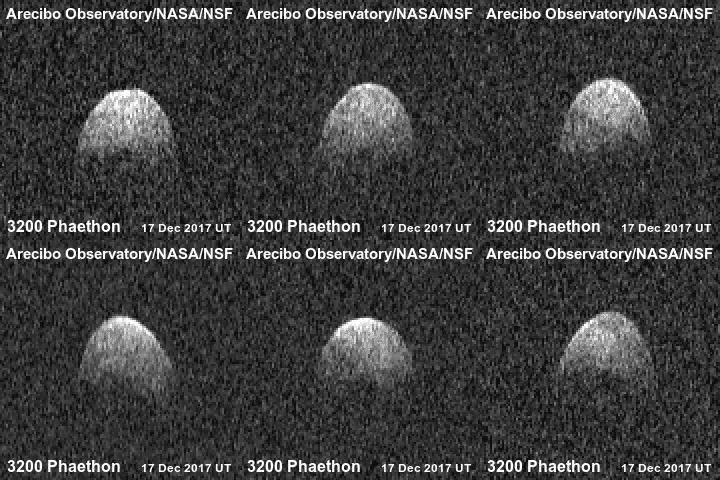
    After several months of downtime after Hurricane Maria blew through, the Arecibo Observatory Planetary Radar has returned to normal operation, providing the highest-resolution images to date of near-Earth asteroid 3200 Phaethon during its December 16 flyby of Earth. The radar images, which are subtle at the available resolution, reveal the asteroid is spheroidal in shape and has a large concavity at least several hundred meters in extent near the leading edge, and a conspicuous dark, circular feature near one of the poles. Arecibo’s radar images of Phaethon have resolutions as fine as about 250 feet (75 meters) per pixel.

    “These new observations of Phaethon show it may be similar in shape to asteroid Bennu, the target of NASA’s OSIRIS-REx spacecraft, but 10 times larger,” said Patrick Taylor, a Universities Space Research Association (USRA), Columbia, Maryland, scientist and group leader for Planetary Radar at Arecibo Observatory. “The dark feature could be a crater or some other topographic depression that did not reflect the radar beam back at us.”
    Near-Earth Asteroid 3200 Phaethon
    Near-Earth asteroid 3200 Phaethon. Credit: Arecibo Observatory/NASA/NSF

    Radar images obtained by Arecibo indicate Phaethon has a diameter of about 3.6 miles (6 kilometers) — roughly 0.6 miles (1 kilometer) larger than previous estimates. Phaethon is the second largest near-Earth asteroid classified as “Potentially Hazardous.” Near-Earth objects are classified as potentially hazardous asteroids (PHAs), based on their size and how closely their orbits approach Earth.

    “Arecibo is an important global asset, crucial for planetary defense work because of its unique capabilities,” said Joan Schmelz of USRA and deputy director of Arecibo Observatory. “We have been working diligently to get it back up and running since Hurricane Maria devastated Puerto Rico.”

    The Arecibo Observatory has the most powerful astronomical radar system on Earth. On September 20, the telescope suffered minor structural damage when Maria, the strongest hurricane to hit the island since 1928, made landfall. Some days after the storm, the telescope resumed radio astronomy observations, while radar observations, which require high power and diesel fuel for generators at the site, resumed operations in early December after commercial power returned to the observatory.

    Asteroid Phaethon was discovered on October 11, 1983, by NASA’s Infrared Astronomical Satellite (IRAS). Observations of Phaethon were conducted at Arecibo from December 15 through 19, 2017, using the NASA-funded planetary radar system. At time of closest approach on December 16 at 3 p.m. PST (3 p.m. EST, 11 p.m. UTC) the asteroid was about 1.1 million miles (1.8 million kilometers) away, or about 4.6 times the distance from Earth to the moon. The encounter is the closest the object will come to Earth until 2093.

    Radar has been used to observe hundreds of asteroids. When these small, natural remnants of the formation of our solar system pass relatively close to Earth, deep space radar is a powerful technique for studying their sizes, shapes, rotation, surface features and roughness, and for more precise determination of their orbital path.

    The Arecibo Planetary Radar Program is fully funded by NASA through a grant to Universities Space Research Association (USRA), from the Near-Earth Object Observations program. The Arecibo Observatory is a facility of the National Science Foundation operated under cooperative agreement by SRI International, USRA, and Universidad Metropolitana.

    NASA’s Planetary Defense Coordination Office is responsible for finding, tracking and characterizing potentially hazardous asteroids and comets coming near Earth, issuing warnings about possible impacts, and assisting coordination of U.S. government response planning, should there be an actual impact threat.

    Never miss a breakthrough: Join the SciTechDaily newsletter.
    Follow us on Google and Google News.

    Asteroid Astronomy Cosmology NEO Popular Telescope
    Share. Facebook Twitter Pinterest LinkedIn Email Reddit

    Related Articles

    Astronomers Prepare for Asteroid 2002 AJ129 Flyby of Earth

    A Small Object (A/2017 U1) from Deep Space Enters Our Solar System

    Event Horizon Telescope Set to View the Black Hole at the Center of the Milky Way

    Fermi Discovers Possible Dark Matter in Andromeda Galaxy

    New Research Shows LIGO’s Twin Black Holes Might Have Been Born Inside a Single Star

    Fermi Satellite Detects Gamma-Ray Pulsar in the Tarantula Nebula

    “Skull Shaped” Asteroid 2015 TB145 Will Flyby Earth This Halloween

    New NASA Animation Follows Long, Strange Trip of Asteroid Bennu

    Fermi’s Motion Captured by Vela Pulsar Video

    Leave A Reply Cancel Reply

    • Facebook
    • Twitter
    • Pinterest
    • YouTube

    Don't Miss a Discovery

    Subscribe for the Latest in Science & Tech!

    Trending News

    New Study Reveals Why Ozempic Works Better for Some People Than Others

    Climate Change Is Altering a Key Greenhouse Gas in a Way Scientists Didn’t Expect

    New Study Suggests Gravitational Waves May Have Created Dark Matter

    Scientists Discover Why the Brain Gets Stuck in Schizophrenia

    Scientists Engineer “Tumor-Eating” Bacteria That Devour Cancer From Within

    Even “Failed” Diets May Deliver Long-Term Health Gains, Study Finds

    NIH Scientists Discover Powerful New Opioid That Relieves Pain Without Dangerous Side Effects

    Collapsing Plasma May Hold the Key to Cosmic Magnetism

    Follow SciTechDaily
    • Facebook
    • Twitter
    • YouTube
    • Pinterest
    • Newsletter
    • RSS
    SciTech News
    • Biology News
    • Chemistry News
    • Earth News
    • Health News
    • Physics News
    • Science News
    • Space News
    • Technology News
    Recent Posts
    • Is AI Really Just a Tool? It Could Be Altering How You See Reality
    • JWST Reveals a “Forbidden” Planet With a Baffling Composition
    • New Research Challenges 30-Year-Old Theory of Eye Development
    • The Protein “Sabotaging” Aging Muscle Recovery Could Be Key to Surviving Aging
    • This Diet–Gut Interaction Could Transform Fat Into a Calorie-Burning Machine
    Copyright © 1998 - 2026 SciTechDaily. All Rights Reserved.
    • Science News
    • About
    • Contact
    • Editorial Board
    • Privacy Policy
    • Terms of Use

    Type above and press Enter to search. Press Esc to cancel.