
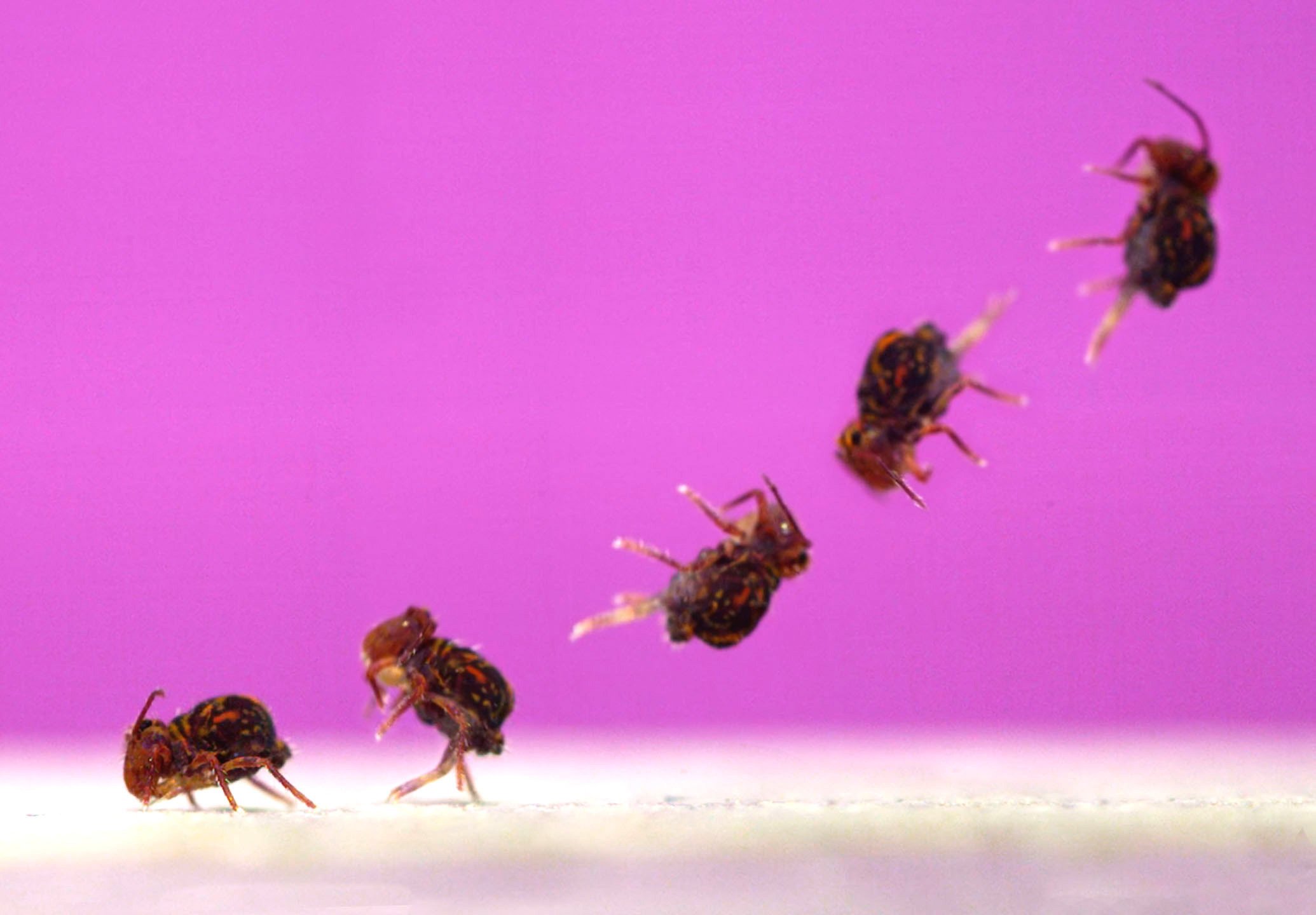
Researchers have detailed the jumping mechanics of globular springtails, small hexapods that perform rapid, spinning backflips to avoid predators.
Using high-speed cameras, they captured these jumps, revealing how springtails use a special appendage to achieve remarkable speeds and heights, far exceeding their own body length.
Move over, Sonic. There’s a new spin-jumping champion in town – the globular springtail (Dicyrtomina minuta). This diminutive hexapod backflips into the air, spinning to over 60 times its body height in the blink of an eye, and a new study features the first in-depth look at its jumping prowess.
Globular springtails are tiny, usually only a couple of millimeters in body length. They don’t fly, bite, or sting. But they can jump. In fact, jumping is their go-to (and only) plan for avoiding predators. And they excel at it – to the naked eye, it seems as though they vanish entirely when they take off.
The Mechanics of a Miniature Acrobat
“When globular springtails jump, they don’t just leap up and down, they flip through the air – it’s the closest you can get to a Sonic the Hedgehog jump in real life,” says Adrian Smith, research assistant professor of biology at North Carolina State University and head of the evolutionary biology and behavior research lab at the North Carolina Museum of Natural Sciences. “So naturally I wanted to see how they do it.”
Finding the globular springtails was easy enough – they’re all around us. The ones in this study are usually out from December through March. Smith “recruited” his research subjects by sifting through leaf litter from his own backyard. But the next part proved to be the most challenging.
Globular springtail jumps captured by filming at 10,863 frames per second. Credit: Adrian Smith
High-Speed Captures Reveal Stunning Agility
“Globular springtails jump so fast that you can’t see it in real-time,” Smith says. “If you try to film the jump with a regular camera, the springtail will appear in one frame, then vanish. When you look at the picture closely, you can see faint vapor trail curlicues left behind where it flipped through the one frame.”
Smith solved that problem by using cameras that shoot 40,000 frames per second. He urged the springtails to jump by shining a light on them or lightly prodding them with an artist’s paintbrush. Then he looked at how they took off, how fast and far they went, and how they landed. A video explanation of this research can be found here:
Globular springtails don’t use their legs to jump. Instead, they have an appendage called a furca that folds up underneath their abdomen and has a tiny, forked structure at its tip. When the springtails jump, the furca flips down and the forked tip pushes against the ground, launching them into a series of insanely fast backflips.
Record-Setting Rotational Speeds
What do we mean by insanely fast?
“It only takes a globular springtail one-thousandth of a second to backflip off the ground and they can reach a peak rate of 368 rotations per second,” Smith says. “They accelerate their bodies into a jump at about the same rate as a flea, but on top of that, they spin. No other animal on earth does a backflip faster than a globular springtail.”
The springtails were also able to launch themselves over 60 millimeters into the air – more than 60 times their own height. And in most cases, they went backward.
“They can lean into a jump and go slightly sideways, but when launching from a flat surface, they mostly travel up and backward, never forward,” says Jacob Harrison, a postdoctoral researcher at the Georgia Institute of Technology and paper co-author. “Their inability to jump forward was an indication to us that jumping is primarily a means to escape danger, rather than a form of general locomotion.”
Implications and Observations in Springtail Research
Landing was found in two styles: uncontrolled and anchored. Globular springtails do have a sticky forked tube they can evert – or push out of their bodies – to grapple a surface or halt their momentum, but Smith observed that bouncing and tumbling to a stop was just as common as anchored landings.
“This is the first time anyone has done a complete description of the globular springtail’s jumping performance measures, and what they do is almost impossibly spectacular,” Smith says. “This is a great example of how we can find incredible, and largely undescribed, organisms living all around us.”
The work appears in the scientific journal Integrative Organismal Biology.
Reference: “Jumping Performance and Behavior of the Globular Springtail Dicyrtomina minuta” by A A Smith and J S Harrison, 29 August 2024, Integrative Organismal Biology.
DOI: 10.1093/iob/obae029
Authors: Adrian Smith, North Carolina State University and the North Carolina Museum of Natural Sciences; Jacob Harrison, Georgia Institute of Technology.
Never miss a breakthrough: Join the SciTechDaily newsletter.
Follow us on Google and Google News.