
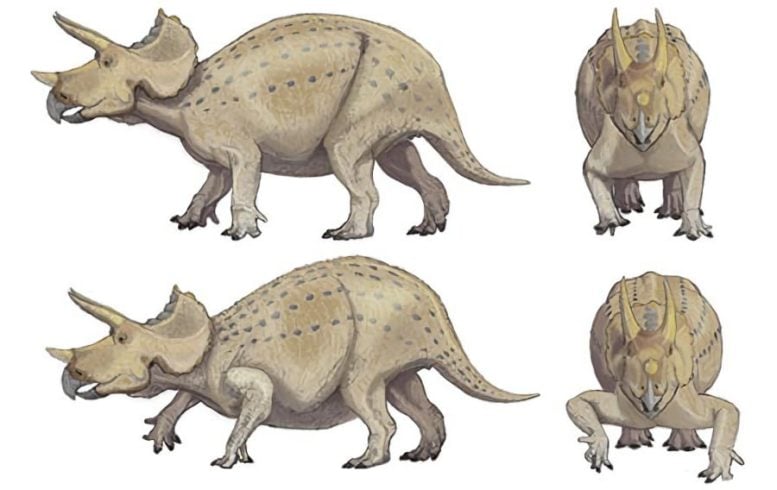
Researchers from the University of Tokyo and the Royal Veterinary College have published findings showing that Triceratops had upright forelimbs like larger mammals, not splayed out to the sides like most reptiles and amphibians. This research suggests that they might have been more athletic than previously thought.
Research published on February 22nd provides, for the first time, a clear answer to the debate as to whether Triceratops and other extinct creatures took on a more mammal-like or more reptile-like posture.
Dr. Shin-ichi Fujiwara from the University of Tokyo and Professor John Hutchinson from the Royal Veterinary College have developed a new, advanced method that provides insight into the kinds of forelimb postures animals might use, derived from simple measurements on bones.
Findings using the new method show that, contrary to popular belief, Triceratops had quite upright forelimbs like larger mammals, not splayed out to the sides like most reptiles and amphibians. This understanding changes the way we visualize the posture and motion of Triceratops, and also suggests that the animal might have been more athletic than previously thought.
Different land animals use different muscles to support their weight, which attach to different bones in the elbow. Because of this Fujiwara and Hutchinson concluded that the bones must be shaped differently to form competent levers for the attaching elbow muscles.
Upright animals (e.g. dogs, cats, elephants, rhinos) favor their triceps muscles and as a result have a large ‘funny bone’, or olecranon process, to act as an efficient lever for those muscles to keep the elbow from flexing too much. In contrast, sprawling animals (e.g. lizards, salamanders, frogs, crocodiles) favor their adductors (muscles that pull the elbow to the body) to keep the elbows from splaying too far out laterally.
To test their ideas the researchers measured the elbows of 318 different skeletons and found that three main measurements captured the complexity of elbow joint support in animals. Dr. Fujiwara remarked: “I traveled to museums around the United Kingdom and Japan to measure every animal specimen I could find. It was weeks and weeks of measuring skeletons but was worth it! We were able to develop a massive database for testing our hypotheses.”
Professor Hutchinson commented: “We’ve developed a new method for reconstructing forelimb postures that is statistically rigorous and numerical, rather than relying on hazy value judgments based on intuitive impressions from anatomy. It is also based on real, established mechanisms of locomotor biomechanics that diverse animals use today, linking bone form and function. It thus packs a potent explanatory power, rather than arguing from correlation equals causation. That’s a satisfying step forward and a leg up on prior methods.”
The next step, the researchers say, is to apply this method to other extinct animals including various large dinosaurs and mammals to examine how giant animals supported their weight similarly or differently during their evolution.
The research is published in the Royal Society Journal Proceedings of the Royal Society B on the 22nd February 2012.
Reference: “Elbow joint adductor moment arm as an indicator of forelimb posture in extinct quadrupedal tetrapods” by Shin-ichi Fujiwara and John R. Hutchinson, 22 February 2012, Proceedings of the Royal Society B.
DOI: 10.1098/rspb.2012.0190
Never miss a breakthrough: Join the SciTechDaily newsletter.
Follow us on Google and Google News.