
Close Menu
    Facebook X (Twitter) Instagram
    SciTechDaily
    • Biology
    • Chemistry
    • Earth
    • Health
    • Physics
    • Science
    • Space
    • Technology
    Facebook X (Twitter) Pinterest YouTube RSS
    SciTechDaily
    Home»Space»Astronomers Discover A New Neptune-Size Exoplanet, K2-263 b
    Space

    Astronomers Discover A New Neptune-Size Exoplanet, K2-263 b

    By Harvard-Smithsonian Center For AstrophysicsDecember 18, 2018No Comments3 Mins Read
    Facebook Twitter Pinterest Telegram LinkedIn WhatsApp Email Reddit
    Share
    Facebook Twitter LinkedIn Pinterest Telegram Email Reddit

    Neptune Size Exoplanet K2 263 b

    The remarkable exoplanet discoveries made by the Kepler and K2 missions have enabled astronomers to begin to piece together the history of the Earth and to understand how and why it differs from its diverse exoplanetary cousins. Two still outstanding puzzles include the differences between the formation and evolution of rocky versus non-rocky small planets, and why there seems to be a size gap with very few exoplanets at or about two Earth-radii in size (planets with smaller radii are likely to be rocky or Earth-like in their composition). In order to estimate an exoplanet’s composition its density is needed, requiring a measurement of mass as well as size. While a radius can be estimated from the shape of the planet’s transit curve as it blocks out its host star’s light, a mass is more difficult to determine. In order to develop the emerging picture, however, precise and accurate masses are required for more planets that are similar in size to the Earth.
    Exoplanet K2 263 b
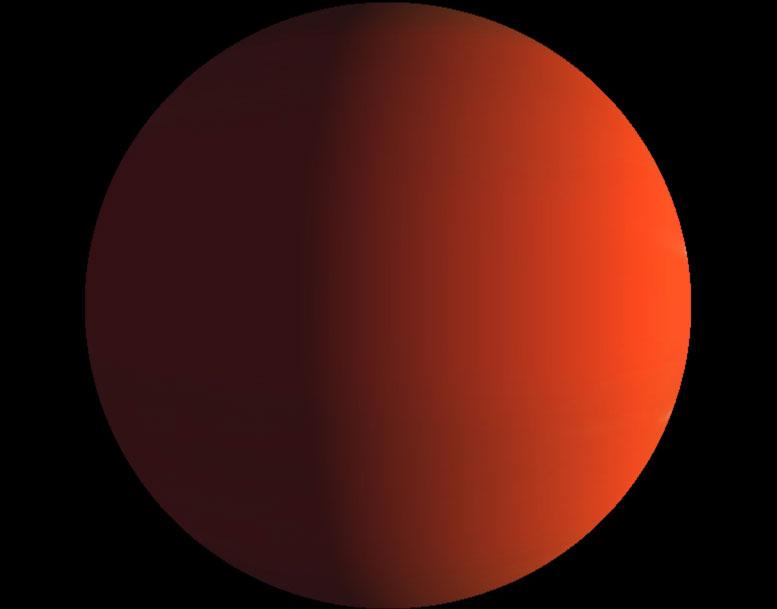
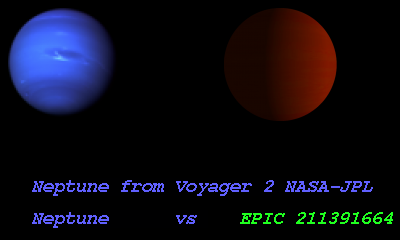
    An image of Neptune taken by the Voyager spacecraft compared with an artist’s conception of the exoplanet K2-263b. NASA; exoplanetkyoto.org

    The K2 exoplanetary mission is the revived version of the Kepler exoplanetary discovery mission. Together they have discovered thousands of exoplanets, and uncovered a remarkable and unexpected diversity in the exoplanet population. K2 is sensitive only to short-period planets (it has only found a few with periods longer than 40 days). The exoplanet K2-263b orbits a star less massive than the sun (0.86 solar masses) and is located 536 light-years away as measured with the new Gaia satellite. This exoplanet has a radius of 2.41 Earth-radii (with a 5% uncertainty). CfA astronomers Maria Lopez-Morales, Dave Charbonneau, Raphaelle Haywood, John Johnson, Dave Latham, David Phillips, and Dimitar Sasselov and their colleagues used the HARPS-N high precision spectrometer on the Telescopio Nazionale Galileo in La Palma, Spain, to measure the periodic velocity of the exoplanet as it orbited and thus to derive its mass.

    The HARPS-N velocity measurements were amazingly precise – uncertain to about a mere eleven miles an hour, about the speed of a slow bicyclist. From the orbital details, the scientists obtained an exoplanet mass of 14.8 Earth masses and hence a density of about 5.6 grams per cubic centimeter (for comparison, the density of water is one gram per cubic centimeter, and the average density of the rocky Earth is 5.51 grams per cubic centimeter). The scientists conclude that K2-263b most likely contains an equivalent amount of ice compared to rocks, roughly consistent with current ideas about planet formation and the relative abundances in a circumstellar nebula of the building-block elements like iron, nickel, magnesium, silicon, oxygen, carbon and nitrogen.

    Reference: “K2-263 b: a 50 d period sub-Neptune with a mass measurement using HARPS-N” by A Mortier, A S Bonomo, V M Rajpaul, L A Buchhave, A Vanderburg, L Zeng, M López-Morales, L Malavolta, A Collier Cameron, C D Dressing, P Figueira, V Nascimbeni, K Rice, A Sozzetti, C Watson, L Affer, F Bouchy, D Charbonneau, A Harutyunyan, R D Haywood, J A Johnson, D W Latham, C Lovis, A F Martinez Fiorenzano, M Mayor, G Micela, E Molinari, F Motalebi, F Pepe, G Piotto, D Phillips, E Poretti, D Sasselov, D Ségransan and S Udry, 3 September 2018, MNRAS.
    DOI: 10.1093/mnras/sty2360

    Never miss a breakthrough: Join the SciTechDaily newsletter.
    Follow us on Google and Google News.

    Astronomy Harvard-Smithsonian Center for Astrophysics Planetary Science
    Share. Facebook Twitter Pinterest LinkedIn Email Reddit

    Related Articles

    Coldest Brown Dwarfs Are Warmer Than Previously Thought

    ALMA Reveals First Ever Snow Line Seen Around a Distant Star

    Astronomers Discover Transiting Planets in Star Cluster NGC 6811

    Water Planets in the Habitable Zone: A Closer Look at Kepler 62e and 62f

    Kepler Finds Over 2,300 Candidate Exoplanets

    Earth-like Planets May Have Older and More Evolved Life

    Kepler Data Suggests 17 Billion Earth-Sized Worlds in the Milky Way

    A New Subclass of Extra-Solar Planets Discovered

    Near Miss Asteroid – An Opportunity To Test a Rapid Response Program

    Leave A Reply Cancel Reply

    • Facebook
    • Twitter
    • Pinterest
    • YouTube

    Don't Miss a Discovery

    Subscribe for the Latest in Science & Tech!

    Trending News

    Largest-Ever Study Finds Medicinal Cannabis Ineffective for Anxiety, Depression, PTSD

    250-Million-Year-Old Egg Solves One of Evolution’s Biggest Mysteries

    Living With Roommates Might Be Changing Your Gut Microbiome Without You Knowing

    Century-Old Cleaning Chemical Linked to 500% Increased Risk of Parkinson’s Disease

    What if Your Memories Never Happened? Physicists Take a New Look at the Boltzmann Brain Paradox

    One of the Universe’s Largest Stars May Be Getting Ready To Explode

    Scientists Discover Enzyme That Could Supercharge Ozempic-Like Weight Loss Drugs

    Popular Sweetener Linked to DNA Damage – “It’s Something You Should Not Be Eating”

    Follow SciTechDaily
    • Facebook
    • Twitter
    • YouTube
    • Pinterest
    • Newsletter
    • RSS
    SciTech News
    • Biology News
    • Chemistry News
    • Earth News
    • Health News
    • Physics News
    • Science News
    • Space News
    • Technology News
    Recent Posts
    • Scientists Find Way to Reverse Fatty Liver Disease Without Changing Diet
    • Could Humans Regrow Limbs? New Study Reveals Promising Genetic Pathway
    • Black Hole Jets Pack Power of 10,000 Suns, Stunning New Study Reveals
    • A Cosmic Crash Turned This Nearby Galaxy Into Chaos
    • This Alien Solar System Doesn’t Follow the Rules – and Scientists Are Intrigued
    Copyright © 1998 - 2026 SciTechDaily. All Rights Reserved.
    • Science News
    • About
    • Contact
    • Editorial Board
    • Privacy Policy
    • Terms of Use

    Type above and press Enter to search. Press Esc to cancel.