
Close Menu
    Facebook X (Twitter) Instagram
    SciTechDaily
    • Biology
    • Chemistry
    • Earth
    • Health
    • Physics
    • Science
    • Space
    • Technology
    Facebook X (Twitter) Pinterest YouTube RSS
    SciTechDaily
    Home»Space»Astronomers Discover the Missing Link Responsible for Pulsating Auroras
    Space

    Astronomers Discover the Missing Link Responsible for Pulsating Auroras

    By Mara Johnson-Groh, NASA's Goddard Space Flight CenterFebruary 20, 2018No Comments3 Mins Read
    Facebook Twitter Pinterest Telegram LinkedIn WhatsApp Email Reddit
    Share
    Facebook Twitter LinkedIn Pinterest Telegram Email Reddit
    THEMIS Solves Pulsating Aurora Mysteries
    Illustration of three THEMIS satellites and Earth’s magnetosphere. Credit: NASA

    Sometimes on a dark night near the poles, the sky pulses a diffuse glow of green, purple and red. Unlike the long, shimmering veils of typical auroral displays, these pulsating auroras are much dimmer and less common. While scientists have long known auroras to be associated with solar activity, the precise mechanism of pulsating auroras was unknown. Now, new research, using data from NASA’s Time History of Events and Macroscale Interactions during Substorms – or THEMIS – mission and Japan’s Exploration of energization and Radiation in Geospace – shortened to ERG, or also known as Arase – satellite, has finally captured the missing link thought responsible for these auroras. The answer lies in chirping waves that rhythmically pulse the particles that create the auroras.

    Earth’s magnetic bubble – the magnetosphere – protects the planet from high-energy radiation coming from the Sun and interstellar space, but during particularly strong solar events, particles can slip through. Once inside, the particles and the energy they carry are stored on the nightside of the magnetosphere, until an event, known as a substorm, releases the energy. The electrons are then sent speeding down into Earth’s upper atmosphere where they collide with the other particles and produce the characteristic glow.
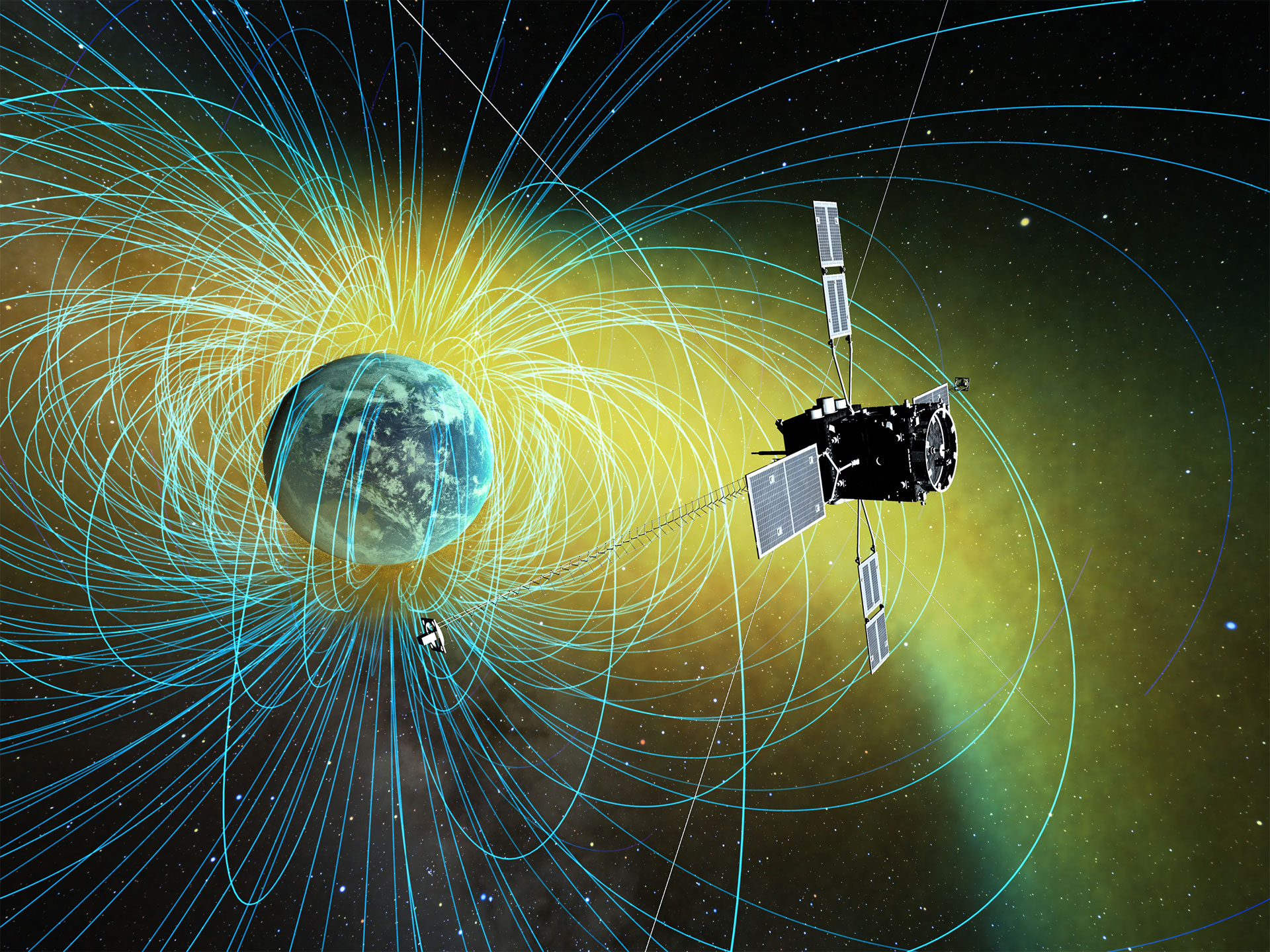
    THEMIS Mission Helps Solve Pulsating Aurora Mysteries
    Illustration of the ERG satellite in orbit. Credit: ISAS/JAXA

    Pulsating auroras, however, have a slightly different cause. The magnetosphere is home to a type of plasma wave known as whistler mode chorus. These waves have characteristic rising tones – reminiscent of the sounds of chirping birds – and are able to efficiently disturb the electrons. When these waves make their appearance within the magnetosphere, some of the electrons scattered by the wave careen down into Earth’s atmosphere, causing the pulsating auroras.

    While scientists have long believed this mechanism to be responsible for pulsating auroras, they had no definitive proof until now. The multipoint observations from the ERG satellite and ground-based all-sky cameras from the THEMIS mission allowed scientists to pinpoint the cause and effect, seeing the event from start to end. The results were published in the journal Nature.

    Research done with NASA’s ground-based camera and Japan’s spacecraft in the near-Earth laboratory has applications further afield. Chorus waves have been observed around other planets in the solar system, including Jupiter and Saturn. Likely, the processes observed around Earth can help explain auroral features on these gas giants as well as on planets around other stars. The results also help scientists better understand how plasma waves can influence electrons — something that occurs in processes across the universe.

    Never miss a breakthrough: Join the SciTechDaily newsletter.
    Follow us on Google and Google News.

    Astronomy Aurora Earth Science NASA Goddard Space Flight Center THEMIS
    Share. Facebook Twitter Pinterest LinkedIn Email Reddit

    Related Articles

    Celestial Geometry Posed a Special Opportunity During Parker Solar Probe’s 7th Solar Encounter

    Astronomers Directly Observe Electrons Bouncing Across Earth’s Magnetosphere

    NASA’s Van Allen Probes Uncover Relativistic Electrons

    Scientists Develop New Space Weather Model to Help Simulate Magnetic Structure of Solar Storms

    Rare Supermoon Lunar Eclipse to Occur on September 27

    A Closer Look at Titan’s Chemical Production

    Ultra-Fast Outflows are Common Features of Black-Hole-Powered Galaxies

    NASA’s THEMIS Satellite Records Effect of Geomagnetic Storms on Radiation Belts

    Strong Geomagnetic Storms a Possibility After Active Sunspot 1401 Erupted

    Leave A Reply Cancel Reply

    • Facebook
    • Twitter
    • Pinterest
    • YouTube

    Don't Miss a Discovery

    Subscribe for the Latest in Science & Tech!

    Trending News

    Monster Storms on Jupiter Unleash Lightning Beyond Anything on Earth

    Scientists Create “Liquid Gears” That Spin Without Touching

    The Simple Habit That Could Help Prevent Cancer

    Millions Take These IBS Drugs, But a New Study Finds Serious Risks

    Scientists Unlock Hidden Secrets of 2,300-Year-Old Mummies Using Cutting-Edge CT Scanner

    Bread Might Be Making You Gain Weight Even Without Eating More Calories

    Scientists Discover Massive Magma Reservoir Beneath Tuscany

    Europe’s Most Active Volcano Just Got Stranger – Here’s Why Scientists Are Rethinking It

    Follow SciTechDaily
    • Facebook
    • Twitter
    • YouTube
    • Pinterest
    • Newsletter
    • RSS
    SciTech News
    • Biology News
    • Chemistry News
    • Earth News
    • Health News
    • Physics News
    • Science News
    • Space News
    • Technology News
    Recent Posts
    • 25-Year Study Uncovers Hidden Paths and Early Warning Signs of Blood Cancer
    • Not Just Snoring – New Research Reveals Sleep Apnea May Be Damaging Your Muscles
    • Scientists Discover a Surprising Reason Intermittent Fasting Extends Life
    • Scientists Discover a New Meteor Shower From a Mysterious Crumbling Asteroid
    • This Simple Fruit Wash Could Make Produce Safer and Last Days Longer
    Copyright © 1998 - 2026 SciTechDaily. All Rights Reserved.
    • Science News
    • About
    • Contact
    • Editorial Board
    • Privacy Policy
    • Terms of Use

    Type above and press Enter to search. Press Esc to cancel.