
Close Menu
    Facebook X (Twitter) Instagram
    SciTechDaily
    • Biology
    • Chemistry
    • Earth
    • Health
    • Physics
    • Science
    • Space
    • Technology
    Facebook X (Twitter) Pinterest YouTube RSS
    SciTechDaily
    Home»Space»Astronomers Discover Two New Massive Stars in the Galactic Center
    Space

    Astronomers Discover Two New Massive Stars in the Galactic Center

    By D L Walker, Harvard-Smithsonian Center For AstrophysicsFebruary 23, 20181 Comment3 Mins Read
    Facebook Twitter Pinterest Telegram LinkedIn WhatsApp Email Reddit
    Share
    Facebook Twitter LinkedIn Pinterest Telegram Email Reddit
    Astronomers Detect High Pressure Star Formation in the Galactic Center
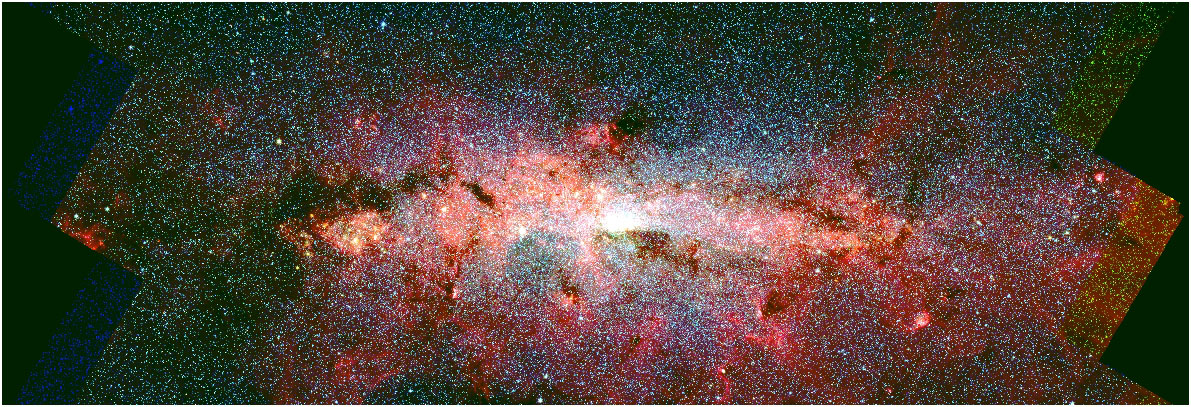
    A false-color Spitzer infrared image of the Milky Way’s Central Molecular Zone (CMZ). Star formation in the CMZ is surprisingly low, suppressed by gas turbulence. CfA astronomers, in a comprehensive study of the CMZ using the SMA, have detected two new young, massive stars and another thirteen dense cores. Credit: Spitzer/NASA/CfA

    Some galaxies in the universe are as much as a thousand times more luminous than our Milky Way galaxy, with most of their light being emitted in the infrared. Astronomers attribute that ultra-intense luminosity to warm dust heated by massive bursts of star formation that are often concentrated in the galaxy’s center, near the supermassive black hole. The Milky Way also has a supermassive black hole, and its inner region (called the Central Molecular Zone, CMZ) has plenty of the gas needed to form new stars. But the star formation rate there is not only not intense, it is less than average given the amount of mass present. There are several notable exceptions, like the dramatic Arches Cluster, but these serve to highlight the strange inactivity everywhere else.

    The low rate of star formation in the CMZ has puzzled astronomers for decades. Because the physical conditions there differ from those in normal giant molecular clouds, astronomers generally have concluded that the responsibility must lie with some combination of their properties, in particular the high values of gas density, temperature, pressure, motion, and magnetic field strength. CfA astronomers Qizhou Zhang, Cara Battersby, and Eric Keto, and their colleagues used the Submillimeter Array (SMA) to undertake a large and comprehensive study of the CMZ in search of answers. They discovered a sample of thirteen high-mass cores with between 50-2200 solar-masses of material that could be incipient young stars, and two objects that appear to be previously unknown young, massive stars. The SMA also observed the spectral lines of the molecules formaldehyde and methyl cyanide to measure the temperature of the gas and its kinematics, including turbulent motions. The scientists conclude, in agreement with previous speculation, that the turbulent environment of the CMZ is responsible for inhibiting star formation there.

    Reference: “Star formation in a high-pressure environment: an SMA view of the Galactic Centre dust ridge” by D L Walker, S N Longmore, Q Zhang, C Battersby, E Keto, J M D Kruijssen, A Ginsburg, X Lu, J D Henshaw, J Kauffmann, T Pillai, E A C Mills, A J Walsh, J Bally, L C Ho, K Immer and K G Johnston, 21 February 2018,  Monthly Notices of the Royal Astronomical Society.
    DOI: 10.1093/mnras/stx2898

    Never miss a breakthrough: Join the SciTechDaily newsletter.
    Follow us on Google and Google News.

    Astronomy Cosmology Harvard-Smithsonian Center for Astrophysics Stellar Evolution
    Share. Facebook Twitter Pinterest LinkedIn Email Reddit

    Related Articles

    Astronomers Reveal That Proxima Centauri Might Be More Sunlike Than Previously Thought

    Harvard Astrophysicists Examine the Properties of Pre-Stellar Cores

    Astronomers Discover “Old Young” Stars in the Eagle Nebula

    New Model Shows How a Collapsing Star Results in Two Black Holes that Form and Fuse

    TW Hydrae Provides Insight About the Birth of Our Sun

    Herschel Discovers the Earliest Known Starburst Galaxy

    New Study Challenges Planck Results

    Masers as Evolutionary Indicators for Star Formation

    Calculations Show the Ideal Time to Study the Cosmos

    1 Comment

    1. Valeriy on February 24, 2018 7:39 am

      Star formation is one of the least comprehended phenomenon in astrophysics. Is there a general theory of star formation? No, there is not. There is a number of models based on computer simulations which include supersonic hydrodynamics with non-ideal MHD turbulence influenced by gravity. They include the line and continuum radiative processes of the energy transfer; a number of chemical processes with dissociation, recombination and ionization, with uncertain nomenclature of atoms and molecules, unknown magnetic fields and formation and destruction of dust particles. In addition there is macrophysics that is an environment in the molecular clouds, clumps and cores; inclusion in the multiple systems, collisions among stellar systems; jets and outflows; radiation pressure.

      Reply
    Leave A Reply Cancel Reply

    • Facebook
    • Twitter
    • Pinterest
    • YouTube

    Don't Miss a Discovery

    Subscribe for the Latest in Science & Tech!

    Trending News

    AI Could Detect Early Signs of Alzheimer’s in Under a Minute – Far Before Traditional Tests

    What if Dark Matter Has Two Forms? Bold New Hypothesis Could Explain a Cosmic Mystery

    This Metal Melts in Your Hand – and Scientists Just Discovered Something Strange

    Beef vs. Chicken: Surprising Results From New Prediabetes Study

    Alzheimer’s Breakthrough: Scientists Discover Key Protein May Prevent Toxic Protein Clumps in the Brain

    Quantum Reality Gets Stranger: Physicists Put a Lump of Metal in Two Places at Once

    Scientists May Have Found the Key to Jupiter and Saturn’s Moon Mystery

    Scientists Uncover Brain Changes That Link Pain to Depression

    Follow SciTechDaily
    • Facebook
    • Twitter
    • YouTube
    • Pinterest
    • Newsletter
    • RSS
    SciTech News
    • Biology News
    • Chemistry News
    • Earth News
    • Health News
    • Physics News
    • Science News
    • Space News
    • Technology News
    Recent Posts
    • Students Found an Ancient Star That Shouldn’t Be in the Milky Way
    • Astronomers Solve 50-Year Mystery and Reveal Hidden Culprit Behind Strange X-Ray Emissions
    • One of the Universe’s Largest Stars May Be Getting Ready To Explode
    • Scientists Discover Enzyme That Could Supercharge Ozempic-Like Weight Loss Drugs
    • Asthma and Depression Don’t Mix the Way Scientists Expected
    Copyright © 1998 - 2026 SciTechDaily. All Rights Reserved.
    • Science News
    • About
    • Contact
    • Editorial Board
    • Privacy Policy
    • Terms of Use

    Type above and press Enter to search. Press Esc to cancel.