
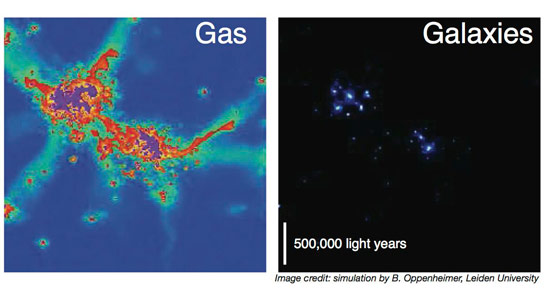
Using Hubble’s two ultraviolet spectrographs, researchers from the University of Notre Dame have identified gaseous streams near galaxies through the absorption they imprint on the spectra of distant, bright background quasars.
Galaxies have a voracious appetite for fuel — in this case, fresh gas — but astronomers have had difficulty finding the pristine gas that should be falling onto galaxies. Now, scientists have provided direct empirical evidence for these gas flows using new observations from the Hubble Space Telescope. The team led by Nicolas Lehner, research associate professor at the University of Notre Dame, is presenting its work today at the meeting of the American Astronomical Society in Long Beach, California.
The team’s observations using Hubble’s two ultraviolet spectrographs, the Cosmic Origins Spectrograph and the Space Telescope Imaging Spectrograph, show large quantities of cool gas with very low quantities of heavy elements in the gaseous cocoons surrounding modern galaxies. The lack of heavy elements indicates this gas in the circumgalactic medium of the galaxies has not been strongly processed through stars. The members’ work, “The Bimodal Metallicity Distribution of the Cool Circumgalactic Medium at z<1,” has been submitted to the Astrophysical Journal.
Led by Lehner, the team of astronomers identified gaseous streams near galaxies through the absorption they imprint on the spectra of distant, bright background quasars. The atoms in the gas remove small amounts of the light, and as the light from the quasars passes through the gas around galaxies, the chemical elements leave characteristic spectral “fingerprints” that allow astronomers to study the physical and chemical properties of the gas. Lehner and collaborators searched for the signature of gas within about 100,000-300,000 light-years of galaxies, identifying this gas due to its strong hydrogen absorption, a known signature of circumgalactic gas. They subsequently determined the amount of “metals” — all elements heavier than hydrogen and helium — in this gas to test whether the circumgalactic matter was being newly accreted from intergalactic space and lacking in metals or being ejected from the galaxies themselves and strong in metals.
“Astronomers have been searching for this infalling gas for a while,” notes Lehner. “However, due to observational limitations, they had to search for metal-poor gas using the metals themselves. Since there is a tiny amount of metals in this gas, it was difficult to find in that way.” The new work uses ultraviolet spectroscopy to identify the gas through its hydrogen absorption, which is independent of the metal content. This has allowed the team for the first time to determine how heavy elements are distributed around galaxies in an unbiased manner.
Galaxies have a voracious appetite for fuel — in this case, fresh gas — but astronomers have had difficulty finding the pristine gas that should be falling onto galaxies. Now, scientists have provided direct empirical evidence for these gas flows using new observations from the Hubble Space Telescope. The team led by Nicolas Lehner, research associate professor at the University of Notre Dame, is presenting its work today at the meeting of the American Astronomical Society in Long Beach, California.
The team’s observations using Hubble’s two ultraviolet spectrographs, the Cosmic Origins Spectrograph and the Space Telescope Imaging Spectrograph, show large quantities of cool gas with very low quantities of heavy elements in the gaseous cocoons surrounding modern galaxies. The lack of heavy elements indicates this gas in the circumgalactic medium of the galaxies has not been strongly processed through stars. The members’ work, “The Bimodal Metallicity Distribution of the Cool Circumgalactic Medium at z<1,” has been submitted to the Astrophysical Journal.
Led by Lehner, the team of astronomers identified gaseous streams near galaxies through the absorption they imprint on the spectra of distant, bright background quasars. The atoms in the gas remove small amounts of the light, and as the light from the quasars passes through the gas around galaxies, the chemical elements leave characteristic spectral “fingerprints” that allow astronomers to study the physical and chemical properties of the gas. Lehner and collaborators searched for the signature of gas within about 100,000-300,000 light-years of galaxies, identifying this gas due to its strong hydrogen absorption, a known signature of circumgalactic gas. They subsequently determined the amount of “metals” — all elements heavier than hydrogen and helium — in this gas to test whether the circumgalactic matter was being newly accreted from intergalactic space and lacking in metals or being ejected from the galaxies themselves and strong in metals.
“Astronomers have been searching for this infalling gas for a while,” notes Lehner. “However, due to observational limitations, they had to search for metal-poor gas using the metals themselves. Since there is a tiny amount of metals in this gas, it was difficult to find in that way.” The new work uses ultraviolet spectroscopy to identify the gas through its hydrogen absorption, which is independent of the metal content. This has allowed the team for the first time to determine how heavy elements are distributed around galaxies in an unbiased manner.
Reference: “The Bimodal Metallicity Distribution of the Cool Circumgalactic Medium at z<1” by N. Lehner, J.C. Howk, T.M. Tripp, J. Tumlinson, J.X. Prochaska, J.M. O’Meara, C. Thom, J.K. Werk, A.J. Fox and J. Ribaudo, 5 June 2013, The Astrophysical Journal.
DOI: 10.1088/0004-637X/770/2/138
Never miss a breakthrough: Join the SciTechDaily newsletter.
Follow us on Google and Google News.