
Close Menu
    Facebook X (Twitter) Instagram
    SciTechDaily
    • Biology
    • Chemistry
    • Earth
    • Health
    • Physics
    • Science
    • Space
    • Technology
    Facebook X (Twitter) Pinterest YouTube RSS
    SciTechDaily
    Home»Space»Astronomers Measure Molecular Emission and Dust Temperatures of the Pipe Nebula
    Space

    Astronomers Measure Molecular Emission and Dust Temperatures of the Pipe Nebula

    By Harvard-Smithsonian Center for AstrophysicsSeptember 12, 20141 Comment3 Mins Read
    Facebook Twitter Pinterest Telegram LinkedIn WhatsApp Email Reddit
    Share
    Facebook Twitter LinkedIn Pinterest Telegram Email Reddit
    Molecular Emission and Effective Dust Temperatures of Dense Cores in the Pipe Nebula
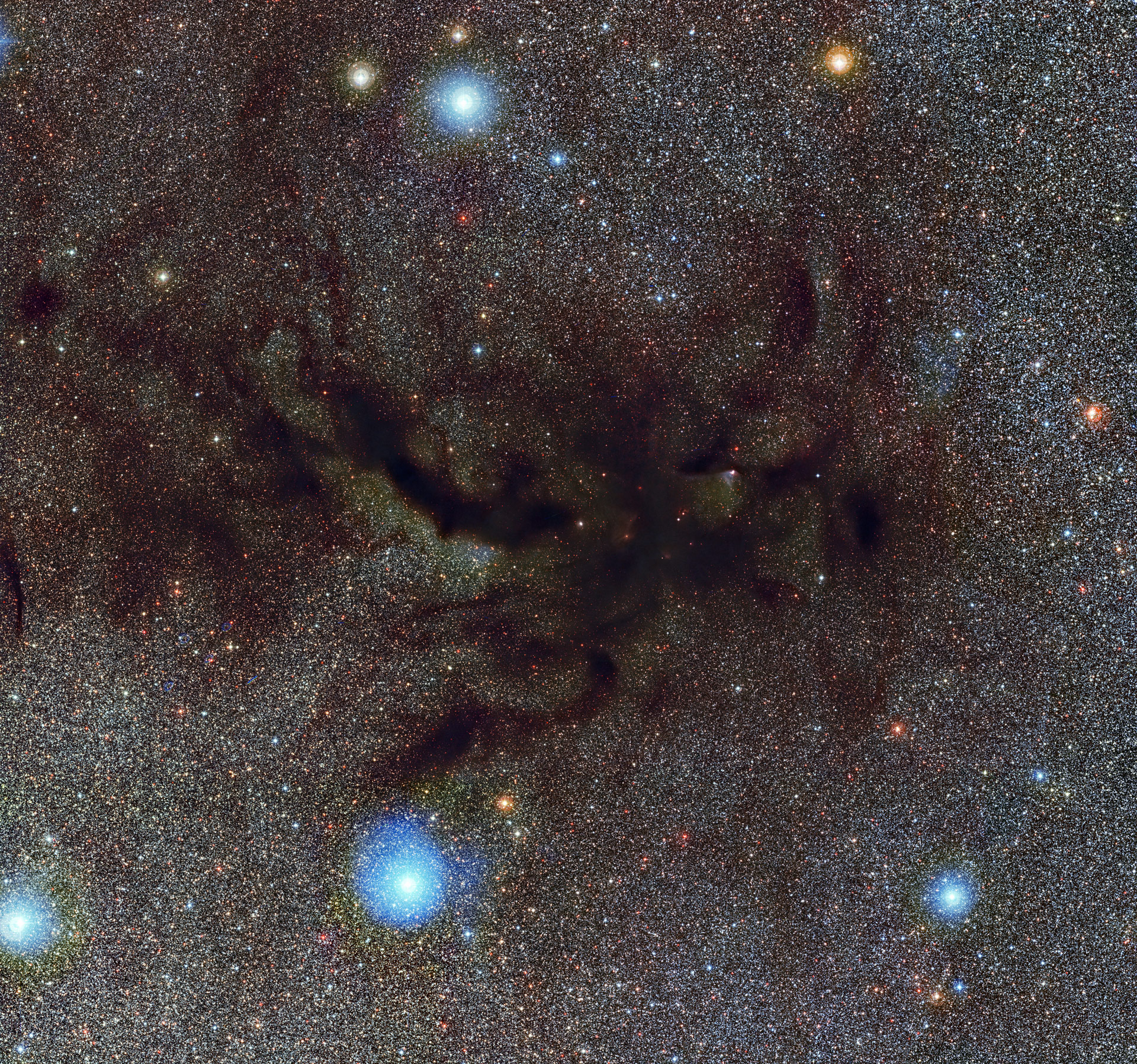
    One portion of the vast dark cloud of interstellar dust is called the Pipe Nebula (shown here is the object Barnard 59). The Pipe Nebula is known for being massive, and so a likely candidate for young stars, yet it is cold and dark with few signs of star formation. Astronomers have observed fifty-two dense cores in the Pipe in six key interstellar molecules using millimeter telescopes, and find clump temperatures as low as thirteen kelvin. Credit: ESO

    Astronomers from the Harvard-Smithsonian Center for Astrophysics recently completed a study of the dense cores of the Pipe Nebula, revealing that the cores are very cold, between 13 and 19 kelvin ( about -260 degrees Celsius or -430 degrees Fahrenheit), with the coldest ones containing the most obscuring dust.

    The Pipe Nebula is a prominent dark molecular cloud located about 430 light-years from us. It contains about ten thousand solar masses of material, making it one of the closest giant molecular complexes to us, and with dimensions of about 10 by 46 light-years, one of the largest. These properties should make it an excellent place to study star formation up close, except for one problem: there is very little star formation underway there. Instead, the Pipe Nebula has become one of the prime cases for testing ideas about star formation, since apparently an abundance of material is not enough by itself to produce new stars.

    The Pipe Nebula is not uniform in density; it contains a large population of dense, low-mass cores, about 134 distinct objects. In other molecular clouds these cores evolve into young stars, but in the Pipe they remain quiescent. Astronomers have been using radio astronomy techniques to study the density and temperatures of particular molecular species in these cold cores, for example, species of carbon monoxide and ammonia, whose relative line strengths can quantify these parameters.

    CfA astronomers Jan Frobrich, Karin Oberg, and Charlie Lada, together with four colleagues, have now completed a study of fifty-two of the Pipe’s cores in the light from six additional molecules that are particularly useful in characterizing star formation activity, and also complemented that data with infrared images from Herschel that show the cold dust distribution. They report that the dense cores in the Pipe are very cold indeed, between 13 and 19 kelvin, with the coldest ones containing the most obscuring dust. The astronomers find that one molecule in particular, N2H+, is the only species to exclusively trace the very densest and coldest cores, making this molecule a key diagnostic for future studies to figure out why these dense cores do not form stars.

    Reference: “Some Like It Cold: Molecular Emission and Effective Dust Temperatures of Dense Cores in the Pipe Nebula” by Jan Forbrich, Karin Öberg, Charles J. Lada, Marco Lombardi, Alvaro Hacar, João Alves and Jill M. Rathborne, 8 August 2014, Astronomy & Astrophysics.
    DOI: 10.1051/0004-6361/201423913
    arXiv: 1406.0540

    Never miss a breakthrough: Join the SciTechDaily newsletter.
    Follow us on Google and Google News.

    Astronomy Astrophysics Harvard-Smithsonian Center for Astrophysics
    Share. Facebook Twitter Pinterest LinkedIn Email Reddit

    Related Articles

    X-Ray Emission From Mysterious Dark Matter

    Analyzing Dust Storm Sequences on Mars

    Intriguing Remains of a Rare Stellar Explosion Discovered in Milky Way Center

    Puzzling Astrophysics of Quasars in the Early Universe

    Four Exoplanets – Including a Super-Earth Planet – Discovered by High School Students

    Massive Rotating Stars in the Pleiades Cluster

    Astronomers Discover First Cloudless, Jupiter-Like Planet – “Smoking Gun Evidence”

    Chandra X-ray Observatory Studies Extraordinary Magnetar [Video]

    Chandra Studies Extraordinary Magnetar: Fastest Spinning and Possibly the Youngest Magnetar Known

    1 Comment

    1. STEVE JOHNSON on October 20, 2014 11:43 am

      View the picture again and think dark matter, view the dark lines, think holographic, view the graphic picture as a hologram
      YOU WILL HAVE A EUREKA MOMENT WHEN YOU GET IT,,, time is running short, let your quantum-mind do the work and sleep on it AHA!!!SLEEPS- ABOUND, UNBOUNDED

      Reply
    Leave A Reply Cancel Reply

    • Facebook
    • Twitter
    • Pinterest
    • YouTube

    Don't Miss a Discovery

    Subscribe for the Latest in Science & Tech!

    Trending News

    Scientists Discover Bizarre 100-Million-Year-Old Insect With Giant Claws

    Scientists Discover “Good” Gut Microbes That Could Protect Against Autism and ADHD

    Scientists Reveal That Eating Almonds Every Day Could Transform Your Gut, Metabolism, and Appetite

    Scientists May Have Solved Two of Fusion Energy’s Biggest Problems at Once

    Scientists Discover Hidden “Switch” That Burns Fat and Could Treat Bone Disease

    After 50 Years of Mystery, Researchers Identify New Human Blood Group

    Beyond Pain Relief: Scientists Discover a Protein That Could Stop Osteoarthritis in Its Tracks

    Scientists Discover Why Alcohol Prevents the Liver From Healing, Even After You Quit

    Follow SciTechDaily
    • Facebook
    • Twitter
    • YouTube
    • Pinterest
    • Newsletter
    • RSS
    SciTech News
    • Biology News
    • Chemistry News
    • Earth News
    • Health News
    • Physics News
    • Science News
    • Space News
    • Technology News
    Recent Posts
    • Exercise Changes the Heart in a Way Researchers Never Expected
    • Scientists Warn Ultra-Processed Foods Could Be Hurting Your Brain
    • Your Liver May Be Filling With Plastic – and Scientists Are Alarmed
    • Goodbye Plastic? Scientists Create New Supermaterial That Could Transform Modern Manufacturing
    • Scientists Uncover Hidden Biological Differences Between Men and Women’s Immune Systems
    Copyright © 1998 - 2026 SciTechDaily. All Rights Reserved.
    • Science News
    • About
    • Contact
    • Editorial Board
    • Privacy Policy
    • Terms of Use

    Type above and press Enter to search. Press Esc to cancel.