
Close Menu
    Facebook X (Twitter) Instagram
    SciTechDaily
    • Biology
    • Chemistry
    • Earth
    • Health
    • Physics
    • Science
    • Space
    • Technology
    Facebook X (Twitter) Pinterest YouTube RSS
    SciTechDaily
    Home»Space»Astronomers Probe Four Newly Discovered Milky Way Neighbors
    Space

    Astronomers Probe Four Newly Discovered Milky Way Neighbors

    By Megan Watzke, Harvard-Smithsonian Center for AstrophysicsSeptember 30, 20181 Comment3 Mins Read
    Facebook Twitter Pinterest Telegram LinkedIn WhatsApp Email Reddit
    Share
    Facebook Twitter LinkedIn Pinterest Telegram Email Reddit
    Four Newly Discovered Milky Way Neighbors
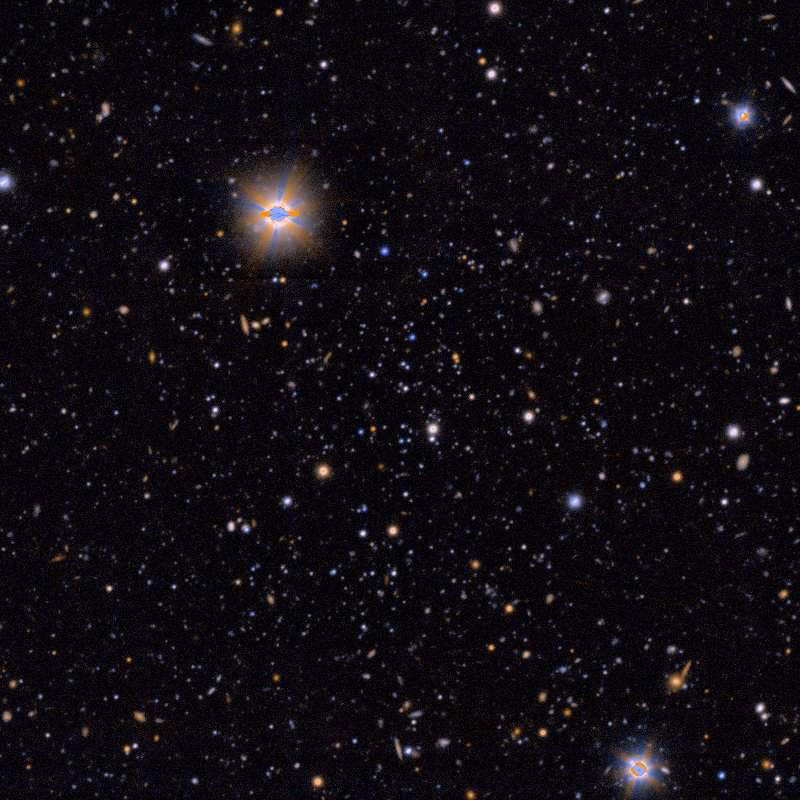
    A Magellan megacam optical image of the dwarf galaxy Phoenix II. Yes, the faint galaxy’s stars are indeed hard to spot amongst the many foreground stars of the Milky Way. A new paper provides sensitive new observations and constraints on four of the Milky Way’s dwarf galaxy neighbors. Credit: Mutlu-Pakdil et al. 2018

    Ultra-faint, dwarf galaxies are the smallest, most dark matter dominated, and least chemically enriched stellar systems in the universe and are important targets for understanding dark matter and galaxy formation. They comprise by number the majority of galaxies in the universe. And not least, dwarf galaxies around the Milky Way provide crucial empirical input for verifying formation scenarios of our own galaxy. There are currently about sixty dwarf galaxies associated with the Milky Way and closer than about one million light-years; the Andromeda Galaxy, our closest large neighbor spiral galaxy, is two and one-half million light-years away.

    Many new MW satellite galaxies have been discovered in the last few years, but some have been called into question by more sensitive imaging campaigns and most have only poorly constrained properties. CfA astronomer Nelson Caldwell was a member of a team that used the Magellan Clay telescope and the Megacam instrument to obtain images of four nearby dwarf galaxies probing nearly sixteen times fainter than previous measurements. The images reveal new stars and other objects, including extended structures, and enabled the astronomers to revise key parameters of these galaxies.

    One of the dwarfs, Sagittarius II, with a gas mass of only 1300 solar masses, is unusual in that it is small in size even for a dwarf galaxy and might instead be considered as the most extended globular cluster of stars for its brightness. Another, Reticulum II, is the most elongated dwarf galaxy known (nearly eight times longer than it is wide). A third, Tucana III, seems to be associated with a stream of material flowing into the MW and may be tidally disrupted. The sensitive new results were unable to measure any gas in any of the objects, but they set new limits, and will help astronomers make a more complete census of the Milky Way’s family of galaxies.

    Reference: “A Deeper Look at the New Milky Way Satellites: Sagittarius II, Reticulum II, Phoenix II, and Tucana III” by Burçi̇n Mutlu-Pakdi̇l, David J. Sand, Jeffrey L. Carlin, Kristine Spekkens, Nelson Caldwell, Denija Crnojević, Allison K. Hughes, Beth Willman and Dennis Zaritsky, 7 August 2018, The Astrophysical Journal.
    DOI: 10.3847/1538-4357/aacd0e


    Never miss a breakthrough: Join the SciTechDaily newsletter.
    Follow us on Google and Google News.

    Astronomy Cosmology Harvard-Smithsonian Center for Astrophysics Magellan Clay Telescope
    Share. Facebook Twitter Pinterest LinkedIn Email Reddit

    Related Articles

    Astronomers Just Reconstructed a Galaxy’s 12-Billion-Year History

    Webb’s Mysterious “Little Red Dots” May Be the Cradle of the First Black Holes

    Mysterious Radio Signals Reveal What’s Hiding Between Galaxies

    Cosmic Mystery Solved: Astronomers Have Discovered the Universe’s “Missing” Matter

    Invisible Storm Lights Up Galaxy Cluster With Record-Breaking Radio Glow

    Herschel Observations Help Identify the Physical Processes Underway in Cold, Dense Clouds

    CfA Scientists Measure the Rate of Expansion of the Universe

    New Study Challenges Planck Results

    Calculations Show the Ideal Time to Study the Cosmos

    1 Comment

    1. mpc755 on October 1, 2018 6:21 am

      Dark matter is a supersolid that fills ’empty’ space, strongly interacts with ordinary matter and is displaced by ordinary matter. What is referred to geometrically as curved spacetime physically exists in nature as the state of displacement of the supersolid dark matter. The state of displacement of the supersolid dark matter is gravity.

      The supersolid dark matter displaced by a galaxy pushes back, causing the stars in the outer arms of the galaxy to orbit the galactic center at the rate in which they do.

      Displaced supersolid dark matter is curved spacetime.

      Reply
    Leave A Reply Cancel Reply

    • Facebook
    • Twitter
    • Pinterest
    • YouTube

    Don't Miss a Discovery

    Subscribe for the Latest in Science & Tech!

    Trending News

    Scientists Warn That This Common Pet Fish Can Wreck Entire Ecosystems

    Scientists Make Breakthrough in Turning Plastic Trash Into Clean Fuel Using Sunlight

    This Popular Supplement May Interfere With Cancer Treatment, Scientists Warn

    Scientists Finally Solved One of Water’s Biggest Mysteries

    Could This New Weight-Loss Pill Disrupt the Entire Market? Here’s What You Should Know About Orforglipron

    Earth’s Crust Is Tearing Open in Africa, and It Could Form a New Ocean

    Breakthrough Bowel Cancer Trial Leaves Patients Cancer-Free for Nearly 3 Years

    Natural Compound Shows Powerful Potential Against Rheumatoid Arthritis

    Follow SciTechDaily
    • Facebook
    • Twitter
    • YouTube
    • Pinterest
    • Newsletter
    • RSS
    SciTech News
    • Biology News
    • Chemistry News
    • Earth News
    • Health News
    • Physics News
    • Science News
    • Space News
    • Technology News
    Recent Posts
    • Ancient Roman Ship Coating Reveals Secrets Hidden for 2,200 Years
    • Enormous Prehistoric Insects Puzzle Scientists
    • College Student Identifies Bizarre New Carnivorous Dinosaur Three Times Older Than T. rex
    • The Most Effective Knee Arthritis Treatments Aren’t What You Expect
    • Scientists Develop Bioengineered Chewing Gum That Could Help Fight Oral Cancer
    Copyright © 1998 - 2026 SciTechDaily. All Rights Reserved.
    • Science News
    • About
    • Contact
    • Editorial Board
    • Privacy Policy
    • Terms of Use

    Type above and press Enter to search. Press Esc to cancel.